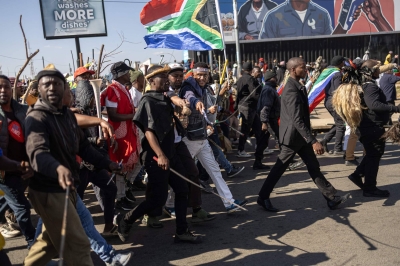
Thousands of people from other African countries have left South Africa ahead of Tuesday's deadline set by anti-migrant groups.
How the world covered this
Read the editorial comparison
Prose synthesis of how each outlet framed the story, with side-by-side outlet quotes and divergence notes.
14 articles from 5 sources
01

02
Anti-immigrant groups have set June 30 as an unofficial deadline for undocumented migrants to leave, with protests planned across South Africa. Large numbers of security forces have been deployed.
03
Tensions are rising ahead of planned anti-migrant protests on June 30, as South Africa's government warns against violence. Analysts say deep social and economic crises are fueling unrest and xenophobia.
04
While the Department of Home Affairs is overwhelmed and anti-migration groups plan mass marches on Tuesday, 30 June, traditional leaders, church groups and local committees are mobilising to protect foreign nationals…

05
While a law proposing fines of R100,000 does not come into operation tomorrow, 30 June 2026, it remains illegal to employ an undocumented foreigner in South Africa. Here are answers to some frequently asked questions.

06
Whatever happens this week, we need as a society to fully understand and act against the forces of hate, division and chaos that simmer beneath the surface of our constitutional democracy.
07
With fears mounting over March and March’s anti-immigrant deadline, Malawian migrants prepare to depart South Africa, caught in a whirlwind of anxiety and urgent repatriation efforts.

08
South Africa has a serious immigration management problem that has to be managed so that communities are listened to while the country remains a democratic, humane and lawful society for which many sacrificed.
09
One consequence of the decline of the migrant labour system has been that workers from such countries – where opportunities are sorely lacking – are still drawn to South Africa, following the spoor of their fathers,…

10
Live updates as March and March’s 30 June deadline arrives. Daily Maverick journalists are reporting from the ground in KZN, Western Cape and Gauteng to bring you the facts.

11
With the March and March 30 June deadline looming and anti-illegal immigration protests taking over the headlines, things are getting complex. Got burning questions about SA’s anti-immigrant crisis and where it’s all…
12
In the lead-up to the 30 June 2026 deadline set by anti-immigrant groups, South African public health professionals call on health workers to support and protect the rights of refugees and migrants, ensuring equitable…

13
En Afrique du Sud, l’ultimatum anti-immigrés et la montée des violences poussent 25 000 personnes à quitter le pays
Under pressure from threatening organized groups, thousands of illegal foreign nationals are taking refuge in precarious camps while awaiting an uncertain return to their country of origin.
14
The demonstrations set to take place are the culmination of weeks of protests that have displaced thousands of mainly African expatriates.
AI read
What the coverage agrees on, and where it splits
This view is generated from the clustered articles, so it is best read as a map of coverage rather than a replacement for the source reporting.
Broadly agreed
- Multiple sources confirm tens of thousands of migrants have left South Africa ahead of the June 30 deadline.
- All covering sources confirm the South African government warned against violence and placed police on high alert.
- Daily Maverick and Deutsche Welle both confirm the Department of Home Affairs is overwhelmed.
Contested framing
- Daily Maverick frames the crisis as a systemic governance failure rooted in the decline of the migrant labour system; Deutsche Welle and BBC frame it primarily as a public order and government-response story.
- Daily Maverick explicitly calls for health workers and communities to resist the deadline as an act of civic defiance; other outlets report the deadline as a factual deadline without normative framing.
Still unclear
Whether large-scale violence materialised on or after June 30, and how many migrants ultimately left South Africa, is not confirmed in the available summaries.
Notable omissions
Nigerian, Kenyan, and other African outlets are largely absent from this story despite its significance for African migrant communities across the continent.
Quality check
The escalation narrative depends on unconfirmed June 30 outcomes; treat the 'deadline' as an activist declaration, not government policy.
- Critical Unknowns: whether violence materialized on/after June 30 and how many migrants actually left—these are the core 'escalation' claims, yet remain unconfirmed.
- Daily Maverick's normative framing (calling for 'civic defiance') is flagged but not clearly distinguished from reporting in the consensus section.
- The June 30 'deadline' is framed as established fact, but the summaries do not clarify whether it was a formal government ultimatum or an informal activist declaration—this distinction affects whether readers interpret this as an official government action.
- Significant regional omission (Nigerian, Kenyan outlets absent) limits perspective on cross-African migrant network impacts.
Review confidence: 68%
Signal strength
4/5
Narrative divergence
5
Sources compared
2
Days in coverage
↘ converging
How each outlet frames this story
Divergence
4/5
Narrative Divergence
How differently the sources covering this story frame it — measured by tone, emphasis, and what each outlet chooses to highlight or omit.
1 — Sources frame the story almost identically
2 — Minor differences in tone or emphasis
3 — Noticeable differences; some outlets highlight what others omit
4 — Stark contrasts; conflicting narratives
5 — Sources tell fundamentally different stories
South African
Daily Maverick provides the most intensive coverage, using document analysis to expose the legal implications of employing undocumented workers, profiling communities resisting xenophobia, documenting terror experienced by Malawian migrants, linking the crisis to the decline of the migrant labour system, and issuing urgent calls to health workers to reject the deadline—framing the entire situation as a governance credibility emergency.
German
Deutsche Welle frames the protests as a rising-tensions story ahead of the deadline, noting the South African government's warnings against violence but stopping short of the structural critique in Daily Maverick.
British
BBC reports the South African president warning anti-migrant protesters and documenting thousands of Africans leaving the country—foregrounding institutional protocol and the government's response.
French
Le Monde reports 25,000 people leaving South Africa under pressure from organised groups, framing it through humanistic consequence and the precarious conditions of those displaced.
Japanese
Japan Times covers the police high alert before protests, treating it as an institutional logistics and security problem without the structural analysis present in South African sources.