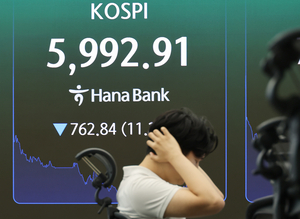
Seoul stocks crashed Tuesday, with the benchmark Kospi tumbling nearly 11 percent as a selloff in chip heavyweights intensified. The Kospi closed the regular session at 6,023.66, down 10.84 percent from the previous day.
How the world covered this
Read the editorial comparison
Prose synthesis of how each outlet framed the story, with side-by-side outlet quotes and divergence notes.
3 articles from 2 sources
01
02
South Korean stocks crashed more than 10 percent Tuesday as investors sold off tech shares on intensifying doubts over the future of large-scale investment into artificial intelligence infrastructure. The local currency…

03
Losses underscore how quickly sentiment has turned on one of the market’s most crowded trades

AI read
What the coverage agrees on, and where it splits
This view is generated from the clustered articles, so it is best read as a map of coverage rather than a replacement for the source reporting.
Broadly agreed
- Korea Herald and Irish Times both confirm a major selloff in semiconductor stocks drove broad market declines on July 28, 2026.
- Multiple sources confirm AI investment scepticism is the primary stated catalyst for the selloff.
Contested framing
- Korea Herald frames the crash as driven by AI scepticism about demand fundamentals; Irish Times frames it as driven by circular funding structures and China competition—two different causal explanations for the same market event.
Still unclear
Whether the selloff represents a temporary correction or the beginning of a sustained AI valuation reset, and what specific news or data triggered the single-session crash, remain unverified from available summaries.
Notable omissions
No source analyses the direct impact on Nvidia's supply chain or US tech valuations resulting from the Seoul crash, despite Samsung and SK Hynix's centrality to US AI infrastructure.
Quality check
Selloff facts confirmed; causes and implications remain contested—treat causal claims as analyst interpretation, not fact.
- Two different causal explanations: AI demand skepticism vs. circular funding + China competition—incompatible analyses
- Whether selloff represents temporary correction or sustained reset remains unverified
- Specific triggering news/data unknown
- Missing: impact analysis on Nvidia supply chain and US tech valuations
Review confidence: 72%
Signal strength
2/5
Narrative divergence
2
Sources compared
1
Days in coverage
How each outlet frames this story
Divergence
2/5
Narrative Divergence
How differently the sources covering this story frame it — measured by tone, emphasis, and what each outlet chooses to highlight or omit.
1 — Sources frame the story almost identically
2 — Minor differences in tone or emphasis
3 — Noticeable differences; some outlets highlight what others omit
4 — Stark contrasts; conflicting narratives
5 — Sources tell fundamentally different stories
South Korean
Korea Herald reports Kospi tumbling nearly 11 percent as chip heavyweights led the selloff, framing the crash through intensifying doubts over the future of AI-driven semiconductor demand—the first such magnitude drop in three months.
South Korean
A second Korea Herald article frames the crash as investor euphoria reversing, noting semiconductor space specifically and global markets showing signs of overextension.
Irish
Irish Times reports the chip rout deepening on circular funding concerns and China competition fears, framing the selloff through European market exposure to the same semiconductor crowded trade.