Coming days are ‘absolutely critical’ for firefighters before temperatures rise again this week, officials say Firefighters in France and Spain are racing to bring huge wildfires under control before another heatwave…
How the world covered this
Read the editorial comparison
Prose synthesis of how each outlet framed the story, with side-by-side outlet quotes and divergence notes.
25 articles from 13 sources
01
02
Hundreds of thousands of residents and holidaymakers in France and Spain have been forced to evacuate Wildfires have forced about 375,000 people to leave their homes in France and Spain . In France, nearly 260,000 have…
03
A fresh spell of extreme heat, driven by climate change, is expected to intensify some of Europe's worst wildfires in decades, stretching firefighting resources.
04
Firefighters sought on Monday to take advantage of more favourable weather to subdue massive wildfires threatening the French city and tourist region of Bordeaux and a number of sites in neighbouring Spain. They were…

05
They are battling the worst wildfires in living memory.
06
A blaze near Bordeaux has torn through more than 162 sq miles (420 sq km) in less than four days, while the Madrid region is seeing its worst fires ever.

07
Local and visitors tell the BBC of disbelief and anxiety as wildfires force more than 300,000 people to evacuate.

08
Residents describe their fear as they were forced to leave their homes by the ‘extremely intense and unpredictable’ blaze Sitting in their suburban apartment in Mérignac on the outskirts of Bordeaux, Krishma, an…
09
With large areas still burning, damage from national park’s worst blaze could take decades, if not longer, to put right It is the jewel in the crown of the Highlands, one of Scotland’s most impressive natural…
10
Record heat and drought have fueled massive wildfires in France and Spain, forcing hundreds of thousands to evacuate in Europe’s largest displacement since World War II. Rising te...

11
Nueva ola de calor golpea a España y eleva el riesgo de incendios forestales a niveles críticos, mientras se expanden las llamas cerca a Madrid
The current emergency, still far from being controlled, leaves more than 50,000 hectares burned and tens of thousands of evacuees.

12
España, Francia y Portugal afrontan una semana decisiva para contener los incendios antes de una nueva ola de calor
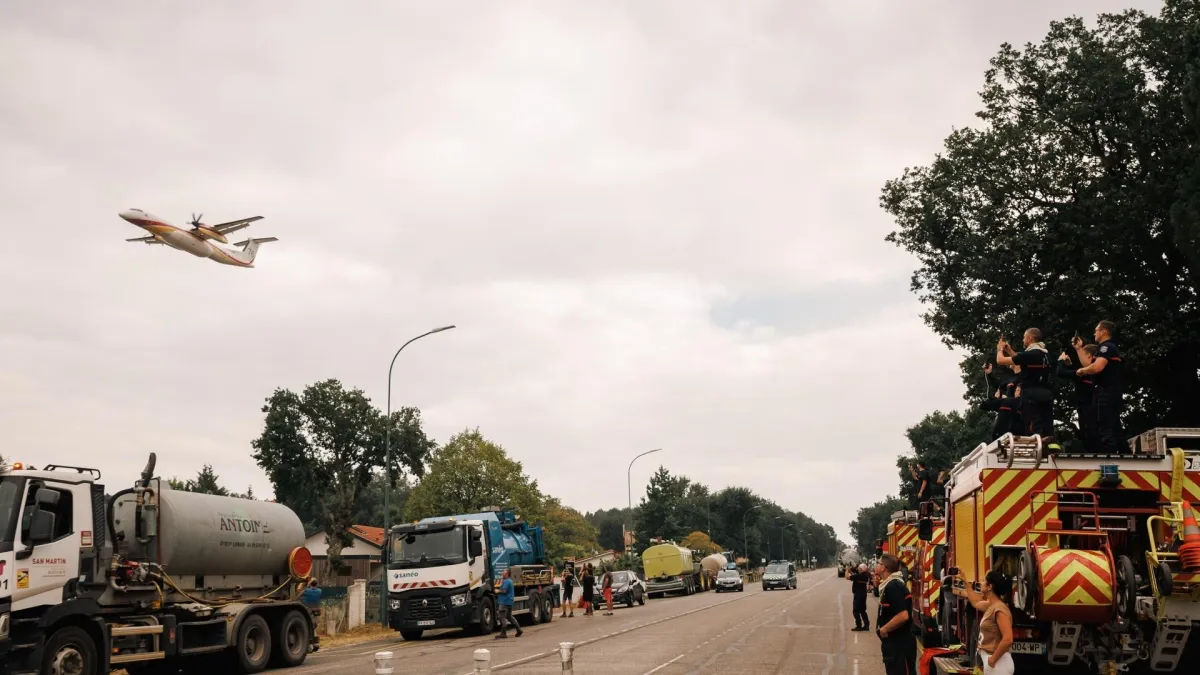
The emergency has forced the deployment of thousands of firefighters and civil protection teams to the Iberian Peninsula and southwestern France.
13
Caldo, arriva la quarta ondata. “Abituiamoci, non finirà presto”
Truce over, boiling temperatures since the weekend: from 35 to 40 degrees with minimums above 25. Back to the red stickers
14
Temperatures in Bordeaux are forecast to reach 33 deg C during the day.
15
Incendie en Gironde : la défense opiniâtre d’une poudrière militaire contre les flammes
Numerous land and air assets were deployed to protect defense sector installations and the Souge camp, located west of Bordeaux.
16
“Sono il sindaco di Peschici e spengo incendi dal 1994, qui la natura ci dà da vivere”
Luigi D'Arenzo, surveyor, put the Gargano on his shoulders while everything was burning: "I did my duty as citizen manager of Civil Protection. But I also acted out of a sense of belonging"

18
As France and Spain battle some of their worst wildfires in years, the French government is holding a crisis meeting. A fire-generated storm cloud over France has added to fears of more outbreaks.
19
At a time when the quickening pace of global heating has never been clearer, climate policies are being deprioritised A new and ominous word has entered the vocabulary of firefighters struggling to cope with the vast…
20
Continue reading...
21
The signs are there See more of Fiona Katauskas’s cartoons here Continue reading...
22
Nueva ola de calor amenaza con agravar incendios en España y Francia

23
Severe wildfires can generate their own unique weather systems

24
Government must commit in next budget to adequately funding nature restoration, Pádraic Fogarty says

25
AI read
What the coverage agrees on, and where it splits
This view is generated from the clustered articles, so it is best read as a map of coverage rather than a replacement for the source reporting.
Broadly agreed
- All covering sources confirm fires are burning simultaneously in France, Spain, and the UK, with hundreds of thousands evacuated.
- Sources broadly agree that a fourth heatwave with temperatures exceeding 40°C in some areas is imminent and will hamper firefighting.
- Multiple sources confirm the Bordeaux fire alone has burned over 420 square kilometres in under four days.
Contested framing
- The Guardian explicitly links fires to climate policy deprioritisation as a political failure; Le Monde frames the same emergency primarily through institutional competence in protecting military infrastructure—two different accountability lenses.
- Irish Times calls for new legal deterrents against deliberate fire-starting; Deutsche Welle focuses on structural climate vulnerability—implying different primary causes for the same crisis.
Still unclear
The total area burned across all affected countries and the full civilian casualty count remain unconfirmed across available summaries.
Notable omissions
No African, Asian, or Latin American outlet provides substantive analysis of the fires' climate policy implications; coverage from those regions is either absent or purely factual without institutional critique.
Quality check
Factual reporting on wildfires and heatwave is reliable; be cautious about which causal explanation (policy vs. structural) is emphasized in individual outlets.
- Two different accountability frames for same crisis (climate policy deprioritisation vs. military infrastructure protection)
- Cause attribution divergence: deliberate arson deterrents vs. structural climate vulnerability—different implied primary causes
- Total area burned and full civilian casualty counts remain unconfirmed
- No African, Asian, or Latin American substantive analysis of climate policy implications
Review confidence: 85%
Signal strength
2/5
Narrative divergence
13
Sources compared
1
Days in coverage
How each outlet frames this story
Divergence
2/5
Narrative Divergence
How differently the sources covering this story frame it — measured by tone, emphasis, and what each outlet chooses to highlight or omit.
1 — Sources frame the story almost identically
2 — Minor differences in tone or emphasis
3 — Noticeable differences; some outlets highlight what others omit
4 — Stark contrasts; conflicting narratives
5 — Sources tell fundamentally different stories
British
The Guardian foregrounds climate institutional adaptation failure, emphasising that political priorities have deprioritised climate policy even as wildfires accelerate, and integrating testimony from evacuees describing 'apocalyptic' scenes.
French
Le Monde reports the military powder magazine near Bordeaux required extensive air and land asset deployment to protect, framing the fires through elite institutional competence and national security infrastructure risk.
German
Deutsche Welle frames the heatwave as a climate-change-driven structural vulnerability, emphasising institutional sustainability rather than military capability, and positioning the fires as an economic infrastructure shock.
Turkish
Daily Sabah frames the fires as institutional violence through accountability mechanism failure, noting record heat and drought as the proximate drivers while emphasising institutional failure to prepare.
Italian
La Repubblica integrates aesthetic and cultural framing—quoting the mayor of Peschici on his duty as 'citizen manager'—with institutional coordination analysis, humanising the emergency response.
Irish
Irish Times provides scientific explanation of 'fire clouds' that generate their own lightning and spread blazes, and calls for stronger deterrents against deliberate fire-starting backed by adequate nature-restoration funding.
Singaporean
Straits Times reports France braces for a fourth major heatwave with Bordeaux temperatures forecast to reach 33°C, framing the story through logistics of firefighting resource deployment.
Mexican
El Universal frames the new heatwave as threatening to worsen fires in Spain and France, providing factual escalation framing without deep institutional analysis.
Colombian
El Tiempo covers Spain, France, and Portugal facing a decisive week to contain fires before a new heatwave, noting more than 50,000 hectares burned and tens of thousands evacuated near Madrid.
Japanese
Yahoo Japan reports insufficient firefighters as a key operational bottleneck, foregrounding institutional resource scarcity rather than climate causation.
Chinese
SCMP focuses on the 'firestorm' pyrocumulonimbus phenomenon as a structural scientific anomaly amplifying institutional vulnerability.