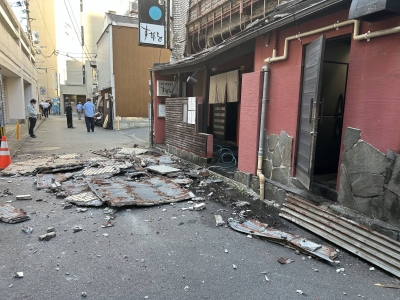
The quake registered up to shindo 7, the highest level on the Japanese seismic intensity scale.
How the world covered this
Read the editorial comparison
Prose synthesis of how each outlet framed the story, with side-by-side outlet quotes and divergence notes.
4 articles from 4 sources
01
02
Japan's south-western Kyushu island has been struck by two strong earthquakes within an hour, sparking warnings of a tsunami wave of up to 1 metre.
03
A tsunami warning for a wave measuring 1m was issued after the earthquake, the Japan Meteorological Agency said.

04
A tsunami warning for a wave measuring 1 metre (3.28 ft) was issued after the earthquake

AI read
What the coverage agrees on, and where it splits
This view is generated from the clustered articles, so it is best read as a map of coverage rather than a replacement for the source reporting.
Broadly agreed
- All covering sources confirm a magnitude-7.1 earthquake struck Japan's Kyushu region on July 28, 2026.
- All sources confirm a tsunami warning for a wave of approximately 1 metre was issued by Japan's meteorological authorities.
Contested framing
- No significant framing divergence exists across covering sources; all treat this as a breaking natural disaster news event requiring factual accuracy.
Still unclear
The extent of structural damage, casualties, and whether the tsunami warning was subsequently downgraded or confirmed as a wave materialised remain unverified from available summaries.
Notable omissions
No source provides analysis of whether Japan's nuclear facilities near Kyushu were affected or placed on alert status following the earthquake.
Quality check
This breaking natural disaster reporting is factually reliable; await confirmation of tsunami materialization and damage assessment.
- Extent of structural damage, casualties, and tsunami confirmation status unverified
- Nuclear facility alert status near Kyushu not addressed in any source
Review confidence: 92%
Signal strength
1/5
Narrative divergence
4
Sources compared
1
Days in coverage
How each outlet frames this story
Divergence
1/5
Narrative Divergence
How differently the sources covering this story frame it — measured by tone, emphasis, and what each outlet chooses to highlight or omit.
1 — Sources frame the story almost identically
2 — Minor differences in tone or emphasis
3 — Noticeable differences; some outlets highlight what others omit
4 — Stark contrasts; conflicting narratives
5 — Sources tell fundamentally different stories
Japanese
Japan Times leads with the tsunami alert issued after the quake registered shindo 7, the highest level on Japan's seismic intensity scale, framing the story through established disaster preparedness institutional protocols.
Australian
ABC Australia frames the story as breaking news emphasising two strong earthquakes within an hour on Kyushu island sparking tsunami wave warnings, foregrounding the sequential nature of the seismic events.
Singaporean
CNA provides terse factual reporting—1-metre tsunami warning issued by Japan Meteorological Agency—consistent with its facts-first supply-chain consequence framing for regional disasters.
Indian
The Hindu reports the 1-metre tsunami warning alongside the quake's magnitude, framing it through South Asian regional seismic monitoring awareness without deeper institutional analysis.