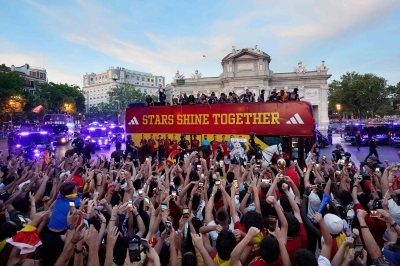
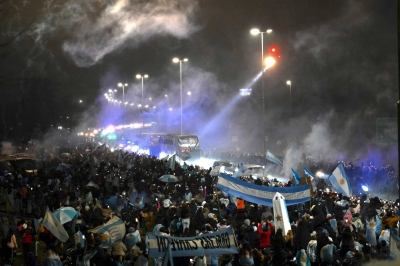
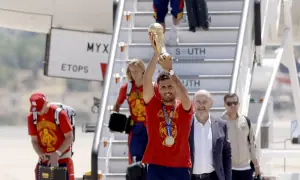
Spain's victory at the 2026 FIFA World Cup — the largest ever held — has triggered global celebrations, political debates about the tournament's American commercial identity, solidarity expressions from Gaza, and a Ballon d'Or race, while Argentina's defeat sparked fan divisions and public mourning.
15 sources34 articles11 perspectives
15Sources in this topicDifferent outlets covering the same story arc.
34Articles collectedThe full set backing this topic page right now.
2/5Narrative divergenceHover for scale explanation.
Narrative Divergence
How differently the sources covering this story frame it — measured by tone, emphasis, and what each outlet chooses to highlight or omit.
1 — Sources frame the story almost identically
2 — Minor differences in tone or emphasis
3 — Noticeable differences; some outlets highlight what others omit
Garcia led the Belgian national team to qualify for the 2026 World Cup and reach the quarter-finals, an exceptional achievement that witnessed the team’s return to competition on the international stage after outstanding results.
احتفلت بفوز إسبانيا.. غزة تسرق لحظة فرح من قلب الحرب
Palestinians in Gaza celebrated Spain's victory in the 2026 World Cup, considering the victory an occasion to break the cruelty of war and a message of gratitude for Spain's positions in support of Palestine.
أزمة أجهزة التبريد ومبابي.. كواليس خلافات ديشان مع الاتحاد الفرنسي
The departure of coach Didier Deschamps from coaching the French national team was not only a technical decision, but was preceded by months of tensions and disagreements within the French Federation, which led to the intervention of player Kylian Mbappe in more than one file.
Celebrations of the Spanish national team's victory in the FIFA World Cup were not limited only to all parts of Spain, but also spread throughout large parts of the Arab world, especially in Palestine.
نجاح كروي وجدل سياسي.. كيف أعاد مونديال 2026 رسم صورة أمريكا؟
"The 2026 World Cup revealed another face of America; It boosted football's popularity, but sparked debate about immigration, identity, and "Americanization." The tournament and Trump’s role, to confirm that sports have become a mirror of political and cultural polarization in the United States...
هوية كرة القدم على المحك.. كيف سنتذكر مونديال 2026؟
After the curtain falls on the historic edition of the 2026 World Cup, the biggest question remains: Did the world witness the last World Cup in its traditional form, or has football already begun writing a new chapter in its history?
صراع الكرة الذهبية 2026 يشتعل بعد فوز إسبانيا بكأس العالم
Spain's victory in the 2026 World Cup ignites the race for the Ballon d'Or amid the absence of a single clear candidate, adding excitement to the prestigious award awarded by France Football magazine.
The 2026 World Cup sparked a shift in soccer’s identity, blending American entertainment with traditional gameplay, raising questions about its lasting impact on the sport’s future.
Weekend con Guardiola: Maldini in missione per fargli scegliere l’Italia
The director of the Football Federation together with Leonardo in Barcelona at Pep's house: they offered him the bench of the national team, but for the moment he is taking his time
Il cuore triste di Messi vuole un’altra coppa: “Una ferita da guarire”
In 2030 they will also be played in Argentina and Spain, the two homelands of Leo who aims to play a World Cup match at home and in the USA he finally showed his feelings: "An immense pain, now I will need time"
The party said the panel would investigate the root causes of the dispute, engage stakeholders and restore unity, while urging aggrieved members to embrace internal dispute resolution mechanisms instead of litigation.…
A teenager died and several people were injured during celebrations of Spain’s victory in the World Cup after a fountain collapsed in western Spain, local authorities and media said on Monday. “The city hall of Ciudad…
Palestinian Islamist movement Hamas announced on Monday that it had elected Khalil al-Hayya, the group’s lead negotiator in indirect ceasefire talks with Israel, as the new head of its political bureau. “The Islamic…
Spain’s newly crowned FIFA World Cup champions on Monday arrived back in Madrid, where a million fans are expected to greet them after a night of raucous celebrations across the country. Spain captain Rodri held the…
Though Donald Trump mostly stayed clear of stadiums, the World Cup may influence the US midterm elections. DW looks at the political implications of "the most successful sporting event maybe in the history of the world."
A worthy world champion, a call from the US president, security concerns and a few pleasant surprises: The biggest World Cup ever is now over. So what will we remember about the 2026 World Cup?
Uzbekistan’s national team lost 49 FIFA ranking points after losing all three matches at the 2026 FIFA World Cup, dropping 10 places to 60th in the FIFA World Rankings. It is the…
Hyundai Motor Group used its long-running FIFA partnership to showcase its robotics and future mobility technologies while reinforcing its global brand presence at the 2026 FIFA World Cup. The group has partnered with…
Spain's victory ended Argentina's reign as world champions and completed another memorable chapter in La Roja's football history The post World Cup 2026: Ferran Torres fires Spain past 10-man Argentina to lift second…
This view is generated from the clustered articles, so it is best read as a map of coverage rather than a replacement for the source reporting.
Broadly agreed
All covering sources confirm Spain defeated Argentina in the 2026 World Cup final.
Sources broadly agree the tournament was the largest in history and generated significant cultural and political debates beyond the sport itself.
Contested framing
Daily Maverick frames the tournament as threatening football's soul through American commercial entertainment values; CNA frames it as a celebration worth remembering despite imperfections.
Al Jazeera Arabic frames Spain's win as symbolically significant for Palestinians; Daily Nation frames Spain's Palestine solidarity stance as winning global admiration; neither Western outlet frames the win primarily through this lens.
Still unclear
The outcome of the Ballon d'Or race following Spain's win remains open, with no clear frontrunner confirmed across sources.
Notable omissions
Coverage largely omits detailed scrutiny of FIFA governance controversies flagged by the Council of Europe, and the economic impact on host cities beyond Mexico receives minimal analysis across sources.
Quality check
The match result itself lacks direct confirmation in available titles; most coverage focuses on political symbolism and speculation about awards rather than tournament facts.
Core consensus fact (Spain defeated Argentina) is confirmed, but no article titles directly confirm this—entire 'aftermath' framing rests on inference
Ballon d'Or race outcome listed as unknown but treated as live competitive narrative—uncertain whether this is actual news or speculation
Al Jazeera Arabic's framing of Spain's win as 'symbolic victory for Palestine' is contested by absence of Western outlet engagement, but the framing itself is not fact-checked
Omissions note FIFA governance controversies and host city economic impact not scrutinized—major geopolitical dimensions absent
Review confidence: 35%
Signal strength
2/5Narrative divergence
15Sources compared
1Days in coverage
How each outlet frames this story
Divergence2/5
Narrative Divergence
How differently the sources covering this story frame it — measured by tone, emphasis, and what each outlet chooses to highlight or omit.
1 — Sources frame the story almost identically
2 — Minor differences in tone or emphasis
3 — Noticeable differences; some outlets highlight what others omit
4 — Stark contrasts; conflicting narratives
5 — Sources tell fundamentally different stories
Qatari
Al Jazeera Arabic saturates coverage with football statistics, Spain's FIFA ranking rise, Belgium's coaching search, tactical analysis of Deschamps' disputes, and the symbolic meaning of Spain's win for Palestinians in Gaza.
South African
Daily Maverick examines how the 2026 World Cup's American entertainment framing leaves soccer facing a battle for its soul, integrating cultural identity analysis with institutional critique.
Nigerian
Premium Times directly asks whether the World Cup was a success and affirms yes, with Spain winning; framed as a straightforward assessment with cultural resonance.
Mexican
El Universal reports the World Cup left less economic impact in Mexico than expected, with CEESP estimating only 0.1% of GDP spill, using an institutional economic accountability lens.
German
Deutsche Welle takes stock of the World Cup as football's biggest show yet, noting Trump's presence at the final was booed and that the tournament may influence US midterm elections.
Japanese
Japan Times covers thousands welcoming Argentina home without Messi after the World Cup loss and the Spain victory parade drawing an estimated 2 million in Madrid.
South Korean
Korea Herald covers Hyundai deepening its FIFA partnership with a robotics push at the World Cup, framing the tournament through corporate alliance and future mobility technology.
Italian
La Repubblica analyses how Spain creates its footballing myth through youth development, and covers Messi's emotional statement about his 'wound' that will take time to heal.
Singaporean
CNA publishes a commentary celebrating the World Cup as one to remember despite chaos and controversy, maintaining a pragmatic balanced assessment.
Emirati
The National grades the eight Arab teams' performance at the World Cup and covers Messi's post-final statement, integrating regional identity with sports analysis.
Uzbek
Gazeta.uz reports Uzbekistan dropped 10 FIFA ranking places after losing all three World Cup matches, framing it as a factual national sports accountability outcome.
Copied!
Related coverage
More topic clusters connected by category, source overlap, or narrative signal.