‘I go with good grace and a smile on my face’, says outgoing Prime Minister Keir Starmer says
How the world covered this
Read the editorial comparison
Prose synthesis of how each outlet framed the story, with side-by-side outlet quotes and divergence notes.
23 articles from 10 sources
01

02
Jonathan Reynolds was named Secretary of State for Business, Innovation, Science and Trade in an expanded role after losing his position as business Minister to Peter Kyle in a reshuffle under former Prime…

04
Andy Burnham, former Greater Manchester mayor and newly elected Labour MP, is the seventh Prime Minister in a decade.

05
‘I go with good grace and a smile on my face’, says outgoing Prime Minister Keir Starmer says

06
Novo premiê do Reino Unido, Andy Burnham é torcedor do Everton e católico, 'nessa ordem'
"Everton FC, the Labor Party and the Catholic Church. In that order." In 2009, this is how Andy Burnham, the new Prime Minister of the United Kingdom, responded when asked about the most important things in his…
07
Andy Burnham toma posse como premiê do Reino Unido e promete abrigar sem-teto
With an impromptu, short and emotional speech, Andy Burnham, 56, took office as Prime Minister of the United Kingdom this Monday (20), in London. He recalled that he was the seventh prime minister to take over the country in recent times…
08
بيرنهام يكشف تشكيلة حكومته ويعرض أولويات داونينغ ستريت
The new British Prime Minister, Andy Burnham, pledged that his term would be a turning point for Britain towards addressing the crises associated with high prices, weak economic growth, as well as social problems.
09
Andy Burnham has been sworn in as the successor to British Prime Minister Keir Starmer. The former Manchester mayor has become a leading figure in the Labour Party and one of the UK's most popular politicians.
10
After securing the leadership of the ruling Labour Party last week, Burnham has been invited to form a government by King Charles III. He promised both stability and major reforms in his first speech.
11
Andy Burnham, the former mayor of Greater Manchester and new leader of the Labour Party, became Britain's seventh prime minister in a decade Monday after a meeting with King C...

12
Inizia l’era di Burnham: “Crescita e speranza, ho un piano decennale”
The new British prime minister presents the team and its guidelines: "Council housing and industry". And he calls the leaders of the USA, Ukraine and the EU
13
William Boyd: “Burnham è autentico e concreto, vediamo se il governo lo cambierà”
The British writer on the new Prime Minister: "Farage will have a difficult time against him, who defines himself as a man of the people. He will not be able to paint him as one of the establishment"
14
Chinese Premier Li Qiang on Monday extended congratulations to Andy Burnham on becoming Britain’s new prime minister. Strengthening dialogue and cooperation between China and Britain will benefit the two countries…

15
Andy Burnham took office on Monday as Britain’s new prime minister, promising a 10-year plan to restore political stability and revive the economy while acknowledging that six other UK leaders have tried and failed to…

16
LONDON, July 21 - Andy Burnham will set out his first measures as Britain's new prime minister on Tuesday in an attempt to deliver on his promises to ease a cost-of-living crisis, improve lives and end a decade of…
17
Narayan was appointed minister for AI and online safety in September 2025.
18
The US President earlier said he knew little about Burnham and described him as “extremely liberal”.
19
In his brief speech, Burnham said he would “bring forward a new plan for Britain, a 10-year plan”.
20
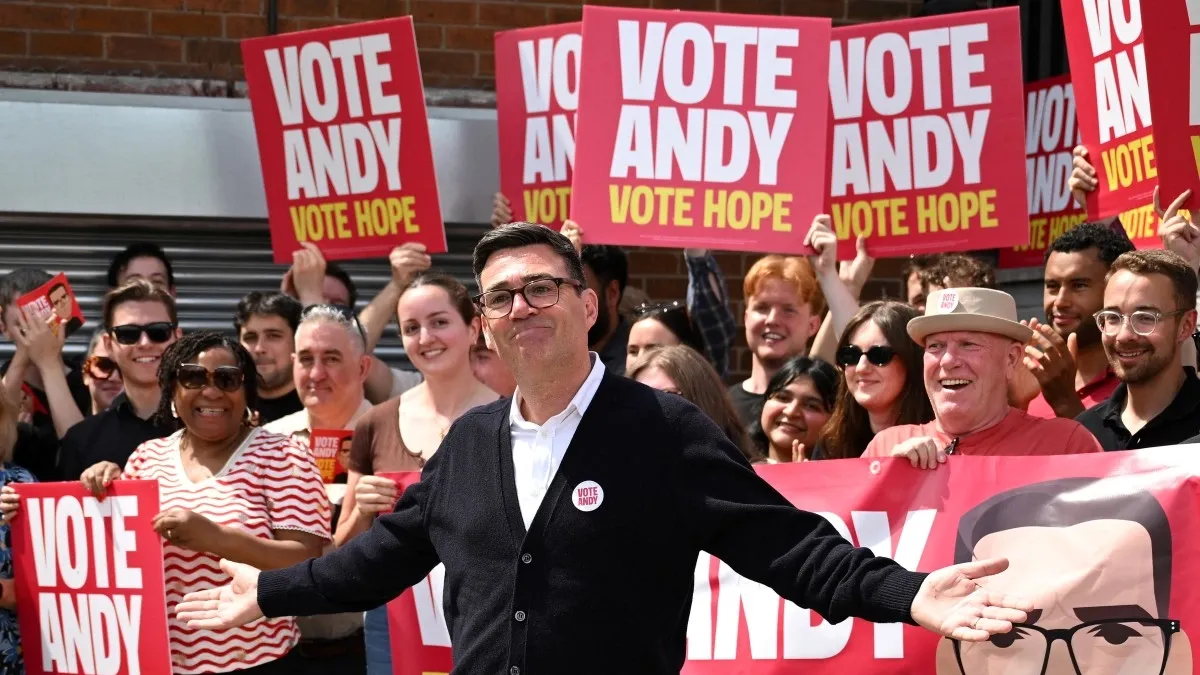
Andy Burnham asume como primer ministro del Reino Unido tras recibir el encargo del rey Carlos III
The new leader of the Labor Party was officially appointed by the monarch after the resignation of Keir Starmer.
21
Labour leader is clear-eyed about Britain’s social and economic problems and candid about how Brexit has made them worse

22
A welcome reminder that opponents are not enemies

23
The UK's new leader moved to remove VAT from electricity bills from October 1. The move comes before Burnham chairs his first cabinet meeting later today.
AI read
What the coverage agrees on, and where it splits
This view is generated from the clustered articles, so it is best read as a map of coverage rather than a replacement for the source reporting.
Broadly agreed
- All sources confirm Burnham was formally appointed PM by King Charles III and immediately undertook a Cabinet shake-up purging Starmer loyalists.
- Sources broadly agree Burnham's signature commitments include a 10-year plan, reindustrialisation, and decentralisation of power.
Contested framing
- Irish Times frames Starmer's departure as heartening and civilised; Le Monde focuses on the political battle Burnham faces from Farage's far-right, suggesting a more contested political landscape.
- Singaporean Straits Times emphasises Burnham's AI minister appointment as an institutional tech governance signal; Brazilian Folha de S.Paulo foregrounds the humanistic and emotional dimensions of his first speech.
Still unclear
The specific policy details of Burnham's 10-year plan and how quickly he will act on energy drilling policy — which The Guardian notes risks a Labour backlash — have not been confirmed.
Notable omissions
Coverage largely omits the perspective of Conservative opposition and of Scottish and Welsh devolved governments who may be affected by Burnham's decentralisation agenda.
Quality check
Appointment and Cabinet changes are confirmed; specific policy agenda and parliamentary reception remain unconfirmed.
- Specific policy details of Burnham's 10-year plan not confirmed—readers should not assume detailed knowledge of his agenda
- Energy drilling policy flagged as risking Labour backlash but no confirmation of his position on it
- Conservative opposition and devolved governments' perspectives absent—limits assessment of parliamentary and regional headwinds
- International framing (Irish Times, Le Monde, Singapore, Brazil) is light on policy substance; mostly focuses on symbolic/emotional dimensions
Review confidence: 78%
Signal strength
2/5
Narrative divergence
10
Sources compared
1
Days in coverage
How each outlet frames this story
Divergence
2/5
Narrative Divergence
How differently the sources covering this story frame it — measured by tone, emphasis, and what each outlet chooses to highlight or omit.
1 — Sources frame the story almost identically
2 — Minor differences in tone or emphasis
3 — Noticeable differences; some outlets highlight what others omit
4 — Stark contrasts; conflicting narratives
5 — Sources tell fundamentally different stories
Indian
The Hindu reports Burnham's Cabinet appointments including Reynolds as Business Minister and Rayner for housing, framing it as a factual institutional transition with Starmer's graceful departure noted.
Brazilian
Folha de S.Paulo highlights that Burnham is an Everton fan and Catholic 'in that order', and emphasises his impromptu emotional speech promising to shelter the homeless, foregrounding humanistic consequence framing.
German
Deutsche Welle covers Burnham cutting household electricity VAT as his first major policy move, and profiles him as a former Manchester mayor who has taken office as the seventh PM in ten years.
Turkish
Daily Sabah describes Burnham as the seventh British PM in a decade after meeting King Charles, contextualising the transition within British political instability.
Chinese
SCMP reports Premier Li Qiang congratulating Burnham and covers his pledge to end years of instability with a 10-year plan, framing it through a business-strategic lens.
Singaporean
Straits Times covers Burnham stamping authority with a Cabinet shake-up and picking Narayan as first British AI minister to attend Cabinet, emphasising institutional and technology governance dimensions.
Italian
La Repubblica publishes a British writer's assessment that Burnham is 'authentic and concrete' and that Farage will struggle against him, integrating cultural and political interpretation.
Colombian
El Tiempo reports Burnham taking over as PM after receiving the commission from King Charles III, framing it as a straightforward institutional succession.
Irish
Irish Times editorially welcomes Burnham's domestic focus as good for the UK, and praises the heartening manner of Keir Starmer's departure, integrating humanistic reflection with political analysis.