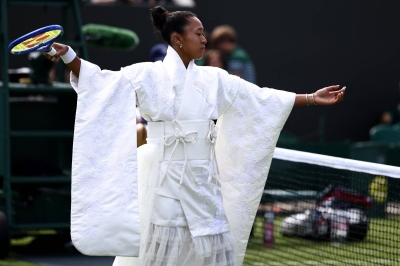
Naomi Osaka has long been renowned for dazzling crowds with her on-court outfits - but making that compatible with Wimbledon's all-white dress code required special inspiration.
How the world covered this
Read the editorial comparison
Prose synthesis of how each outlet framed the story, with side-by-side outlet quotes and divergence notes.
5 articles from 5 sources
01

02
Defending champion Jannik Sinner twice fought back from a set down to clinch a victory past Serbia's Miomir Kecmanovic and avoid a huge shocker in the Wimbledon first round on...

03
South Korea’s Kwon Soon-woo marked his return to Wimbledon with a straight-sets victory, advancing to the second round of the year’s third Grand Slam tournament. The world No.


05
Osaka, the 14th-seeded player and former world No. 1, did her walk-on in an all-white look by Hana Yagi, an independent Japanese designer, titled "Evolving Ceremony."
AI read
What the coverage agrees on, and where it splits
This view is generated from the clustered articles, so it is best read as a map of coverage rather than a replacement for the source reporting.
Broadly agreed
- All covering sources confirm Sinner advanced past the first round after a difficult five-set match.
- Multiple sources confirm Osaka wore a kimono-inspired outfit by Japanese designer Hana Yagi for her Wimbledon walk-on.
Still unclear
Whether Osaka's kimono design required a special exemption from Wimbledon's all-white dress code requirement has not been confirmed in the available summaries.
Notable omissions
No outlet examines the broader commercial and diplomatic significance of high-profile athletes using major Western sporting events as platforms for cultural expression from non-Western traditions.
Quality check
Tournament facts are solid; dress code exception status and cultural significance interpretation are unclear.
- Sinner first-round advancement and five-set difficulty are confirmed
- Osaka kimono outfit and designer name are confirmed
- Whether outfit required dress code exemption is unconfirmed
- Broader commercial/diplomatic significance angle is analytical, not reported in summaries
Review confidence: 85%
Signal strength
1/5
Narrative divergence
5
Sources compared
1
Days in coverage
How each outlet frames this story
Divergence
1/5
Narrative Divergence
How differently the sources covering this story frame it — measured by tone, emphasis, and what each outlet chooses to highlight or omit.
1 — Sources frame the story almost identically
2 — Minor differences in tone or emphasis
3 — Noticeable differences; some outlets highlight what others omit
4 — Stark contrasts; conflicting narratives
5 — Sources tell fundamentally different stories
British
BBC focuses on Naomi Osaka's kimono outfit and its significance as a cultural statement paying 'love and respect to Japan' within Wimbledon's strict all-white dress code.
Turkish
Daily Sabah reports Sinner's difficult five-set victory straightforwardly, treating it as a competitive tennis story without cultural framing.
South Korean
Korea Herald reports Kwon Soon-woo's straight-sets victory on his Wimbledon return, framing it as a national sports achievement story.
Emirati
The National covers Sinner defending his title with a narrow escape from a first-round exit, focusing on competitive drama.
Japanese
Japan Times covers Osaka's Wimbledon fashion choice with the detail that the designer Hana Yagi is an independent Japanese designer, treating it as a cultural diplomacy and fashion industry story.