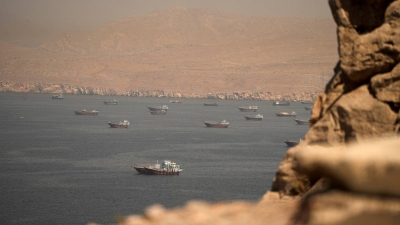
The BBC visits Bandar Abbas to see how the US-Israeli war with Iran has affected everyday life in the port city.
How the world covered this
Read the editorial comparison
Prose synthesis of how each outlet framed the story, with side-by-side outlet quotes and divergence notes.
9 articles from 8 sources
01

02
بموافقة عُمانية.. تحرك بريطاني فرنسي لتأمين الملاحة في مضيق هرمز
A British-French statement said that the Sultanate of Oman agreed to work with London and Paris to ensure the safety of navigation in its territorial waters.
03
The UN nuclear watchdog says inspections of Iran's nuclear program are possible in principle. The bigger question is whether Tehran will allow meaningful access.
04
Privately, some Gulf Arab officials hold the same view, sources said, though this is not necessarily the formal position of their governments.
05
How many crises does it take to change the way the world trades? For Asia, the answer appears to be three.

06
Accord Iran-USA : le porte-avions français rentre à son port d’attache de Toulon, annonce Emmanuel Macron
The “Charles-de-Gaulle” is currently in the Mediterranean Sea, specified the Elysée, which announced the “favorable development” constituted by the agreement between Tehran and Washington to cease hostilities.
07
Three Japanese buyers were looking at possible crude oil purchases from Iran, their first since 2019, said two Iranian sources.
08
The Iran-aligned group warned that they would target “Saudi airports and vital interests on land and sea”.
09
US officials attempted to warn Iran of fears that Israel would assassinate mediators CNN
AI read
What the coverage agrees on, and where it splits
This view is generated from the clustered articles, so it is best read as a map of coverage rather than a replacement for the source reporting.
Broadly agreed
- Multiple sources confirm Hormuz navigation was significantly disrupted by the US-Iran conflict and that an uneasy calm has returned.
- Asian outlets and Japan Times broadly agree that the crisis has accelerated energy supply chain diversification across the region.
Contested framing
- BBC frames Hormuz aftermath through civilian consequence and everyday life; SCMP and Japan Times frame the same events through supply chain structural vulnerability — reflecting consistent outlet patterns.
- CNN reports US officials privately warned Iran about Israeli assassination of mediators, suggesting internal US-Israel friction; this angle is absent from Israeli and Gulf sources.
Still unclear
Whether IAEA inspectors will actually return to Iran's nuclear sites and on what timeline remains publicly unconfirmed.
Notable omissions
Iranian domestic perspectives on the ceasefire terms and what Iran accepted or rejected are absent from all available summaries.
Quality check
Supply chain and navigation impacts are clearer than diplomatic aftermath; Iranian government position on ceasefire remains unreported.
- IAEA nuclear inspections timeline entirely unconfirmed; do not present return of inspectors as decided.
- Iranian domestic perspective on ceasefire terms is completely absent—comparison presents only Western and Gulf framings.
- CNN's claim about US officials warning Iran regarding Israeli assassination of mediators is contested by absence in Israeli/Gulf sources; flag as US-sourced claim, not consensus.
- Hormuz disruption described as 'significant' but timeline and current status unclear—'uneasy calm' language is vague.
Review confidence: 78%
Signal strength
4/5
Narrative divergence
8
Sources compared
1
Days in coverage
How each outlet frames this story
Divergence
4/5
Narrative Divergence
How differently the sources covering this story frame it — measured by tone, emphasis, and what each outlet chooses to highlight or omit.
1 — Sources frame the story almost identically
2 — Minor differences in tone or emphasis
3 — Noticeable differences; some outlets highlight what others omit
4 — Stark contrasts; conflicting narratives
5 — Sources tell fundamentally different stories
British
BBC visits Bandar Abbas port to document everyday life impact — seized ships, shark fishermen — finding an 'uneasy calm' that foregrounds civilian consequence over strategic framing.
Qatari
Al Jazeera Arabic reports a British-French initiative to secure Hormuz navigation with Omani approval, treating the episode as a multilateral institutional response to a specific crisis.
Japanese
Japan Times frames the crisis entirely through Asian energy security vulnerability, noting Asia is building larger fuel buffers and diversifying suppliers — treating warfare as an infrastructure logistics problem.
Chinese
SCMP examines how the Hormuz crisis is accelerating Asia's shift away from just-in-time supply chains, with structural vulnerability analysis dominating over military framing.
French
Le Monde reports the Charles de Gaulle carrier returning to Toulon after a 'favorable development' in Iran-US talks, signalling de-escalation from a French institutional lens.
German
Deutsche Welle examines whether IAEA inspectors can return to Iran's nuclear sites, treating the question through institutional sustainability framing without militaristic tone.
Japanese
A separate Japan Times article reports Iran exploring oil sales to Japan for the first time since 2019, positioning the post-war moment as an economic realignment opportunity.
Japanese
Yahoo Japan notes no progress seen in US-Iran indirect talks, presenting a more pessimistic assessment of the diplomatic track than Western outlets.