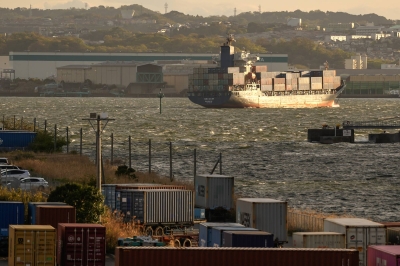
The trade deficit expanded to ¥406.9 billion on an unadjusted basis from a revised ¥391.8 billion gap in May.
How the world covered this
Read the editorial comparison
Prose synthesis of how each outlet framed the story, with side-by-side outlet quotes and divergence notes.
5 articles from 3 sources
01
03
For Japan, days where the mercury soars above 40C now have their own term – kokushobi (酷暑日), or ‘cruelly hot day’, as rising temperatures cause heatstroke deaths and impact on crop yields across the country Japan…
04
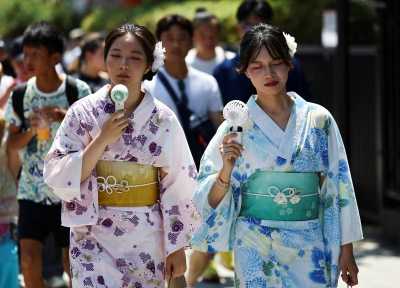
The weather agency issued heat stroke alerts for much of the country, forecasting a second straight day of "kokushobi" — literally meaning brutally hot day.
05
Authorities urged residents to use air conditioning liberally, hydrate regularly and avoid spending long hours outdoors.

AI read
What the coverage agrees on, and where it splits
This view is generated from the clustered articles, so it is best read as a map of coverage rather than a replacement for the source reporting.
Broadly agreed
- Multiple sources confirm Japan's trade deficit widened in July as oil prices rose in connection with the Iran war.
- Sources confirm Japan experienced its first 'brutally hot' days (kokushobi, above 40°C) of 2026 with heat stroke alerts issued nationwide.
Contested framing
- Japan Times frames the trade deficit as directly caused by the Iran war through oil price transmission; CNA focuses on the Bank of Japan's monetary policy complication without attributing it to the war.
- The Guardian frames Japan's heat through environmental and wildlife consequence; Japan Times treats it through economic and policy consequence.
Still unclear
Whether the Bank of Japan will adjust its interest rate policy in response to import inflation driven by external energy price shocks, and the duration of current oil price elevation, remain publicly unconfirmed.
Notable omissions
No covering source examines the specific Japanese industries — petrochemicals, shipping, manufacturing — most immediately affected by the import cost surge.
Quality check
Japan's trade deficit and record heat are confirmed, but whether the deficit is primarily Iran-war-driven or reflects broader monetary policy challenges remains disputed.
- Trade deficit widening and first 'brutally hot' days (kokushobi >40°C) are both confirmed across multiple sources
- Critical causal claim: Japan Times directly attributes trade deficit to Iran war through oil price transmission; CNA focuses on BOJ monetary policy complication without attribution—this reflects different analytical frameworks, not factual disagreement
- Unknown: whether Bank of Japan will adjust interest rate policy in response to import inflation driven by external energy shocks—this is forward-looking and necessarily speculative
- Significant omission: no source identifies specific Japanese industries most immediately affected by import cost surge (petrochemicals, shipping, manufacturing mentioned in unknowns but not in articles)
Review confidence: 75%
Signal strength
2/5
Narrative divergence
3
Sources compared
1
Days in coverage
How each outlet frames this story
Divergence
2/5
Narrative Divergence
How differently the sources covering this story frame it — measured by tone, emphasis, and what each outlet chooses to highlight or omit.
1 — Sources frame the story almost identically
2 — Minor differences in tone or emphasis
3 — Noticeable differences; some outlets highlight what others omit
4 — Stark contrasts; conflicting narratives
5 — Sources tell fundamentally different stories
Japanese
Japan Times reports the trade deficit expanded to ¥406.9 billion as the Iran war and weak yen inflate imports, directly linking the Middle East conflict to Japanese economic harm — consistent with the outlet's infrastructure/logistics framing of warfare as an economic problem.
Singaporean
CNA reports Japan imports jumped to a record high on oil price surges, complicating Bank of Japan monetary policy — framing it through central bank institutional decision-making.
British
The Guardian documents Japan sweltering through rising heat in pictures, with 'kokushobi' days now an established meteorological category — environmental framing of the same heat driving energy demand.
Japanese
Japan Times covers how urbanisation has affected cicada singing patterns after dark, offering a cultural-scientific dimension of Japan's heat crisis distinct from the economic and meteorological reporting.