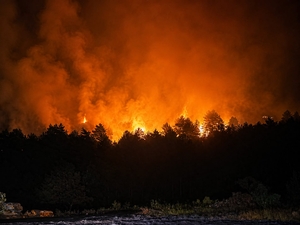
Officials say the blaze, which has forced about 1,200 people to evacuate and has burned at least 30,000 hectares of land, is one of the most complex to affect the country in years.
How the world covered this
Read the editorial comparison
Prose synthesis of how each outlet framed the story, with side-by-side outlet quotes and divergence notes.
9 articles from 8 sources
01
02
Firefighters struggled Tuesday to contain Spain's largest wildfire of the year, while two firefighters were killed battling a fire in southwestern France, as an extreme heat wave continued to fuel dangerous…
03
Around 950 firefighters and multiple aircraft fought the blaze, which spread rapidly despite weakening winds.
04
The blaze close to the parking lots at Bordeaux-Mérignac Airport is said to have originated from a brush fire.

05
FT: жара в Европе привела к снижению стоимости урожая зерновых на €2 млрд
According to the newspaper, France and Hungary suffered the greatest damage.
06
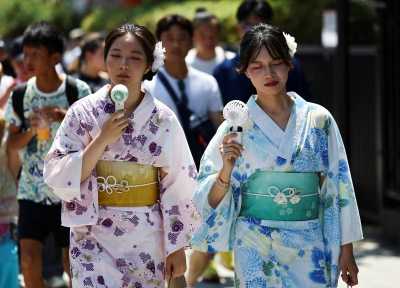
For Japan, days where the mercury soars above 40C now have their own term – kokushobi (酷暑日), or ‘cruelly hot day’, as rising temperatures cause heatstroke deaths and impact on crop yields across the country Japan…
07
The weather agency issued heat stroke alerts for much of the country, forecasting a second straight day of "kokushobi" — literally meaning brutally hot day.
08
Authorities urged residents to use air conditioning liberally, hydrate regularly and avoid spending long hours outdoors.

09
Residents across Europe have struggled to sleep during the latest record heat waves. But as the planet continues to warm, sleep deprivation could create an epidemic of mental and physical ill-health.
AI read
What the coverage agrees on, and where it splits
This view is generated from the clustered articles, so it is best read as a map of coverage rather than a replacement for the source reporting.
Broadly agreed
- Multiple sources confirm Spain's wildfire north of Madrid has burned at least 30,000 hectares and forced 1,200 people to evacuate.
- Sources confirm two French firefighters died fighting a Bordeaux airport-area blaze.
- Sources confirm Japan is experiencing its first 'brutally hot' days of the year with temperatures exceeding 40°C.
Contested framing
- The Guardian frames heatwaves through climate institutional vulnerability and policy failure; TASS frames European heat purely through grain harvest economic loss without climate framing.
- Deutsche Welle connects Spanish wildfire to broader European weather emergency; Korea Herald frames it as part of 'erratic weather' without direct climate attribution.
Still unclear
The full extent of ecological damage from the Spanish wildfire and whether the fire will be contained before spreading to additional populated areas remain publicly unconfirmed.
Notable omissions
No covering source systematically examines the insurance and agricultural economic losses from the combined European and Japanese heatwaves as a unified climate-economic story.
Quality check
The scale of fires and heat events is confirmed across sources, but whether these are climate-driven or cyclical weather, and their total economic impact, remain unintegrated.
- Consensus facts (30,000+ hectares burned, 1,200 evacuated, two firefighter deaths, Japan heat >40°C) are well-confirmed across diverse sources
- Framing divergence is significant: Guardian connects to climate institutional vulnerability; TASS frames only through grain harvest economics; Korea Herald avoids climate attribution—these reflect genuine editorial differences in climate contextualization
- Critical unknown: full ecological damage scope and whether fire will spread to additional populated areas—these directly affect humanitarian consequences framing
- Significant omission: no source provides unified economic loss accounting across European and Japanese heatwaves and wildfires—the combined climate-economic story is fragmented
Review confidence: 80%
Signal strength
1/5
Narrative divergence
8
Sources compared
1
Days in coverage
How each outlet frames this story
Divergence
1/5
Narrative Divergence
How differently the sources covering this story frame it — measured by tone, emphasis, and what each outlet chooses to highlight or omit.
1 — Sources frame the story almost identically
2 — Minor differences in tone or emphasis
3 — Noticeable differences; some outlets highlight what others omit
4 — Stark contrasts; conflicting narratives
5 — Sources tell fundamentally different stories
German
Deutsche Welle reports Spain's firefighters battling a major wildfire north of Madrid burning at least 30,000 hectares and forcing 1,200 to evacuate.
South Korean
Korea Herald covers both Spain's wildfire and two French firefighter deaths battling a Bordeaux blaze as part of Europe's erratic and extreme weather pattern.
British
BBC reports two French firefighters died tackling a blaze near Bordeaux airport originating from a brush fire.
Japanese
Japan Times and CNA report Japan is sweltering through 'brutally hot' days exceeding 40°C — termed 'kokushobi' — with heat stroke alerts issued across the country.
Russian
TASS reports European heat has reduced grain harvest value by €2 billion, noting France and Hungary suffered the greatest damage — framing it through economic consequence rather than climate causation.