Exit polls show damaging losses for Merz's centre-right CDU party in the state of Mecklenburg-Vorpommern and Berlin.
How the world covered this
Read the editorial comparison
Prose synthesis of how each outlet framed the story, with side-by-side outlet quotes and divergence notes.
25 articles from 15 sources
01

02
Elections in Berlin and Mecklenburg-Western Pomerania have dealt the CDU a historic defeat while the AfD saw a massive gain. The pressure on Germany's unpopular chancellor is mounting.
03
Despite making significant gains in both Berlin and Mecklenburg-Western Pomerania, the far-right AfD remains without options to form a state government.
04
The far-right AfD has come first in the state election in Mecklenburg-Western Pomerania, with Chancellor Merz's CDU failing to enter parliament. Meanwhile the Left Party took first place in Berlin.
05
Chancellor Friedrich Merz's record-low approval ratings have emboldened his opponents. There are three ways to remove a chancellor from office in Germany.
06
Russia's full-scale invasion of Ukraine destroyed the once-close relationship between Moscow and Berlin. Yet the far-right AfD is calling for a normalization of relations.
07
Voters in the eastern state of Mecklenburg-Western Pomerania head to the polls on Sunday, with the Social Democrats and far-right AfD neck and neck. Here's a look at key economic issues that could influence the election.
08
BERLIN/FRANKFURT, Sept 21 - Elections in two German states on Sunday resulted in severe losses for the country's leading Christian Democrats, whose Chancellor Friedrich Merz is facing pressure to keep the far-right…
09
Lead candidate Elif Eralp campaigned on the soaring cost of housing.
10
Germany’s far-right AfD win another state election, piling pressure on Chancellor Merz, exit polls show CNN
11
Chancellor Merz calls Germany state elections results a ‘disaster,’ as far-right surges again CNN
12
Is Germany’s leader Friedrich Merz doomed as far right wins again? CNN

14
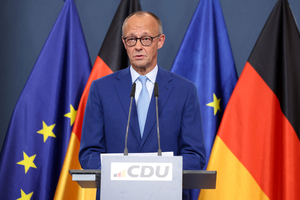
BERLIN (AFP) -- German Chancellor Friedrich Merz starts the week more damaged than ever after his center-right CDU party suffered two bruising regional election defeats at the hands of far-right and far-left parties.…
15
L’ipotesi di cambio in corsa o di governo di minoranza. Lui convoca i media per frenare sulle dimissioni: resta però in bilico
16
Per il politologo Wolfgang Schroeder le elezioni confermano la polarizzazione della Germania, spaccata tra le aree rurali e quelle delle città
17
Apuração parcial mostra que a AfD, partido de extrema direita da Alemanha , voltou a obter fortes resultados eleitorais no país neste domingo (20). Em momento de fragilidade do seu governo , Friedrich Merz classificou o…
18
O nome de Friedrich Merz não estará em nenhuma cédula neste domingo (20), na Alemanha , mas é uma resposta sobre seu futuro como primeiro-ministro que emergirá de duas eleições estaduais em que a AfD, partido de extrema…
19
Pour la première fois depuis 1949, l’Union chrétienne-démocrate (CDU), parti du chancelier, est passée sous les 5 % lors d’un scrutin régional, dans le Land de Mecklembourg-Poméranie-Occidentale, quorum requis pour être…
20
حقق حزب اليسار تقدما لافتا في انتخابات برلين متصدرا النتائج بـ25.7%، متقدما على الديمقراطي المسيحي الذي تراجع إلى 18.8%، بينما حل البديل من أجل ألمانيا ثالثا.
22
First they take Manhattan? Looking to mimic Mamdani, far left’s Elif Eralp eyes Berlin City Hall The Times of Israel
23
I believe it would indeed send a powerful signal if someone with a migration background were to become governing mayor of Berlin, said Elif Eralp

24
German Chancellor Friedrich Merz faced a struggle to stabilise his position and keep his agenda on track on Monday after voters inflicted two more defeats on his party, ejecting it from a state legislature for the first…

25
Partial results show CDU just above the 5 per cent threshold for parliamentary representation in Mecklenburg-Vorpommern

AI read
What the coverage agrees on, and where it splits
This view is generated from the clustered articles, so it is best read as a map of coverage rather than a replacement for the source reporting.
Broadly agreed
- All covering sources confirm the CDU suffered severe, historically unprecedented losses in both states.
- All sources agree the AfD made significant gains but faces a governing firewall from other parties.
- Merz publicly called the results a 'disaster' but vowed to stay on as chancellor.
Contested framing
- BBC and Irish Times frame Merz's position as precarious but survivable; TASS frames it as outright political survival struggle with internal CDU dissent.
- Deutsche Welle emphasises the AfD still cannot form a government; La Repubblica and CNN foreground the prospect of Merz being replaced or governing in a weakened minority position.
- Al Jazeera Arabic highlights the far-left's Berlin victory as the headline result; most Western outlets lead with the CDU collapse and AfD surge.
Still unclear
Whether Merz will face a formal leadership challenge within the CDU or attempt to govern as a minority chancellor remains unconfirmed in the available summaries.
Notable omissions
No outlet in the available summaries addresses the specific policy consequences for Germany's defence spending commitments or Ukraine aid in the wake of the results.
Quality check
Reliable on election results and immediate positioning; speculative on Merz's survival and policy implications.
- Merz's long-term political viability and CDU internal challenge risk remain speculative; only his public statements are confirmed.
- Defence spending and Ukraine aid policy consequences are entirely absent from available source summaries—readers should not infer positions.
- AfD's lack of governing coalition options is confirmed, but counterfactual scenarios about future coalition shifts are not addressed.
Review confidence: 85%
Signal strength
4/5
Narrative divergence
15
Sources compared
1
Days in coverage
How each outlet frames this story
Divergence
4/5
Narrative Divergence
How differently the sources covering this story frame it — measured by tone, emphasis, and what each outlet chooses to highlight or omit.
1 — Sources frame the story almost identically
2 — Minor differences in tone or emphasis
3 — Noticeable differences; some outlets highlight what others omit
4 — Stark contrasts; conflicting narratives
5 — Sources tell fundamentally different stories
British
BBC frames this as a 'disaster' in Merz's own words, emphasising his vow to stay on despite record CDU losses and the AfD's continued surge.
German
Deutsche Welle leads with the AfD's gains but stresses the party still has no government formation options, and separately examines whether Merz can constitutionally be replaced.
French
Le Monde focuses on the CDU's historic sub-5% result as unprecedented since 1949, framing it as an institutional competence failure for Merz.
American
CNN asks whether Merz is 'doomed' as the far right wins again, centering the story on the chancellor's personal political survival.
Brazilian
Folha de S.Paulo notes AfD's strong results but emphasises the party still cannot enter government, contextualising the outcome as polarisation without power transfer.
Italian
La Repubblica frames it as an assault on Merz by opponents within his own coalition, raising the possibility of a minority government or mid-term leadership change.
South Korean
Korea Herald covers the pressure on Merz after CDU's bruising losses, foregrounding alliance implications for Europe.
Singaporean
Straits Times provides five analytical takeaways, treating the results through a governance-stability and European economic resilience lens.
Qatari
Al Jazeera Arabic notes the left-wing party led in Berlin with 25.7% while the CDU fell to 18.8%, framing it as a third electoral blow to Merz.
Japanese
Yahoo Japan provides a brief factual note on the far-right AfD's victory without extended editorial framing.
Israeli
Times of Israel draws a comparison between Berlin's far-left winner Eralp and New York Mayor Mamdani, framing both through a political left lens.
Irish
Irish Times reports Merz's vow to stay despite the 'disaster', noting CDU barely cleared the 5% parliamentary threshold in Mecklenburg-Vorpommern.