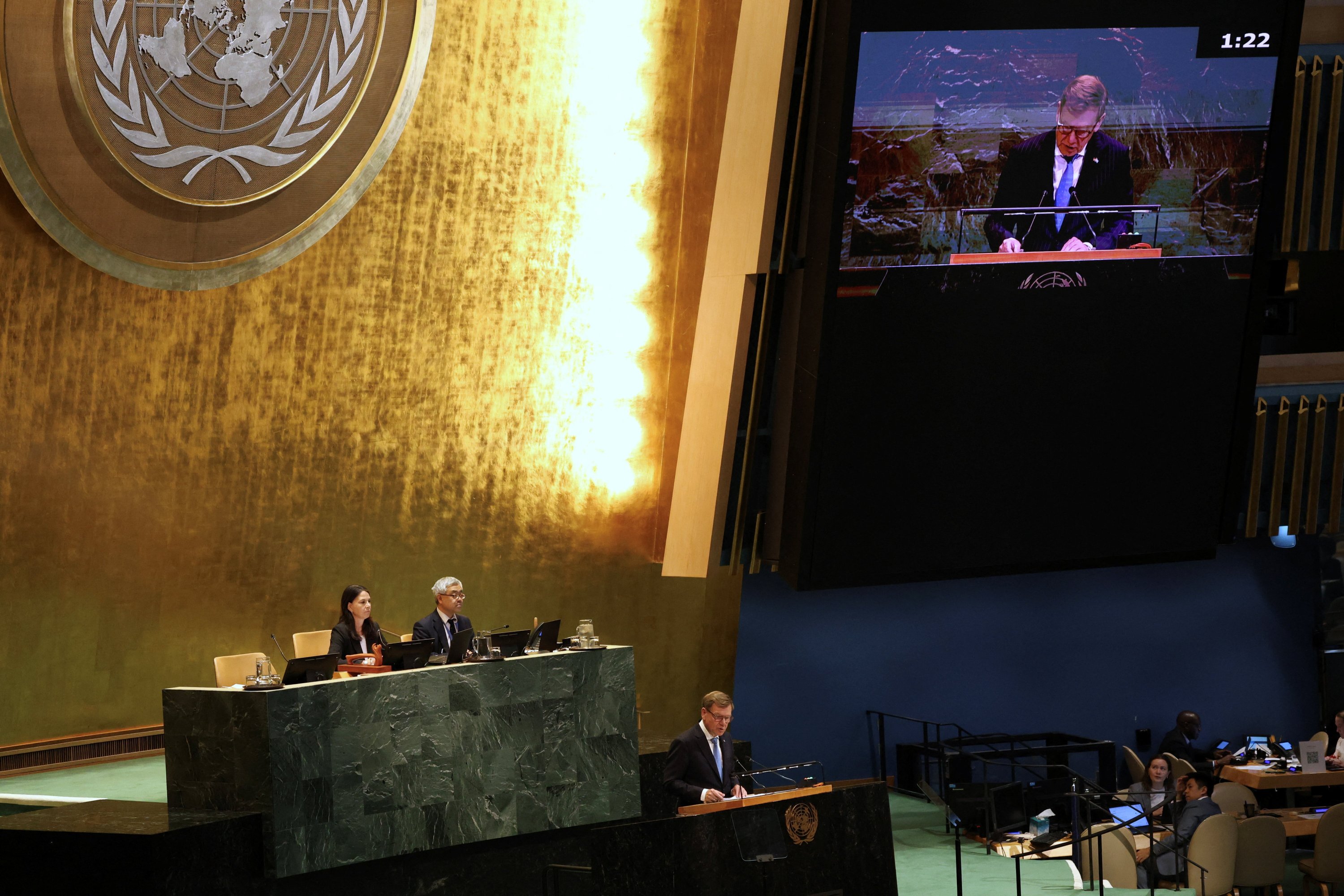
Fifteen of the 193 UN member states sit on the UN Security Council. Germany was in competition with Austria and Portugal for two seats in the "Western Europe and Others" group.
How the world covered this
Read the editorial comparison
Prose synthesis of how each outlet framed the story, with side-by-side outlet quotes and divergence notes.
4 articles from 4 sources
01
02
Germany failed on Wednesday for the first time to secure a seat on the U.N. Security Council, with Portugal and Austria receiving more votes for the two Western European spots star...
03
Portugal and Austria defeated Germany for seats on the powerful but deeply divided UN Security Council on Wednesday in a hotly contested race after intense campaigning. The 10 rotating seats on the 15-member Security…


AI read
What the coverage agrees on, and where it splits
This view is generated from the clustered articles, so it is best read as a map of coverage rather than a replacement for the source reporting.
Broadly agreed
- All sources confirm Germany failed for the first time to secure a UN Security Council seat, losing to Portugal and Austria.
- Sources confirm the vote was hotly contested among UN member states.
Contested framing
- Deutsche Welle frames the loss as a significant institutional setback for German foreign policy; SCMP frames it as reflecting the Security Council's deep divisions rather than German-specific diplomatic failure.
Still unclear
The specific reasons why UN member states voted against Germany in favour of Portugal and Austria—whether driven by policy disagreements, regional bloc voting, or bilateral relations—remain unspecified in available summaries.
Notable omissions
None of the covering articles addresses how Germany's Ukraine diplomacy initiative or its position on the Iran war may have influenced member state voting behaviour.
Quality check
Loss is confirmed, but underlying causes for voting patterns remain unexplained.
- Reasons for member state voting against Germany remain unspecified—attributed to 'divisions' without explaining German-specific factors
- No analysis of whether Ukraine diplomacy or Iran war position influenced voting behaviour despite mentioned as potential factor
- Framing divergence (Deutsche Welle: setback; SCMP: systemic division) reflects interpretation gap rather than factual dispute
Review confidence: 80%
Signal strength
2/5
Narrative divergence
4
Sources compared
1
Days in coverage
How each outlet frames this story
Divergence
2/5
Narrative Divergence
How differently the sources covering this story frame it — measured by tone, emphasis, and what each outlet chooses to highlight or omit.
1 — Sources frame the story almost identically
2 — Minor differences in tone or emphasis
3 — Noticeable differences; some outlets highlight what others omit
4 — Stark contrasts; conflicting narratives
5 — Sources tell fundamentally different stories
German
Deutsche Welle reports Germany losing the vote for the UN Security Council seat for the first time, framing it as a significant institutional setback.
Turkish
Daily Sabah covers Germany's surprise failure to secure the Security Council seat, treating it as a notable shift in European diplomatic standing.
Chinese
SCMP reports Portugal and Austria defeating Germany for Security Council seats on the powerful but deeply divided body, framing it through institutional balance-of-power analysis.
Emirati
The National covers Germany's failure to gain the UN Security Council seat for the first time as five new members were elected, framing it as a significant diplomatic development.