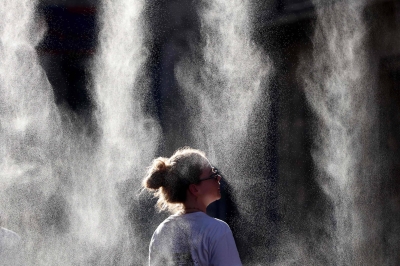
A 'heat dome' pushing temperatures above 40°C across Europe is closing schools, cancelling trains, banning alcohol at public events, and activating national heatwave emergency plans — with scientists explicitly linking the event to fossil-fuel-driven global warming and warning it may rival the deadly 2003 heatwave.
8 sources10 articles8 perspectives
8Sources in this topicDifferent outlets covering the same story arc.
10Articles collectedThe full set backing this topic page right now.
2/5Narrative divergenceHover for scale explanation.
Narrative Divergence
How differently the sources covering this story frame it — measured by tone, emphasis, and what each outlet chooses to highlight or omit.
1 — Sources frame the story almost identically
2 — Minor differences in tone or emphasis
3 — Noticeable differences; some outlets highlight what others omit
Dans toute la France, la Fête de la musique malgré la canicule : « De toute façon, il fait aussi chaud dans l’appartement où je vis »
From Paris to Bordeaux, via Gard and Clermont-Ferrand, the French suffered the new heat wave on Sunday June 21, while 39 departments were classified as heat wave red alert and 45 others...
Scientists have shown that recurring heatwaves are a clear marker of global warming, primarily caused by burning coal, oil and gas — and warn they are set to become more frequent, longer and more intense
Authorities accross Europe have warned of temperatures exceeding 39 and 40 degrees Celsius as a 'heat dome' sets in. Germany also faces the threat of extreme thunderstorms.
Much of Europe was preparing Monday for an already fierce heatwave to intensify even further in the coming days, with some countries taking special measures to mitigate its effects. France recorded heat-related deaths…
A national heatwave plan has been activated to help people stay cool during the Netherlands’ increasingly hot summers Households in Amsterdam are being urged to hang their curtains outside their windows as health…
Canicule : visualisez l’évolution des températures au cours des prochains jours
The second early heat episode of the year is expected to intensify this weekend and could continue into next week. Browse the Météo-France forecast map, region by region.
Hot spell comes amid ongoing heatwave in several parts of Europe
AI read
What the coverage agrees on, and where it splits
This view is generated from the clustered articles, so it is best read as a map of coverage rather than a replacement for the source reporting.
Broadly agreed
All covering sources confirm temperatures are exceeding 39-40°C across multiple European countries including France, Netherlands, Germany, and Spain.
Multiple sources confirm that schools have closed, trains have been cancelled, and national heatwave emergency plans have been activated.
Contested framing
The Guardian explicitly attributes the heatwave to fossil fuel burning and frames it as a systemic inequality crisis; Le Monde frames the same event through cultural resilience (Parisians coping at festivals) with minimal attribution language.
Deutsche Welle and Japan Times frame the heatwave primarily as an urban infrastructure and logistics problem; The Guardian and The Hindu frame it as a climate justice and public health emergency.
Still unclear
Whether the current event will match or exceed the 2003 death toll is not confirmed in available summaries; mortality projections are not cited.
Notable omissions
The economic cost of heatwave disruption to European businesses and agriculture is largely absent from coverage, which focuses on public safety and climate attribution rather than economic impact.
Quality check
Temperature and emergency response data are solid; treat climate attribution and 2003 comparison as expert assessment, not confirmed equivalence.
2003 death toll comparison cited by French forecasters but actual mortality projections for current event unconfirmed
Attribution to fossil fuels explicit in some outlets, absent in others—normative framing varies
Economic costs to agriculture and business largely absent from coverage
Infrastructure/logistics framing vs. climate justice framing creates different risk emphasis by outlet
Review confidence: 80%
Signal strength
2/5Narrative divergence
8Sources compared
1Days in coverage
How each outlet frames this story
Divergence2/5
Narrative Divergence
How differently the sources covering this story frame it — measured by tone, emphasis, and what each outlet chooses to highlight or omit.
1 — Sources frame the story almost identically
2 — Minor differences in tone or emphasis
3 — Noticeable differences; some outlets highlight what others omit
4 — Stark contrasts; conflicting narratives
5 — Sources tell fundamentally different stories
German
Deutsche Welle reports authorities warning of temperatures exceeding 39-40°C across Europe and cities racing to cool streets, framing heatwaves as an urban infrastructure adaptation challenge with structural vulnerability emphasis.
French
Le Monde covers the Fête de la Musique proceeding despite the heatwave with humanistic depth — quoting Parisians coping — and publishes temperature visualisation tools, treating the event through cultural resilience rather than crisis framing.
Indian
The Hindu reports the European heatwave explicitly as a marker of global warming caused by burning coal and oil, framing it as a climate science accountability story consistent with its non-aligned scientific emphasis.
British
The Guardian reports how Dutch citizens are adapting to heat with mobile jungles and shadow art, and separately covers how India's heatwaves are pushing women out of the workforce — connecting European and Global South climate vulnerability through systemic inequality analysis.
Singaporean
Straits Times maps how different European countries are affected, maintaining terse facts-first operational framing about disruptions to infrastructure across the continent.
Japanese
Japan Times reports schools closing and trains cancelled as the heatwave intensifies, framing European heat infrastructure disruption through an economic consequence lens consistent with Japanese corporate resilience analysis.
Irish
Irish Times forecasts a hot spell of up to 30 degrees in Ireland this week as part of the broader European heatwave, grounding the global climate story in highly localised Irish weather impact.
Chinese
SCMP reports Europe sizzling above 40°C with some areas preparing for intensification, applying its structural vulnerability institutional analysis to the continent's infrastructure resilience.
Copied!
Related coverage
More topic clusters connected by category, source overlap, or narrative signal.