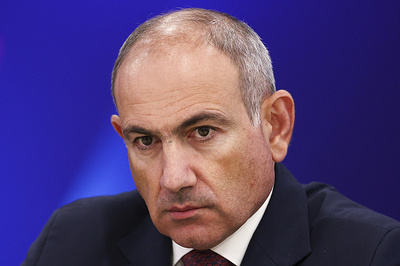
The election result, once confirmed, would cement Pashinyan's Westward push away from Russian influence. It is the first vote since a 2023 crushing military defeat by Azerbaijan.
How the world covered this
Read the editorial comparison
Prose synthesis of how each outlet framed the story, with side-by-side outlet quotes and divergence notes.
7 articles from 5 sources
01
02
Партия Пашиняна получила 49,81% голосов избирателей
03
The preliminary data, from about 16% of Armenia's polling stations, showed the pro-Russian Strong Armenia alliance in second place, with about 22% of the votes

04
Législatives en Arménie : le premier ministre, Nikol Pachinian, revendique une « victoire historique »
According to partial results, the Civil Contract party is well ahead of the Strong Armenia alliance of Russian-Armenian billionaire Samvel Karapetyan.
05
In Armenia, legislative elections decisive for the future of the country and for peace in the region
En Arménie, des élections législatives déterminantes pour l’avenir du pays et pour la paix dans la région
Sunday's vote represents a referendum on peace with Azerbaijan and on rapprochement with the European Union and the United States to the detriment of Russia. A geopolitical reorientation driven by…
06
Armenian Prime Minister Nikol Pashinyan’s party led the opposition Monday in early results from parliamentary elections that could cement his Westward tilt, after threats from Moscow and claims of Russian interference.…

07
Armenians are set to vote on the country's future geopolitical direction on June 7. The election will be a test of public opinion in the long-standing Russia ally, where the population is increasingly eyeing the EU.
AI read
What the coverage agrees on, and where it splits
This view is generated from the clustered articles, so it is best read as a map of coverage rather than a replacement for the source reporting.
Broadly agreed
- All covering sources confirm that Pashinyan's Civil Contract party led in early results from the June 7 Armenian parliamentary elections.
- Multiple sources agree the election result, once confirmed, would cement Armenia's Western geopolitical orientation.
Contested framing
- TASS reports only the raw vote percentage for Pashinyan's party without any geopolitical framing; Le Monde and Deutsche Welle explicitly frame the result as a pro-EU, anti-Russian geopolitical signal.
- Le Monde frames the election primarily as a referendum on peace with Azerbaijan; Deutsche Welle frames it primarily as a test of public opinion on EU versus Russian alignment.
Still unclear
Whether final certified results will confirm Pashinyan's majority and whether the pro-Russian Strong Armenia alliance will contest the results remains unconfirmed.
Notable omissions
No available summaries address what Armenia's pivot westward means for Russian military basing rights on Armenian territory or the future of the CSTO membership.
Quality check
Pashinyan's early lead is confirmed, but geopolitical consequences and final certification both uncertain.
- Outcome not yet certified: Whether final results confirm Pashinyan majority and whether results will be contested remain unconfirmed
- Framing variance: TASS reports raw vote data without geopolitical framing; Le Monde/DW explicitly frame as pro-EU/anti-Russian—reflects different editorial mandates
- Critical omission: No coverage of implications for Russian military basing rights or CSTO membership status
- Framing divergence on primary issue: Le Monde frames as peace-with-Azerbaijan referendum; DW frames as Russia-vs-EU alignment test
Review confidence: 80%
Signal strength
3/5
Narrative divergence
5
Sources compared
1
Days in coverage
How each outlet frames this story
Divergence
3/5
Narrative Divergence
How differently the sources covering this story frame it — measured by tone, emphasis, and what each outlet chooses to highlight or omit.
1 — Sources frame the story almost identically
2 — Minor differences in tone or emphasis
3 — Noticeable differences; some outlets highlight what others omit
4 — Stark contrasts; conflicting narratives
5 — Sources tell fundamentally different stories
German
Deutsche Welle frames the result as cementing Pashinyan's 'Westward push away from Russian influence,' treating it as a democracy and geopolitical orientation test.
Russian
TASS reports only that 'Pashinyan's party received 49.81% of the votes' — a factual minimum with zero engagement of the EU/Russia geopolitical implications.
Indian
The Hindu reports the ruling party leads with 54% in early results with the pro-Russian Strong Armenia alliance in second — framing it through regional collective positioning without Western alignment framing.
French
Le Monde frames the Armenian election as 'decisive for the future of the country and for peace in the region,' treating it as a referendum on EU rapprochement and peace with Azerbaijan.
Chinese
SCMP frames it as Armenia 'setting course for the West' as Pashinyan heads for election win, consistent with its structural analysis of geopolitical alignment shifts.
German
Deutsche Welle additionally covered Armenia considering an EU future, framing Armenians as voting on the country's geopolitical direction as a public opinion test.