US announces new tariffs over forced labour concerns
It comes after the US Supreme Court struck down many of US President Donald Trump's previous duties in February.

The Trump administration's new tariff proposals targeting up to 60 countries on forced labor grounds, following Supreme Court invalidation of earlier duties, threaten to reshape trade flows across Asia, Latin...
Le Monde explicitly frames Trump's new forced-labor tariffs on 60 countries as "Donald Trump's latest maneuver to circumvent the Supreme Court decision," imputing strategic intent to evade judicial constraint. This framing treats tariffs as procedurally motivated rather than substantively justified.
BBC News reports the tariffs as "a policy response to forced labor concerns" without engaging the circumvention framing, treating them as straightforward enforcement of labor standards rather than legal maneuvering. The BBC approach accepts the policy's stated rationale at face value.
Folha de S.Paulo frames Lula's response as assertive trade independence—"I will sell to someone else"—positioning Brazil as having alternatives to US markets. El Tiempo treats tariffs as a threat requiring defensive diplomatic engagement from Colombia. The divergence between Le Monde's strategic framing and BBC's technical framing reflects disagreement on whether tariffs represent genuine policy or procedural gaming.
Whether the forced labor tariff mechanism will survive legal challenge, and which of the 60 targeted countries will face the full 12.5% rate versus negotiated exemptions, remains unconfirmed.
African countries affected by the proposed tariffs are entirely absent from coverage despite Premium Times and Daily Nation being in the source set; the African trade dimension is wholly missing.
BBC reports new US tariffs framed around forced labor concerns, noting they come after the Supreme Court struck down many previous Trump duties in February.
Yahoo Japan reports the US is considering additional 12.5% tariffs on Japan, framing it as a direct threat to Japanese export competitiveness.
The Hindu reports the US proposed 12.5% tariffs on India and other countries, with the Indian government saying it 'remains engaged' with Washington, maintaining a strategic autonomy framing.
Le Monde frames the forced labor tariff as Trump's 'latest maneuver to circumvent the Supreme Court decision', emphasizing the executive institutional workaround dimension.
Dawn reports Pakistani exporters are confident a proposed 10% US duty will have no significant impact on their exports, reflecting a sector-level pragmatic assessment.
El Tiempo warns the tariff proposal could hit Colombia, noting Washington included Colombia on a list of states lacking mechanisms to prevent goods from countries with forced labor from entering US markets.
Irish Times frames EU-China trade war tensions as potentially difficult for the EU to reconcile French enthusiasm with German reticence, emphasizing intra-EU institutional divergence.
This page maps the coverage. The 9 articles below are the original reports the comparison is drawn from — open them for each publisher's full reporting.
It comes after the US Supreme Court struck down many of US President Donald Trump's previous duties in February.
The action follows investigations launched against 60 countries over what the USTR described as their failure to impose and effectively enforce bans on imports made with forced labour

The Trump administration intends to impose new taxes on products from around sixty countries accused of being too lax towards forced labor. An attempt to escape his obligation to repay…
KARACHI: Representatives of exporters are confident that a proposal under consideration in Washington to impose 10 per cent additional duties on imports would not hurt Pakistan’s exports. The US Trade Representative…
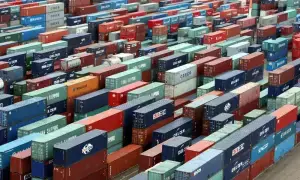
Washington included the country on a list of States that, according to its assessment, do not have mechanisms to prevent goods produced with forced labor.

Although immigration officials will maintain the authority to decide on a case-by-case basis, the risk is that the responses will be different.

Brazilian President Luiz Inacio Lula da Silva thanked China for clearing the country’s beef of foot-and-mouth disease and fired a barb at US President Donald Trump, saying “I will sell to someone else”, after Washington…

It may prove difficult for the EU to reconcile the enthusiasm of member states led by France with the reticence of Germany and Spain
