Israel and Lebanon agree to implement ceasefire if Hezbollah stops attacks
The countries reject "any attempt, by any state or non-state actor, to hold Lebanon's future hostage", the US State Department says.

A conditional ceasefire between Israel and Lebanon, brokered by the US, represents the most significant diplomatic development in the West Asia war and could affect the broader Iran conflict trajectory.
BBC News, Deutsche Welle, and Daily Maverick treat the Israel-Lebanon ceasefire as a discrete diplomatic success, with BBC emphasizing mutual rejection of "any attempt, by any state or non-state actor, to hold Lebanon's future hostage." This framing presents the agreement as balanced and precedent-setting.
Irish Times explicitly links the Lebanon ceasefire to the Iran war as an integrated diplomatic package, contextualizing it within broader conflict resolution efforts. Meanwhile, La Repubblica quotes Carnegie analyst framing Israel as seeking to "expand its hegemony" and reports the White House statement "We want to separate the conflict from the one with Iran"—indicating internal tension over whether the two tracks should be treated jointly or separately.
Al Jazeera Arabic's coverage contextualizes the ceasefire alongside ongoing Israeli raids killing civilians in Gaza, while SCMP reports the agreement requires "complete cessation" of fire by Iran-backed Hezbollah, keeping military enforcement mechanisms visible. The divergence reflects whether coverage treats the Lebanon deal as diplomatic isolation or symptom of broader regional recalibration.
Israel and Lebanon agree ceasefire, reject hostile state actor interference
Israel-Lebanon ceasefire reached as part of Iran conflict diplomacy package
Lebanon ceasefire achieved; 49 died during negotiations, White House separates Iran track
Whether Hezbollah will comply with the ceasefire's conditions, and whether the 'pilot zones' with Lebanese army deployment will be practically implemented, remains unconfirmed.
The civilian toll in Lebanon during the weeks of intensified fighting preceding the ceasefire is noted briefly in La Repubblica (49 dead during negotiations) but is largely absent from Western outlet summaries.
BBC reports the ceasefire as requiring Hezbollah to stop attacks, with both sides rejecting any state or non-state actor holding Lebanon's future hostage, framing it as a conditional institutional agreement.
Deutsche Welle reports the ceasefire as US-brokered following intensification of hostilities, treating it as a governance-level diplomatic achievement without speculating on durability.
Daily Maverick reports the ceasefire implementation agreement via Reuters wire without distinct editorial framing.
Dawn reports the ceasefire as conditional, noting both sides agreed to 'pilot zones' with Lebanese army deployment, and that Trump wants to separate Lebanon and Iran talks.
The Hindu covers the conditional ceasefire and creation of 'pilot zones', and Iran's Foreign Minister warning that any attack on Beirut will trigger full-scale resumption of war, emphasizing fragility.
Irish Times reports the ceasefire deal was reached following Washington negotiations aimed at ending conflict that flared up alongside the Iran war, linking the two theaters explicitly.
CNA and Straits Times both report the ceasefire as boosting hopes for a broader Iran deal, framing it through regional stability and energy security implications.
La Repubblica reports 49 people died during the negotiations leading to the ceasefire, with a Carnegie Endowment analyst saying only Trump can stop Israeli expansion ambitions.
SCMP reports the ceasefire with Trump and Netanyahu playing down their heated call, contextualizing the diplomatic friction between US and Israeli leadership.
Al Jazeera Arabic covers the ceasefire announcement alongside continued Israeli raids killing civilians in Gaza and the father of an Israeli soldier describing drone warfare in south Lebanon.
Yahoo Japan confirms Israel and Lebanon re-agreed ceasefire, and Japan Times reports oil prices fell on the ceasefire news while the Strait of Hormuz remains the market's main focus.
This page maps the coverage. The 20 articles below are the original reports the comparison is drawn from — open them for each publisher's full reporting.
The countries reject "any attempt, by any state or non-state actor, to hold Lebanon's future hostage", the US State Department says.
The agreement comes as hostilities between Israel and Lebanese militants Hezbollah have intensified in recent weeks. It is unclear if the renewed truce will affect stalled talks between the US and Iran.
June 3 (Reuters) - Lebanon and Israel said on Wednesday that they had agreed to the implementation of a ceasefire following negotiations in Washington aimed at ending the conflict that flared up alongside the war in…

The White House: “We want to separate the conflict from the one with Iran”
Israel and Lebanon agreed Wednesday to implement a ceasefire but said it would require a “complete cessation” of fire by Iran-backed Hezbollah, according to a joint statement after US-led talks in Washington. The two…

It comes following negotiations in Washington.
Deal reached following negotiations in Washington aimed at ending conflict that flared up alongside war in Iran

Israel and Lebanon agreed on Wednesday to implement a ceasefire but said it would require a “complete cessation” of fire by Hezbollah, according to a joint statement after US-led talks in Washington. The two sides,…
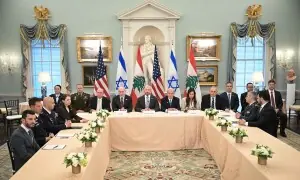
Israel and Lebanon, which do not have formal diplomatic relations, also agreed to create “pilot zones” in which the Lebanese armed forces “will take exclusive control of the territory to the exclusion of all non-state…

Lebanese security sources said Israeli drones struck at least 10 vehicles across south Lebanon on Wednesday

Iran has repeatedly insisted that any deal to end the wider West Asia war — which its ally Hezbollah joined on March 2 — must also halt the fighting in Lebanon.

Lebanon and Israel agreed to implement a ceasefire, according to a joint statement released by the US State Department this Wednesday (3), following negotiations in Washington. Read more…
Israel and Lebanon agree on ceasefire; Trump says he wants to separate talks on Lebanon and the war in Iran but Tehran warns that any attack on Beirut would trigger a "full-scale resumption" of the war
Israel and Lebanon reached a ceasefire agreement, amid a field escalation that left dozens of victims as Tel Aviv's attacks continued on southern and central Lebanon.
Iranian Foreign Minister Abbas Araqchi warned of the consequences of any Israeli attack on the Lebanese capital, Beirut, at a time when Israel intensified its military operations against Lebanon in flagrant violation of the ceasefire agreement.
The American President stressed that he will not allow Iran to possess a nuclear weapon, and if it signs the agreement, this means that it will agree not to obtain a nuclear bomb, stressing that the opportunity to sign an agreement is approaching.
The Carnegie Endowment's Middle East manager: "The US president wants to end this war, he knows that an agreement with Iran would help"
The father of an Israeli soldier participating in military operations in southern Lebanon said that the soldiers there face a constant threat that makes them depend on luck to stay alive, describing the battle as “a hunting field for soldiers with Hezbollah marches.”
The oil market's main focus remains on the Strait of Hormuz, a key waterway through which one-fifth of global crude normally passes.