CJP protest: The youth movement India's Modi didn't see coming
The CJP protest began with exam paper leaks. It became India's biggest student movement in years - why?

India's largest student protest movement in years — the CJP (Competitive Justice Platform) movement — has brought tens of thousands to New Delhi demanding the education minister's resignation over exam...
BBC frames the movement as something Modi 'didn't see coming,' language implying government unpreparedness and strategic surprise at youth mobilization around exam corruption. The Hindu frames government-youth talks as a positive development and institutional opening, without the framing of surprise or unpreparedness.
Deutsche Welle questions whether the movement can expand beyond exam corruption to become nationwide, treating its scalability as uncertain. Japan Times treats the movement as 'India's first Gen Z protest movement' and 'landmark national moment,' establishing it as a historically significant institutional rupture rather than a nascent campaign of uncertain scope. CNA and Folha de S.Paulo report Sonam Wangchuk's 26-day hunger strike ending as the catalyst for government engagement, centering individual sacrifice as the mechanism driving institutional response.
CJP protest India's Modi didn't see coming
India youth protest leaders to hold talks with government
Indian activist Sonam Wangchuk ends hunger strike
How Abhijeet Dipke became face of India's first Gen Z protest
Modi promises punishment for evidence leak but opposition calls
Whether the government talks will result in substantive education reform or merely defuse the immediate protest without addressing systemic exam corruption remains unconfirmed.
No source addresses the specific policy demands of the CJP movement beyond the education minister's resignation, or what the government has concretely offered in negotiations.
BBC frames the CJP protest as a youth movement 'India's Modi didn't see coming,' emphasizing the government's surprise and the movement's emergence from exam paper leaks into a broader corruption protest.
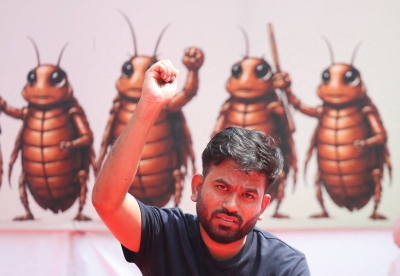
Deutsche Welle asks whether the 'Cockroach' protest movement — framed as beginning with social media satire — can go nationwide, analyzing its Gen Z anti-corruption character.
Japan Times profiles Abhijeet Dipke as the face of India's first Gen Z protest movement, contextualizing it as a landmark moment in Indian civic engagement.
Folha de S.Paulo reports Modi promising 'speedy trial' courts for exam fraud but the opposition calling for the education minister's resignation, framing it through institutional accountability.
This page maps the coverage. The 6 articles below are the original reports the comparison is drawn from — open them for each publisher's full reporting.
The CJP protest began with exam paper leaks. It became India's biggest student movement in years - why?
The decision was announced hours after activist Sonam Wangchuk ended a 26-day hunger strike overnight, raising hopes that the two sides could be moving toward a breakthrough in the crisis.

Sonam Wangchuk has ended his hunger strike after 26 days, saying the decision follows a "long negotiation" on various conditions and "in view of possible violence in the country."
Over the past three days, tens of thousands have gathered in New Delhi demanding the resignation of India's education minister, and at the center of it all is Abhijeet Dipke.
The Prime Minister of India, Narendra Modi, stated this Thursday (23) that "speedy trial" courts will be created to prosecute those responsible for the leak of national evidence, in his first...
Sonam Wangchuk, a supporter of youth-led protesters demanding education reforms, says he wants to avert "possible violence".
