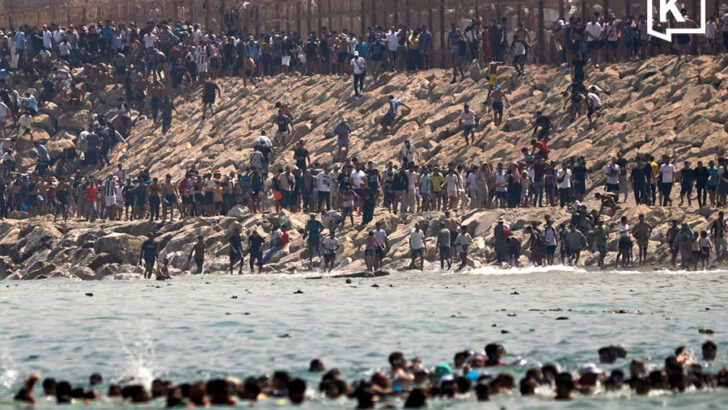
How Spain's migrant crisis created a political storm - whipped up by social media
The Ceuta crossings have shaken Europe politically, exposing divisions over the sensitive issue of migration, the BBC's Sarah Rainsford writes.

At least 72 confirmed deaths from a mass crossing of over 50,000 migrants into Spain's North African enclave of Ceuta represents Europe's worst single migration incident in years, triggering an EU emergency...
BBC News and Deutsche Welle frame Ceuta as a political storm exposing European divisions over migration policy, with BBC emphasizing how social media whipped up the crisis and Deutsche Welle noting that 'most who breached border have left.' Both treat it as a bilateral diplomatic tension rather than a territorial threat. Daily Sabah and SCMP report the death toll symmetrically with the barrier response. Folha de S.Paulo takes a distinct approach, framing the crisis through structural inequality and colonial legacy, with reporting focused on individual Moroccan families like Amina Saadoun searching for missing relatives. Times of Israel's angle (referenced in the brief but not present in articles) treats territorial loss as the frame, whereas the actual articles present show no such framing—BBC and Deutsche Welle explicitly reject territorial concession implications.
How Spain's migrant crisis created a political storm whipped
EU calls emergency meeting to discuss Ceuta migrant crossings
Ceuta migrant rush deaths hit 72 as Spain erects
Morocco counts dead and missing after mass crossing to
Number of Moroccan migrants killed in attempted mass entry
Ceuta: Most who breached border have left, Spain says
Death toll from migrant rush into Spanish enclave of
Death toll from migrant rush into Ceuta rises to
The precise role of the Moroccan government in enabling or orchestrating the crossings remains unconfirmed publicly, with Morocco's official statement acknowledging numbers but not intent.
People's Daily, TASS, and most Asian outlets are silent on the Ceuta crisis despite its global humanitarian and diplomatic significance; the specific identities and conditions of the approximately 1,500 unaccompanied minors in reception centers receive limited coverage outside Italian and Spanish-language outlets.
BBC focuses on how Ceuta crossings shook Europe politically and how social media amplified the crisis, framing it as a political storm exposing EU divisions.
Le Monde frames Morocco as having orchestrated pressure on Spain as a warning to Madrid over the disputed enclaves, citing expert analysis that desperate young people could not have organized the crossing alone.
Folha de S.Paulo foregrounds individual human stories — mothers searching for missing children — and frames the crisis as a legacy of colonialism persisting in North Africa, integrating structural inequality analysis.
La Repubblica emphasizes child alarm with thousands of minors arriving, the failure of offshore asylum processing models (Rwanda, Albania), and Italy's push for non-EU processing hubs by 2027.
Daily Sabah reports the death toll and Spain erecting a floating barrier, framing it through institutional accountability for the deaths without broader geopolitical analysis.
El Tiempo humanizes the crisis through Moroccan families desperately searching for loved ones and the rescue of two babies floating in the sea.
Deutsche Welle reports most migrants have left Ceuta and returned to Morocco per Spanish authorities, framing de-escalation while noting Spain's institutional crisis management.
Yahoo Japan reports Spain building a sea fence in response, with minimal editorial framing.
Straits Times covers Moroccan families gathering at the border desperate for news, centering the human consequences over political analysis.
Irish Times reports from the ground in Spain on soldiers rounding up Moroccans, with locals suspecting US role in the influx, adding a geopolitical conspiracy dimension.
The National reports the death toll rising to 72, with terse factual framing.
Al Jazeera Arabic reports Morocco's first official confirmation of 40,000 crossings and 11 deaths — figures sharply lower than Spanish and NGO counts — without interrogating the discrepancy.
This page maps the coverage. The 24 articles below are the original reports the comparison is drawn from — open them for each publisher's full reporting.
The Ceuta crossings have shaken Europe politically, exposing divisions over the sensitive issue of migration, the BBC's Sarah Rainsford writes.
There have been tense exchanges between Spain and other EU states over the influx of migrants into the enclave of Ceuta.

At least 72 migrants died during last week's mass crossing into Spain's North African enclave of Ceuta, where tens of thousands swam from Morocco, local officials said Su...

Amina Saadoun spent Saturday (1st) on the road that connects Ceuta to Morocco, showing a small photo of her 15-year-old brother to each migrant who returned at a slow pace. "Have you seen this boy?
The number of migrants killed in the attempted mass entry into Ceuta rose to 72, shows a new report released this Sunday (2) by the local government. Read more (02/08/2026 - 10:11 am)
Nearly all of the more than 50,000 migrants who breached the border this week have returned to Morocco, according to Spanish officials. At least 72 people died in the border rush.
The death toll from a mass rush of migrants from Morocco into the Spanish enclave of Ceuta last week reached at least 72 on Sunday, as five more bodies were found along the North African coast, officials said. The…

Parents sought reassurance from those returning, showing them pictures of their loved ones and asking for news.
Most of the migrants who rushed into Spain’s North African territory have returned to Morocco.
More than 50,000 people crossed into Ceuta by land and sea, driven to migrate by economic hardship and encouraged by social media rumors.
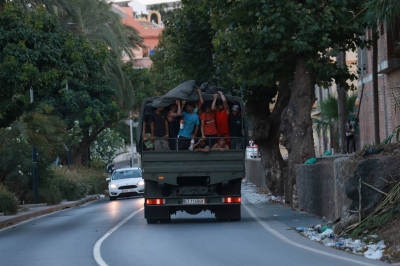
The figures contrast with those of Spain, which brings the number of migrants who entered its territories to more than 50,000 and the number of deaths to 72.
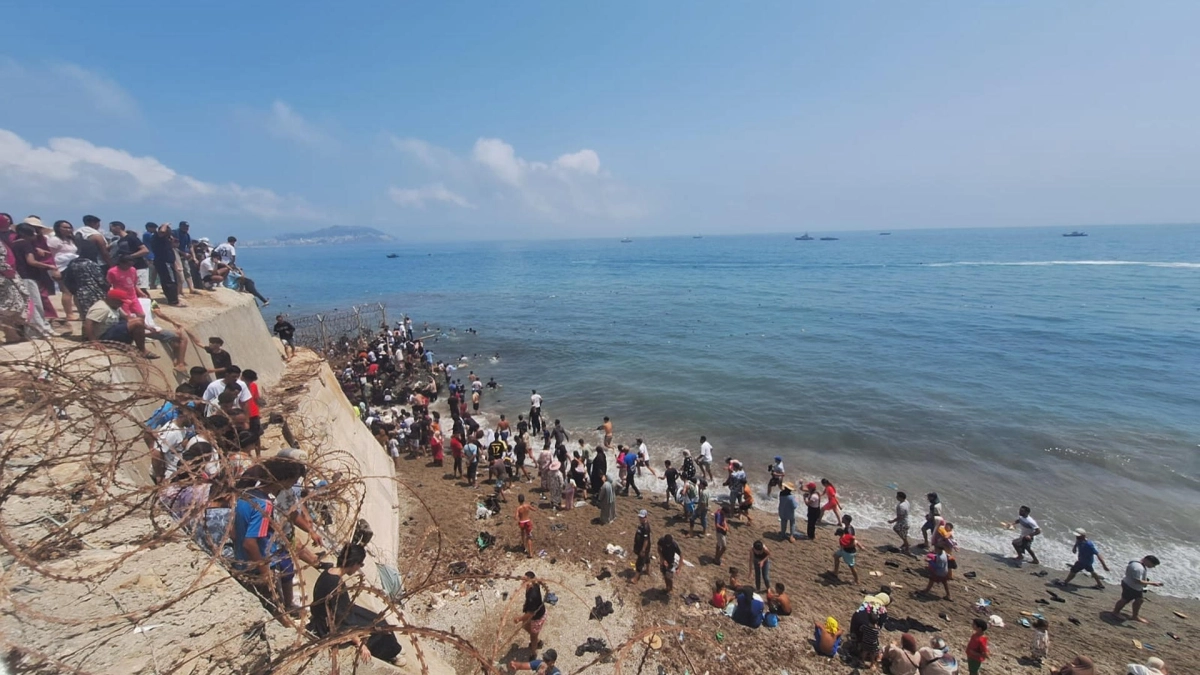
There are already 72 deaths confirmed by the authorities, but the toll could increase. Almost all of those who crossed were returned to Morocco.

The minors were found while search and rescue efforts continued due to the immigration emergency on the Spanish border.

The largest migrant rush into the enclave has caused an international crisis for Spain, with European partners criticising Madrid for its immigration policies.

The sudden arrival of 50,000 people in Ceuta raises questions about the role of Rabat in this migration crisis, while the Shereef kingdom contests the belonging of the two cities to Spain.
Countless young men coming out of the sea, armed soldiers, steel fences. Images from Ceuta that circulated last week show the migration crisis in North Africa that led to the deaths of at least 72 people.
One thousand five hundred in the reception centres, just as many outside among the bodies that the sea returns, including those of crushed children
Pierr Vermeren: “Those desperate young people couldn't get there on their own: for the monarchy, the two exclaves are just the fruit of colonialism”
The Moroccan Ministry of the Interior announced - yesterday, Sunday - that about 40,000 people headed towards the city of Ceuta in attempts at irregular crossing, during events that resulted in the death of 11 people, in Rabat’s first official suspension.
Soldiers round up Moroccans roaming the streets and hiding in poorly-lit areas

MADRID (AP) — Thousands of migrants have streamed into the tiny Spanish territory of Ceuta in North Africa from Morocco, with at least 18 dying in the attempt, prompting Spain to deploy its military to restore the…