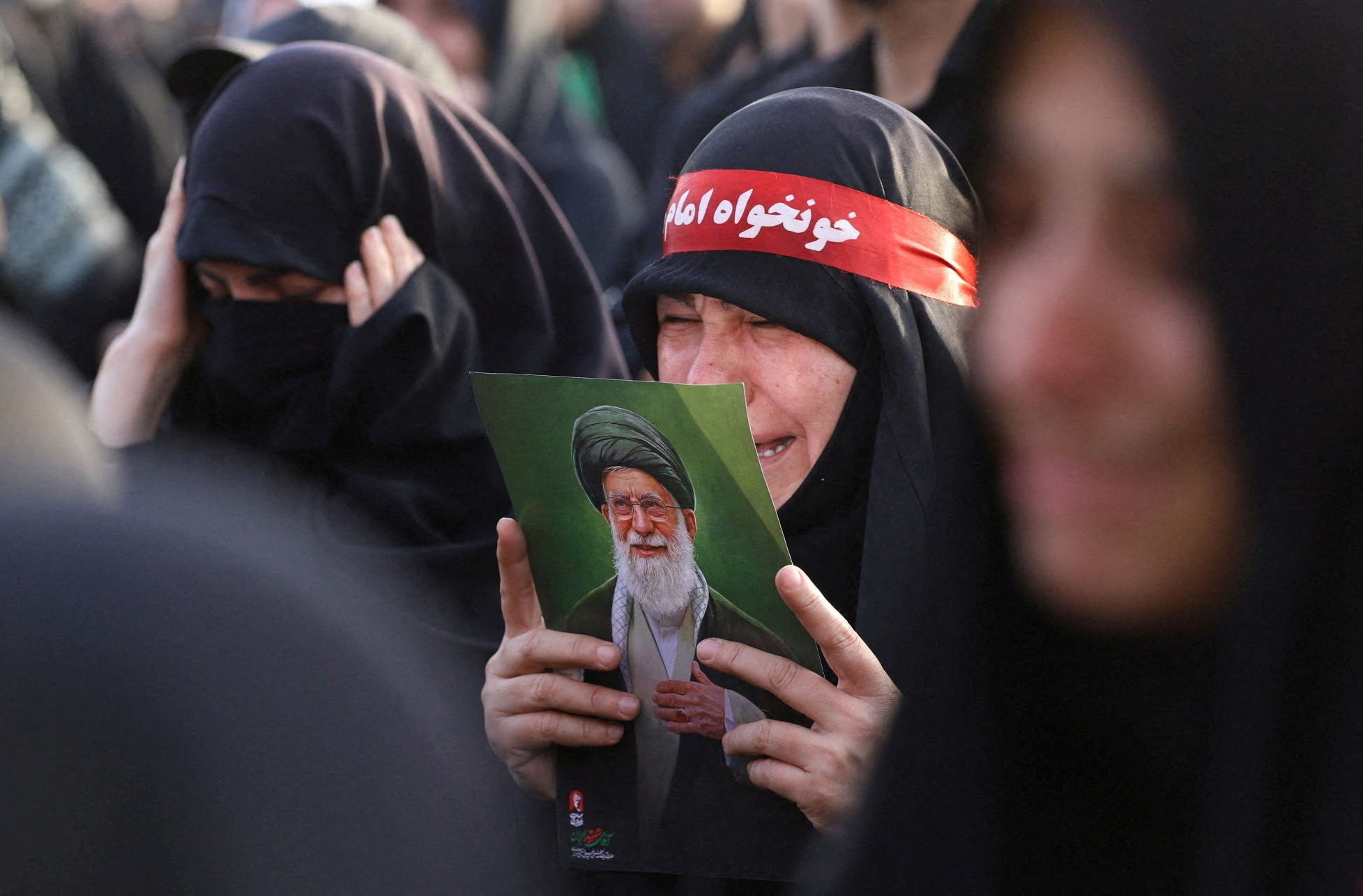
Khamenei’s flag-covered coffin was carried aloft into the shrine of Imam Reza in his home city of Mashhad in eastern Iran as a sea of people waited outside and listened to prayers
How the world covered this
Read the editorial comparison
Prose synthesis of how each outlet framed the story, with side-by-side outlet quotes and divergence notes.
35 articles from 13 sources
01
02
Khamenei’s flag-covered coffin was carried aloft into the shrine of Imam Reza in his home city of Mashhad in eastern Iran as a sea of people waited outside and listened to prayers

03
DUBAI, July 9 (Reuters) - Iran’s slain Supreme Leader Ayatollah Ali Khamenei was buried in the country’s holiest shrine, state media said early on Friday, after huge crowds gathered for his funeral with his son and…
04
Irã registra explosões pelo terceiro dia consecutivo após fim de trégua com os EUA
Several explosions were heard for the third consecutive day in Iran, this Thursday (9), according to the Iranian news agency Mehr. Reports include attacks in the cities of Bushehr, where one of the…
05
Irã enterra aiatolá Ali Khamenei, líder supremo morto por ataques dos EUA e Israel
Iran buried its murdered supreme leader, Ayatollah Ali Khamenei, this Thursday (9), in the country's holiest shrine. Read more (09/07/2026 - 10:10 am)
06
Irã volta a atacar bases americanas no Oriente Médio e acusa EUA de tentar ofuscar funeral de Khamenei
Iran's Revolutionary Guard said on Thursday (9) that it once again attacked US bases in Bahrain, Qatar and Kuwait, three Gulf monarchies allied with Washington. Hours later, explosions were…
07
Regional mediators are racing against time to avoid a new military escalation between Washington and Tehran and save the memorandum of understanding, before seeking to arrange a new round of negotiations between the two sides.
08
Iran's latest attacks show it can easily disrupt shipping, energy markets and draw in Gulf neighbors. DW asks how much leverage Tehran really has over Washington and if its high-risk strategy could backfire.
09
Iran, attacchi incrociati: “Può durare un mese”. Tumulato l’ayatollah Khamenei
The USA: 170 targets also hit near the Bushehr power plant. Witkoff and Kushner negotiate again.
10
Landis: “Spareranno ancora e poi torneranno a discutere”
The US analyst: “This latest dispute arose from the too vague terms of the memorandum of understanding which give rise to misunderstandings and consequent clashes”
11
Guerra in Iran, tutte le news. Wsj: “Teheran ha un nuovo piano per uccidere Trump”
Israel has shared intelligence information with the United States
12
Iran on Friday laid to rest its former supreme leader Ali Khamenei over four months after his killing in an air strike, as two days of US and Iranian attacks raised fears of a return to all-out war. Khamenei’s…

13
China called on the United States and Iran to stick with peace plans after a resumption of missile strikes in the Middle East spurred a jump in oil prices. “Reigniting the conflict does not serve any party’s interests,”…


15
Katz: IDF ‘alert and prepared’ to resume campaign in Iran ‘with even greater force’ The Times of Israel
16
Iran warns against more US military 'adventurism' as FM discusses Hormuz with Oman, Turkey The Times of Israel
17
Iran says it targeted sites in Kuwait, Qatar, Bahrain in response to US strikes The Times of Israel
18
PM, IDF chief stress Israel’s readiness to return to war with Iran amid fresh fighting The Times of Israel
19
'We will kill Trump' banners seen at Khamenei funeral; Iranian president, FM attacked as not hardline enough The Times of Israel
20
覚書は終わり トランプ氏激怒の訳
21
イラン トランプ氏の暗殺を計画か
22
米イラン 攻撃応酬で高まる緊張
23
Trump says the attacks are "retribution for yesterday's bombing of ships by Iran". Iran earlier promised strong retaliation.

24
The United States launched new air strikes against Iran early Thursday, and Tehran responded by targeting Bahrain, Kuwait and Qatar in crossfire that again threatened an interim deal intended to help end the war in the…

25
米軍が追加攻撃完了 イランも報復
26
米大統領 イランとの戦争再開否定
27
米イラン緊張 パキスタン懸念表明
28
米軍がイラン攻撃 商船攻撃に対抗
29
ホルムズ海峡で船舶攻撃 混乱続く
30
Tehran's Health Ministry reported that 14 people were killed and 78 injured

31
Data shows a decline in the number of ships - many carrying oil and gas - going through the waterway after attacks this week.


33
WSJ: Израиль передал США данные о якобы подготовке Ираном покушения на Трампа
This information could lead to a toughening of Washington’s position and increased escalation in the conflict with Tehran, the publication writes.
34
‘People here all seek revenge’: Crowds mass for Khamenei’s burial, banners call to kill Trump The Times of Israel
35
IDF chief says Iran fight 'not over,' jokes that captivity training prepared soliders for leaders' speeches The Times of Israel
AI read
What the coverage agrees on, and where it splits
This view is generated from the clustered articles, so it is best read as a map of coverage rather than a replacement for the source reporting.
Broadly agreed
- All covering sources confirm that Ayatollah Ali Khamenei was buried at the Imam Reza shrine in Mashhad after a large public funeral procession.
- Sources across regions agree that fresh US-Iran military exchanges occurred after the ceasefire memorandum collapsed, with Iran retaliating by striking US bases in Gulf states.
- Multiple sources confirm ship traffic through the Strait of Hormuz declined significantly following the new strikes.
Contested framing
- Times of Israel and Israeli sources frame Iran as an existential aggressor plotting to kill Trump and requiring military readiness; TASS and Russian sources frame the funeral as a demonstration of Iranian popular strength and state legitimacy.
- CNN asks whether the war had a point given Trump's denuclearization claim; Al Jazeera Arabic highlights Iranian domestic opposition to any deal with Washington, suggesting internal fracture rather than unified hostility.
- SCMP and Emirati outlets frame the crisis primarily as an economic and Gulf security problem; Israeli and American sources frame it as a terrorism and nuclear security problem.
Still unclear
The exact terms of the collapsed ceasefire memorandum, the status of Iran's nuclear program following US strikes, and who will consolidate power as Iran's new supreme leader remain publicly unconfirmed.
Notable omissions
People's Daily and Gazeta.uz are entirely absent from coverage of the US-Iran conflict, reflecting their state-aligned editorial priorities; Russian TASS covers the funeral's scale but omits any analysis of Iran's retaliatory capacity or the ceasefire's collapse.
Quality check
Read as 'military exchanges resumed after ceasefire breakdown' rather than as 'war escalates'—the underlying facts are solid but the escalation narrative relies on interpretation.
- Consensus on Khamenei's burial is strong, but 'war escalates' framing depends on interpreting military exchanges as 'escalation' rather than 'retaliation'—linguistic choice matters
- Critical unknown: exact ceasefire terms remain unconfirmed, making it impossible to verify who violated what
- Geographic gap: China and African outlets absent from coverage; TASS omits Iran's retaliatory capacity analysis
- Unknowns about Iran's new supreme leader succession and nuclear program status are significant for understanding conflict trajectory
Review confidence: 72%
Signal strength
5/5
Narrative divergence
13
Sources compared
1
Days in coverage
How each outlet frames this story
Divergence
5/5
Narrative Divergence
How differently the sources covering this story frame it — measured by tone, emphasis, and what each outlet chooses to highlight or omit.
1 — Sources frame the story almost identically
2 — Minor differences in tone or emphasis
3 — Noticeable differences; some outlets highlight what others omit
4 — Stark contrasts; conflicting narratives
5 — Sources tell fundamentally different stories
British
BBC frames the burial as a massive public mourning event and reports a sharp decline in ship traffic through the Strait of Hormuz after new strikes, emphasizing civilian and institutional consequences.
Indian
The Hindu runs a live blog treating the conflict as a West Asia war, covering both Khamenei's burial and fresh fighting simultaneously, framing India's position through a non-aligned strategic autonomy lens with Modi and Albanese calling for restraint.
Brazilian
Folha de S.Paulo emphasizes the human dimension — explosions for a third consecutive day and Iran's burial of Khamenei — framing the US as an aggressor whose aid to Venezuela is dwarfed by oil profits, suggesting moral inconsistency.
Qatari
Al Jazeera Arabic covers Iranian street slogans in Mashhad and Tehran calling leaders 'traitors' for negotiating with Washington, highlighting internal Iranian political fracture over whether to pursue a deal.
Russian
TASS reports Iran's state TV claim that over 40 million people attended Khamenei's farewell — the largest procession ever — framing the funeral as a demonstration of Iranian state strength and popular solidarity.
Israeli
Times of Israel highlights 'We will kill Trump' banners at Khamenei's funeral, IDF chief's warning that the fight is 'not over,' and Israeli intelligence sharing about an alleged new Iranian plot to assassinate Trump, framing Iran as irredeemably hostile.
German
Deutsche Welle asks whether the Strait of Hormuz remains Iran's trump card, using endurance framing — how long can Iran sustain disruptions — rather than military capability analysis.
Singaporean
SCMP analyzes the ceasefire collapse as a revival of global inflation risks, noting China's call for both sides to stick to peace, and framing the conflict through supply-chain and economic vulnerability.
Emirati
The National reports Iran targeted sites in Kuwait, Qatar, and Bahrain in response to US strikes, framing this as a Gulf collective security threat requiring regional strategic response.
Japanese
Yahoo Japan reports US military completed additional attacks with Iran retaliating, Trump denying restarting the war, and rising tensions, framing the conflict primarily through the lens of regional stability affecting Japan.
South African
Daily Maverick republishes a Reuters dispatch on Khamenei's burial with minimal editorial framing, treating it as a straight news relay rather than analytical commentary.
Singaporean
CNA reports Israel shared intelligence about an Iranian plot to kill Trump and that North Korea vowed to boost nuclear buildup in this context, linking regional security threats.
Singaporean
Straits Times reports Israel shared intel about a 'new' Iran plot to kill Trump, framing it through regional security implications.