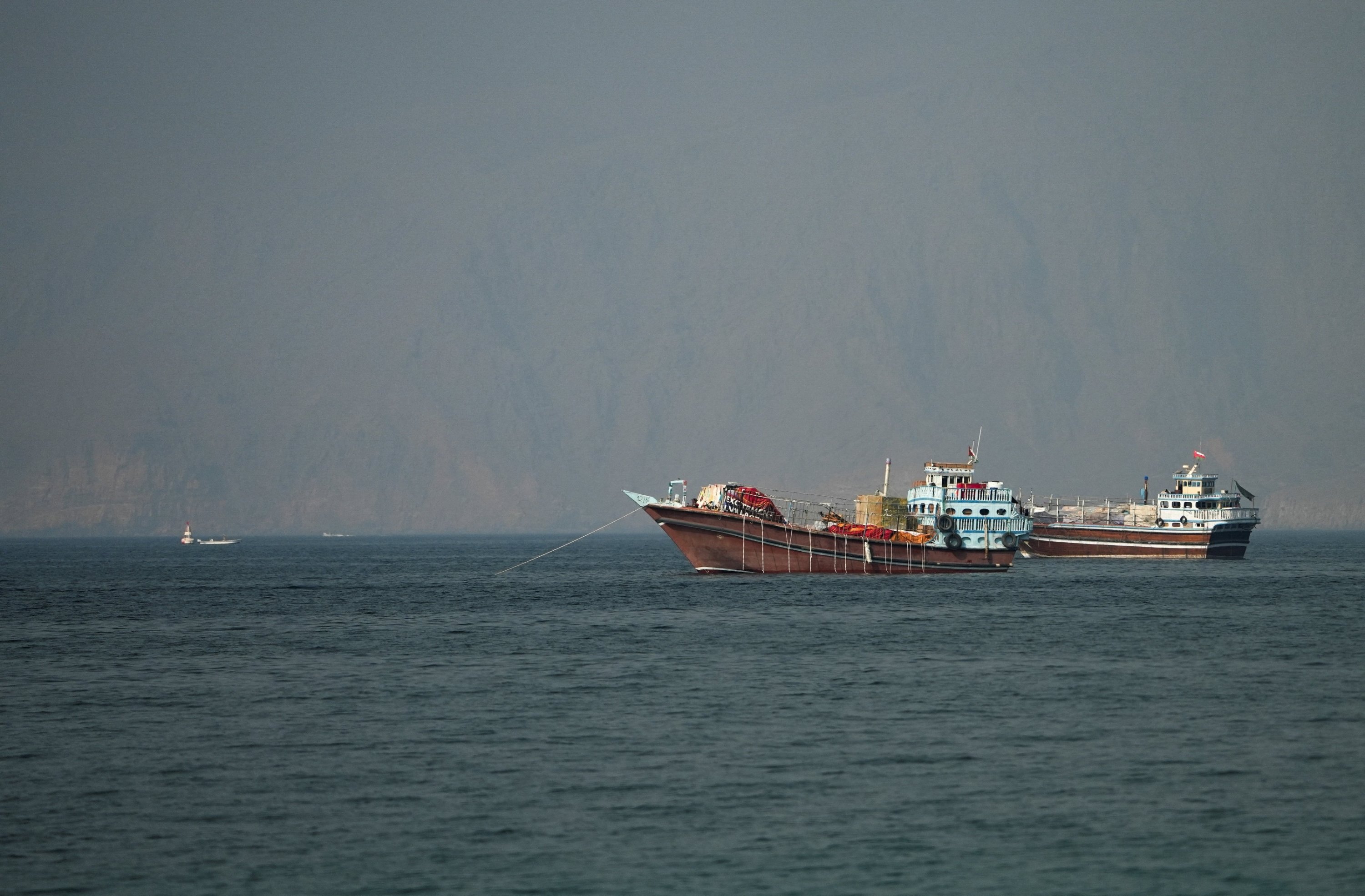
U.S. President Donald Trump on Friday denounced recent drone attacks on vessels transiting the Strait of Hormuz as a 'foolish violation' of the ceasefire with Iran, urging respect...
How the world covered this
Read the editorial comparison
Prose synthesis of how each outlet framed the story, with side-by-side outlet quotes and divergence notes.
31 articles from 15 sources
01
02
The United States carried out military strikes inside Iran on Friday in retaliation for an attack on a commercial vessel transiting the Strait of Hormuz, with U.S. Central Command...
03
US President Donald Trump has accused Iran of carrying out a drone attack on a cargo vessel on Thursday and violating the US-Iran deal. In response, the US military has launched fresh strikes on Iran.
04
Crece el temor de guerra: Guardianes de la Revolución de Irán anuncian ataques contra objetivos de Estados Unidos en la región a pesar de la tregua
This offensive is in retaliation for the new bombings launched by Washington, state television Irib reported.

05
Iran says it has launched retaliatory attacks at US infrastructure in Kuwait and Bahrain after the US said it hit multiple targets across Iran.

06
U.S. President warns of a point where the U.S.

07
The U.S. military says it struck 10 targets in Iran as ceasefire is strained by second day of attacks
08
Iran’s Foreign Ministry did not identify the locations of its “defensive” attacks, which it said were a response to “the barbaric air strikes” by the U.S. on its coastal surveillance facilities, which it said also…

09
Prime Minister Shehbaz Sharif said that Pakistan was navigating conflicts and multi-faceted security challenges, marked by a dangerous combination of international and internal threats

10
The war the U.S. and Israel launched has come to a fragile pause with a preliminary agreement between Washington and Tehran, but it has already diminished America’s presence in the region, prompting Gulf countries to…

11
الكويت تتصدى لهجمات صاروخية وإطلاق صفارات إنذار في البحرين
The Kuwaiti army announced, at dawn on Sunday, that its air defenses responded to missile attacks and enemy drones, while the Bahraini Ministry of Interior announced the sounding of sirens.
12
Iran and the US continued their attacks in the Gulf as each accused the other of violating an interim deal signed less than two weeks ago to end their four-month-old war. Shortly after President Donald Trump warned the…

13
US President Donald Trump said on Saturday that the American military struck Iranian missile and drone storage locations, and coastal radar sites for violating a US-Iran ceasefire agreement. “There may come a point…


17
Iran fires several drones at Bahrain in first tit-for-tat strikes with US since deal signed The Times of Israel
18
Senior Iranian official vows ‘swift and decisive’ response to alleged US violations of deal The Times of Israel
19
Both sides have accused the other of violating the agreement reached two weeks ago.
20
The exchange of fire came after Washington accused Tehran of attacking a cargo ship in the Strait of Hormuz.
21
Arab Gulf states grow uneasy as US-Iran talks on Hormuz's future status drag on.
22
米と湾岸諸国 海峡通航料「拒否」
23
ホルムズ海峡に飛翔体 船舶へ攻撃
24
THE latest exchange of fire between the US and Iran reminds us once more that ceasefires are sustained not by signatures alone but also political restraint. The reported US strikes, following a dispute over Iran’s…
25
• Israeli defence minister warns Iran against ‘undermining’ Lebanon agreement • Hezbollah rejects framework pact, says it should be replaced by Islamabad MoU JERUSALEM / WASHINGTON: Israeli forces carried out drone…
26
Guerra in Iran, le news. Trump: “Teheran ha violato cessate il fuoco”. E gli Usa rispondono. Kuwait e Bahrain sotto attacco
The American president accuses Tehran of violating the ceasefire with an attack against Hormuz maritime traffic. Meanwhile, a new round of negotiations is expected in Doha on July 2, while the agreement between…
27
Javedanfar:“Sono tregue fragili minate dai falchi di Iran e Israele”
The analyst: "The Gulf countries are also dissatisfied, because they remain under fire from the Pasdaran missiles"
28
Droni e missili sul Golfo ma Usa e Iran dialogano. Sale la tensione in Libano
Despite raids against a ship and Bahrain, negotiations continue. Hezbollah rejects the agreement.
29
Les Etats-Unis bombardent à nouveau l’Iran, les gardiens de la révolution disent frapper le Koweït et Bahreïn en représailles
The US military claims to have targeted Iranian strategic infrastructure on Saturday, raising fears of a new regional escalation.
30
В Иране назвали атаки США нарушением договоренностей об урегулировании
The Republic's Foreign Ministry emphasized that Tehran is ready to defend national sovereignty and territorial integrity in accordance with Article 51 of the UN Charter
⚑ 1 language note
"ready to defend national sovereignty and territorial integrity in accordance with Article 51 of the UN Charter" — Iran's framing of potential military action as defensive; TASS amplifies this legitimizing language without editorial distance.
31
The US struck Iran on Friday in response to a drone attack a day earlier on a cargo ship in the Strait of Hormuz, a provocation President Donald Trump said violated the ceasefire between the two countries. US Central…

AI read
What the coverage agrees on, and where it splits
This view is generated from the clustered articles, so it is best read as a map of coverage rather than a replacement for the source reporting.
Broadly agreed
- All covering sources confirm that the US conducted strikes on multiple targets in Iran and that Iran launched retaliatory drone attacks hitting Bahrain and Kuwait.
- Sources across regions confirm both sides are accusing the other of violating the Pakistan-brokered ceasefire deal.
- Multiple sources confirm Trump issued an explicit existential threat warning that Iran 'will no longer exist' if the US escalates further.
Contested framing
- BBC and Times of Israel maintain careful factual distinction between claims and verified violations; TASS frames Iranian responses as defensive sovereign acts without describing them as escalatory.
- The Hindu and Pakistani Dawn frame Pakistan's role as heroic peacemaker; CNN and BBC do not foreground Pakistani agency, instead centring US decision-making.
- SCMP frames the crisis primarily through Iran's economic survival capacity; Daily Sabah frames it through Turkish diplomatic positioning as a stabilising actor.
Still unclear
Whether the interim ceasefire deal has formally collapsed or whether backchannel negotiations are continuing remains unconfirmed across all available summaries.
Notable omissions
People's Daily is entirely absent from coverage of US-Iran strikes; Russian TASS covers Iranian retaliatory framing through a zero-sum geopolitical lens without acknowledging the ceasefire deal's Pakistani origins.
Quality check
Read with caution: whether ceasefire has formally collapsed or negotiations continue remains unconfirmed; framing divergence on escalation vs. defense is substantial.
- Critical unknown: formal ceasefire status unconfirmed across all sources
- Trump's 'will no longer exist' quote requires verification as direct threat vs. rhetorical language
- People's Daily absence limits non-Western perspective on US strike justification
- TASS framing asymmetry: covers Iranian response as 'defensive' without acknowledging escalation pattern
Review confidence: 65%
Signal strength
5/5
Narrative divergence
15
Sources compared
2
Days in coverage
→ stable
How each outlet frames this story
Divergence
5/5
Narrative Divergence
How differently the sources covering this story frame it — measured by tone, emphasis, and what each outlet chooses to highlight or omit.
1 — Sources frame the story almost identically
2 — Minor differences in tone or emphasis
3 — Noticeable differences; some outlets highlight what others omit
4 — Stark contrasts; conflicting narratives
5 — Sources tell fundamentally different stories
British
BBC emphasises the mutual accusations of ceasefire violation, documenting both US strikes on ten Iranian targets and Iran's retaliatory drone attacks on Kuwait and Bahrain, maintaining careful distinction between claims and verified facts.
French
Le Monde foregrounds expert institutional interpretation, noting US strikes on Iranian strategic infrastructure while raising fears of new regional escalation, analysed through elite decision-making competence lens.
Indian
The Hindu maintains strategic autonomy framing, covering Trump's warnings and US strikes on multiple targets while separately positioning Pakistan as a 'peacemaker' having brokered the original deal.
Qatari
Al Jazeera Arabic covers Kuwait's air defence response to missile attacks and Bahrain sirens, centering Gulf civilian and state vulnerability rather than US or Iranian strategic framing.
German
Deutsche Welle frames the US strikes through institutional sustainability and energy infrastructure shock, emphasising endurance framing and Germany's economic exposure to Hormuz disruption.
Turkish
Daily Sabah foregrounds Turkish diplomatic agency, with FM Fidan warning against Israeli provocations derailing US-Iran diplomacy and Trump condemning Hormuz drone attacks as ceasefire violations.
Israeli
Times of Israel reports Iranian officials vowing 'swift and decisive' response to alleged US violations, and separately covers US consideration of relocating Gulf bases damaged by Iran to Israel.
Emirati
The National centres Gulf state vulnerability, reporting Bahrain and Kuwait targeted after US bombs Iran, framing regional security through collective autonomy rather than US or Iranian perspectives.
Japanese
Yahoo Japan covers the airstrikes and Iran's denunciation of the deal as a memorandum violation, with earlier reporting on Hormuz shipping attacks framing events through energy security and sea-lane disruption.
Singaporean
Straits Times and CNA both foreground the mutual accusations of peace deal violation, with the Straits Times noting Arab Gulf states' growing unease over Hormuz's future status as US-Iran talks drag on.
Chinese
SCMP analyses whether Iran can survive the aftermath of three months of war with the US and Israel, framing the ceasefire strain through structural institutional vulnerability and economic collapse risk.
Italian
La Repubblica reports drones and missiles over the Gulf while noting US-Iran negotiations continue, with an analyst describing the truces as fragile and undermined by hawks on both sides.
Pakistani
Dawn's editorial frames the exchange as a reminder that ceasefires require more than signatures, with PM Shehbaz Sharif separately credited for Pakistan's role as peacemaker in brokering the original deal.
Colombian
El Tiempo covers the escalation and Iranian Revolutionary Guards announcing attacks on US targets despite the truce, framing through fears of war growing in the region.