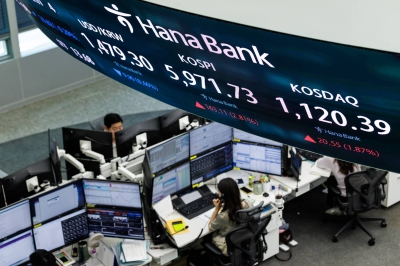
Markets in South Korea and Japan slid after a rally in tech stocks in recent weeks.
How the world covered this
Read the editorial comparison
Prose synthesis of how each outlet framed the story, with side-by-side outlet quotes and divergence notes.
7 articles from 5 sources
01


03
The South Korean benchmark Kospi suffered the worst day of the year as chip stocks tumbled, mirroring a rout in US semiconductor stocks on Wall Street. Soon after opening 1.38 percent lower at 8,048.09, selling…

04
The nation's government bonds have lost 7.5% this year in local-currency terms, the worst performance among 44 markets.

06
The agreement, which comes as memory chipmakers have been straining to keep up with demand, would enable supply to keep pace with Nvidia's plans.
07
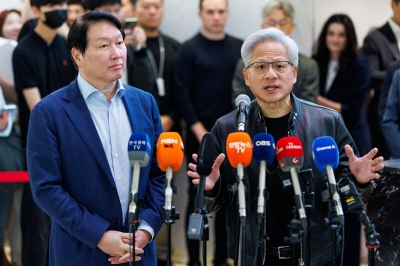
Hyundai Motor Group Executive Chair Chung Euisun and Nvidia CEO Jensen Huang met in Seoul on Monday, reportedly discussing their collaboration to incorporate physical AI in deep tech sectors spanning autonomous driving,…

AI read
What the coverage agrees on, and where it splits
This view is generated from the clustered articles, so it is best read as a map of coverage rather than a replacement for the source reporting.
Broadly agreed
- All covering sources confirm significant Asian tech stock declines on June 8, with South Korea's Kospi suffering its worst day of 2026.
- Sources agree the correction follows a prolonged AI-led rally and was exacerbated by renewed Middle East hostilities raising energy costs.
Contested framing
- The National frames the selloff primarily as an 'AI bubble' correction; BBC frames it as a direct consequence of Middle East attacks; Korea Herald frames it as a US-originated chip rout spreading to Asian markets.
- Korea Herald simultaneously reports Nvidia-SK Group deals advancing, creating a divergence between market sentiment framing and corporate partnership narrative.
Still unclear
Whether the correction represents a temporary sentiment shift or the beginning of a sustained AI valuation deflation is not confirmed by any available source.
Notable omissions
No source provides data on specific earnings or forward guidance from major AI chip companies that might explain the severity of the correction beyond macro factors.
Quality check
Asian tech declines well-confirmed; causes attributed to either AI valuation reset or geopolitical shock remain contested.
- Divergent framing on cause (AI bubble correction vs. Middle East shock) without empirical arbitration
- Korea Herald simultaneously reports market crash and advancing Nvidia-SK Group deals—apparent contradiction not resolved
- No earnings or forward guidance data from AI chip companies; causality inferred from macro factors only
Review confidence: 80%
Signal strength
2/5
Narrative divergence
5
Sources compared
1
Days in coverage
How each outlet frames this story
Divergence
2/5
Narrative Divergence
How differently the sources covering this story frame it — measured by tone, emphasis, and what each outlet chooses to highlight or omit.
1 — Sources frame the story almost identically
2 — Minor differences in tone or emphasis
3 — Noticeable differences; some outlets highlight what others omit
4 — Stark contrasts; conflicting narratives
5 — Sources tell fundamentally different stories
British
BBC reports markets in South Korea and Japan slid after the AI tech stock rally, linking the reversal to renewed Middle East attacks and rising energy costs.
South Korean
Korea Herald frames the Kospi's worst day of the year as part of a global chip rout spreading from US semiconductor markets, emphasising Samsung and SK Hynix exposure.
Japanese
Japan Times reports South Korea's government bonds lost 7.5% year-to-date, the worst among 44 markets, framing AI sector pressure as a sovereign bond market stress event.
Singaporean
CNA headlines 'Seoul leads steep Asian losses as AI-led tech rally hits wall', framing it as a structural correction in the AI investment cycle.
Emirati
The National frames oil prices soaring over Iran war and stocks falling on 'AI bubble concerns' together, linking geopolitical and tech market risks as mutually reinforcing.
South Korean
Korea Herald separately reports Nvidia and Hyundai deepening ties in physical AI, and Nvidia-SK Group deals advancing — positioning Korean tech firms as still embedded in AI growth despite the stock correction.