The Korean won weakened past the 1,560-per-dollar mark during overnight trading on Saturday for the first time in more than 17 years, sinking to its weakest level since the global financial crisis in 2009. The won was…
How the world covered this
Read the editorial comparison
Prose synthesis of how each outlet framed the story, with side-by-side outlet quotes and divergence notes.
8 articles from 2 sources
01

02
Heavy foreign selling rattled South Korean markets on Friday, dragging the benchmark Kospi down more than 5 percent and driving the won to a 17-year low against the greenback. The Kospi closed down 5.54 percent at…

03
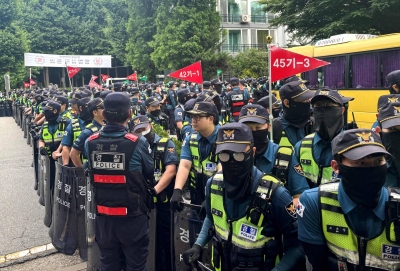
A protest over voting disruptions caused by a ballot paper shortage during the June 3 local elections continued into Saturday. Protesters remained gathered outside the Handball Gymnasium at Olympic Park in Songpa-gu,…

04
Wednesday's election was the first nationwide vote since President Lee Jae Myung took office.
05
Rho Tae-ak, chair of the National Election Commission, offered to resign from the post in the aftermath of the election delays due to ballot shortages at 22 polling stations in the Greater Seoul region. The incident,…

06
The National Assembly on Friday elected six-term liberal lawmaker Rep. Cho Jeong-sik as its new speaker of the country's unicameral legislature.

07
South Korea's main opposition People Power Party is facing mounting internal pressure for leadership change after Wednesday's local elections, as calls grow for Chair Rep. Jang Dong-hyeok to take…

08
South Korea's political landscape is entering a new phase after this week's local elections: President Lee Jae Myung is preparing a Cabinet reshuffle and both major parties are bracing for leadership battles.…

AI read
What the coverage agrees on, and where it splits
This view is generated from the clustered articles, so it is best read as a map of coverage rather than a replacement for the source reporting.
Broadly agreed
- All Korea Herald articles confirm the Korean won breached 1,560 per dollar during overnight trading on June 6, a 17-year low.
- Korea Herald confirms protests over ballot shortages continued into June 6 and the NEC chair offered to resign.
Contested framing
- Korea Herald attributes market decline to both global factors (Iran war, US jobs data) and domestic political uncertainty simultaneously, without clearly weighting which is more significant—this multi-causality framing is not tested by other outlets which are largely absent.
Still unclear
Whether the NEC chair's resignation offer will be accepted, and whether an independent investigation into the ballot shortage will be launched, is not confirmed in available summaries.
Notable omissions
International outlets are largely silent on the South Korean institutional double-crisis, treating it as a purely domestic story despite the won's move to a 17-year low having regional currency contagion implications.
Quality check
Read with economic caution: currency weakness and market decline are confirmed, but causal drivers and systemic implications require deeper analysis.
- Multi-causality attribution (Iran war + US jobs data + political uncertainty) is noted but unweighted—article should specify which caused how much.
- Won's 17-year-low significance overstated without context of currency volatility or regional contagion data.
- Election commission chair resignation status unclear—was resignation accepted or still pending?
- Kospi 5% decline cause cannot be isolated to any single factor based on summaries provided.
Review confidence: 65%
Signal strength
2/5
Narrative divergence
2
Sources compared
1
Days in coverage
How each outlet frames this story
Divergence
2/5
Narrative Divergence
How differently the sources covering this story frame it — measured by tone, emphasis, and what each outlet chooses to highlight or omit.
1 — Sources frame the story almost identically
2 — Minor differences in tone or emphasis
3 — Noticeable differences; some outlets highlight what others omit
4 — Stark contrasts; conflicting narratives
5 — Sources tell fundamentally different stories
South Korean
Korea Herald covers both the currency collapse and the election disruptions as parallel institutional credibility failures, with the NEC chair offering to resign over the ballot fiasco and foreign selling accelerating market decline simultaneously—consistent with its governance accountability lens.