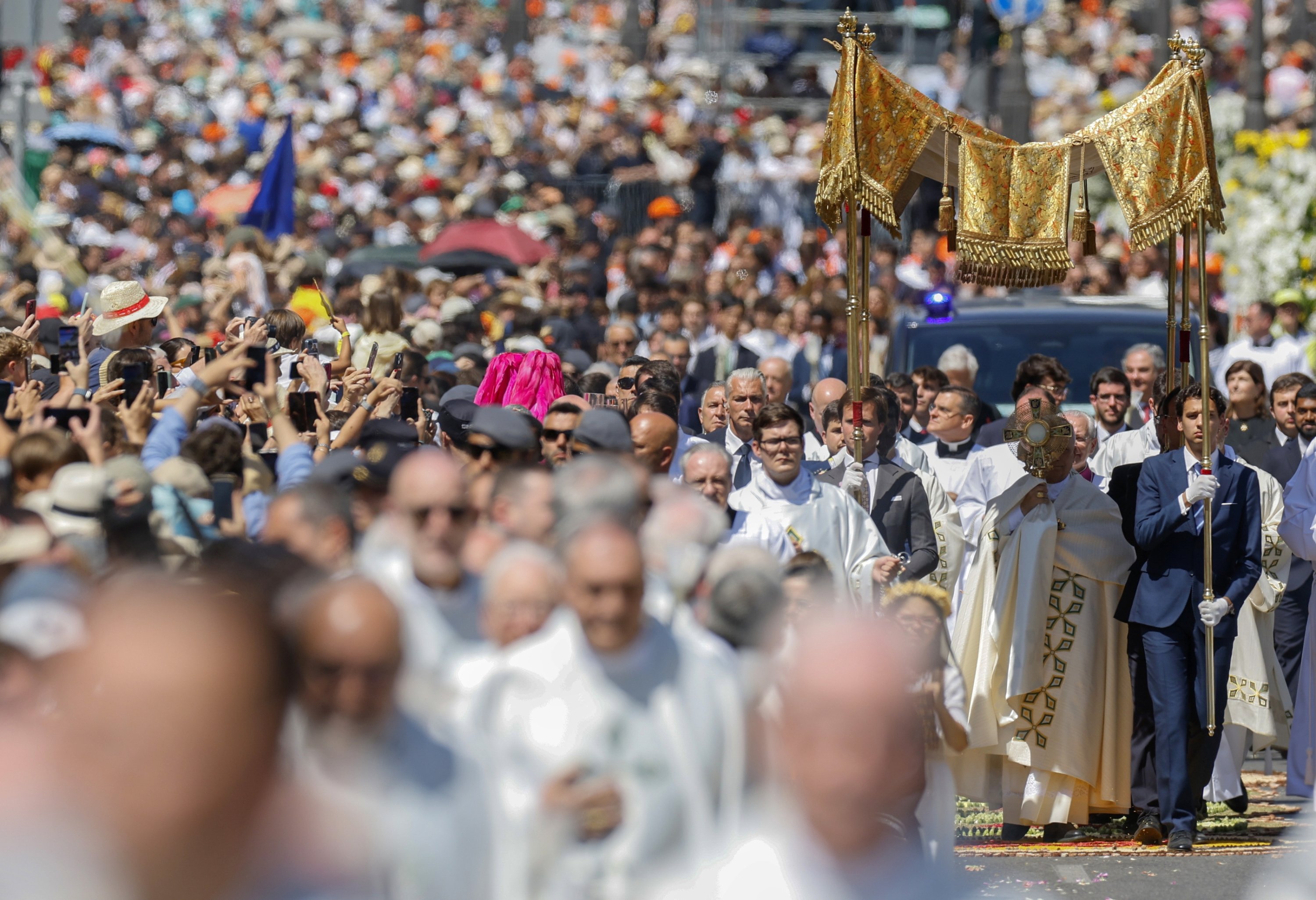
Huge crowds welcomed Pope Leo XIV to Madrid on Sunday. The pontiff is on a five-day trip around Spain during which he is meeting vulnerable people such as migrants and the homeless, and promoting "genuine human values."
How the world covered this
Read the editorial comparison
Prose synthesis of how each outlet framed the story, with side-by-side outlet quotes and divergence notes.
5 articles from 4 sources
01
02
Papa diz que Deus está ao lado dos pobres em missa com 1,2 milhão em Madri
More than 1.2 million people filled the streets of Madrid this Sunday (7) for a mass for Pope Leo 14. At the ceremony, the supreme pontiff called for a renewal of the Catholic faith in Spain and said that God "is on the side of…
03
Over 1.2 million people gathered in Madrid Sunday for a Mass celebrated by Pope Leo XIV, who called for a renewal of the Catholic faith in Spain, during one of the largest religiou...
04
Casos de abuso sexual ainda são ferida aberta, diz papa Leão 14 ao chegar à Espanha
Pope Leo the 14th arrived in Madrid this Saturday (6), the first stage of a seven-day visit to Spain during which he is expected to discuss migration issues and meet with victims of sexual violence in the Catholic Church. "You…
05
More than one million people filled the streets of Madrid on Sunday for a mass by Pope Leo at which he called for a renewal of the Catholic faith in Spain. The mass came on day two of Leo’s seven-day visit to Spain, a…

AI read
What the coverage agrees on, and where it splits
This view is generated from the clustered articles, so it is best read as a map of coverage rather than a replacement for the source reporting.
Broadly agreed
- All covering sources confirm over 1.2 million people attended Pope Leo XIV's Madrid mass on June 7.
- Sources confirm the pope called for a renewal of Catholic faith and spoke to the most vulnerable sectors of society.
Contested framing
- Folha de S.Paulo foregrounds the pope's acknowledgement of sexual abuse wounds as a central element of his Spain visit; other sources focus primarily on the crowd size and faith renewal message.
Still unclear
The specific policy or institutional commitments the pope made regarding the Catholic Church's sexual abuse accountability mechanisms during the visit are not detailed in available summaries.
Notable omissions
No source addresses Spanish domestic politics around the papal visit or any protests or counter-demonstrations by secular or victims' advocacy groups.
Quality check
Attendance and general messaging confirmed; specific institutional commitments and domestic political context missing.
- Crowd figure (1.2M) well-sourced but no independent verification methodology provided
- Sexual abuse accountability mechanism commitments beyond rhetorical acknowledgment not detailed
- No coverage of domestic Spanish political reactions, protests, or victims' advocacy group responses
Review confidence: 85%
Signal strength
1/5
Narrative divergence
4
Sources compared
1
Days in coverage
How each outlet frames this story
Divergence
1/5
Narrative Divergence
How differently the sources covering this story frame it — measured by tone, emphasis, and what each outlet chooses to highlight or omit.
1 — Sources frame the story almost identically
2 — Minor differences in tone or emphasis
3 — Noticeable differences; some outlets highlight what others omit
4 — Stark contrasts; conflicting narratives
5 — Sources tell fundamentally different stories
German
Deutsche Welle reports more than a million people lining Madrid streets for Pope Leo XIV, framing it as a major religious and public diplomacy event.
Brazilian
Folha de S.Paulo covers the pope declaring 'God is on the side of the poor' at the mass, integrating its characteristic humanistic consequence framing around papal messaging.
Turkish
Daily Sabah reports 1.2 million Catholic faithful gathered in Madrid, treating it as a major religious event without critical institutional framing.
Chinese
SCMP reports over one million people at the Madrid mass, noting the pope called for renewal of Catholic faith, treating it as a global religious news item.
Brazilian
Folha de S.Paulo separately reports the pope's acknowledgement upon arriving in Spain that sexual abuse 'cases are still open wounds', connecting institutional church accountability to the visit.