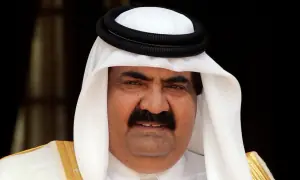
He took power in 1996 after staging a bloodless coup against his father, and went on to transform Qatar into the gas-rich power it is today.
How the world covered this
Read the editorial comparison
Prose synthesis of how each outlet framed the story, with side-by-side outlet quotes and divergence notes.
9 articles from 7 sources
01

02
Hamad Ben Khalifa Al Thani, ancien émir du Qatar, est mort à l’âge de 72 ans
The former sovereign, who deposed his father, Sheikh Khalifa, during a palace revolution in 1995, had inherited a small, marginal emirate with almost empty coffers, which he made into a major player in…
03
India declares one-day national mourning on the demise of His Highness Sheikh Hamad bin Khalifa Al-Thani, Father Amir of the State of Qatar

04
صحف أمريكية وبريطانية: مؤسس قطر الحديثة وإرث من الدبلوماسية والقوة الناعمة
Qatar invited Sheikh Hamad bin Khalifa Al Thani, the architect of its modern renaissance, who transformed it into a global economic, diplomatic and media power, based on investing gas wealth, building soft power, and consolidating its role as an influential mediator.
05
حمد بن خليفة.. "المعتصم" الذي حمى الأنفس والأعراض في دارفور
In the Nile River state in the Darfur region, "companions" It is fully decorated for people, pleasing the onlookers with its yellow walls and its luxurious mosque, which is topped with a green dome and a minaret that reaches into the sky.
06
The former Emir led Qatar's transformation from a small Gulf state into one of the world's wealthiest nations and oversaw the launch of Al Jazeera and the country's World Cup bid.
07
Qatar’s former ruler Sheikh Hamad dies at 74; created Al Jazeera, funded Hamas’s Gaza The Times of Israel
08
Prime Minister Shehbaz Sharif on Monday headed to Qatar on a one-day visit to offer condolences at the passing of former emir Sheikh Hamad bin Khalifa Al Thani. In a post on the social media platform X, the Prime…

09
Qatar’s government on Sunday announced the death of former leader Sheikh Hamad bin Khalifa Al Thani, who led the country from 1995 to 2013. He was 74, according to a government website.
AI read
What the coverage agrees on, and where it splits
This view is generated from the clustered articles, so it is best read as a map of coverage rather than a replacement for the source reporting.
Broadly agreed
- All covering sources confirm Sheikh Hamad died at 74 and was the architect of Qatar's modern transformation from a small Gulf state into a global diplomatic and media power.
- Sources agree he came to power in 1995-1996 via a bloodless coup against his father.
Contested framing
- Times of Israel frames his legacy as founding Al Jazeera and funding Hamas; Al Jazeera Arabic frames him as a defender of lives in Darfur with a legacy of diplomacy and soft power — diametrically opposed characterisations of the same figure.
- BBC and Le Monde frame his palace coup as a political transition fact; Al Jazeera Arabic's framing emphasises his diplomatic and humanitarian legacy without mentioning the coup.
Still unclear
The implications of his death for Qatar's ongoing mediation role in Gaza ceasefire negotiations and its relationships with Hamas are not addressed in available summaries.
Notable omissions
Qatar's funding relationships with various armed groups — acknowledged by Times of Israel — are entirely absent from Qatari, Pakistani, and Indian coverage.
Quality check
Death and Qatar transformation confirmed; his funding relationships and political legacy are disputed across outlets and partially suppressed.
- Fundamental source contradiction unresolved: Times of Israel frames as 'funded Hamas'; Al Jazeera Arabic presents humanitarian legacy without mention — diametrically opposed characterizations require reader awareness this is contested
- Age discrepancy: Le Monde reports 72; most others report 74 — minor but unresolved
- Coup framing: BBC/Le Monde factual; Al Jazeera Arabic omits coup entirely — this is significant editorial choice not flagged to readers
- Unknowns appropriately flagged: Gaza mediation implications and Hamas funding relationships are crucial context entirely absent from summaries
Review confidence: 65%
Signal strength
3/5
Narrative divergence
7
Sources compared
1
Days in coverage
How each outlet frames this story
Divergence
3/5
Narrative Divergence
How differently the sources covering this story frame it — measured by tone, emphasis, and what each outlet chooses to highlight or omit.
1 — Sources frame the story almost identically
2 — Minor differences in tone or emphasis
3 — Noticeable differences; some outlets highlight what others omit
4 — Stark contrasts; conflicting narratives
5 — Sources tell fundamentally different stories
British
BBC frames Sheikh Hamad's legacy as transforming Qatar into a 'gas-rich power', noting he came to power via a bloodless coup against his own father in 1996.
French
Le Monde covers his death with elite institutional analysis, framing him as a former sovereign who had inherited a 'small, marginal' state and converted it into a global player.
Indian
The Hindu notes India declared one-day national mourning on his demise, reflecting the depth of India-Qatar relations.
German
Deutsche Welle focuses on Qatar's transformation under his leadership from a small Gulf state to one of the world's wealthiest nations.
Qatari
Al Jazeera Arabic covers his death through an intimate cultural lens, with articles describing his legacy in Darfur diplomacy and framing him as 'Al-Mu'tasim who protected lives and honour'.
Israeli
Times of Israel headlines his death by noting he 'created Al Jazeera, funded Hamas's Gaza' — a distinctly critical framing absent from other outlets.
Pakistani
Dawn reports PM Shehbaz departing for Qatar to offer condolences, and notes Pakistan will observe a day of mourning — reflecting Pakistan-Qatar diplomatic ties.