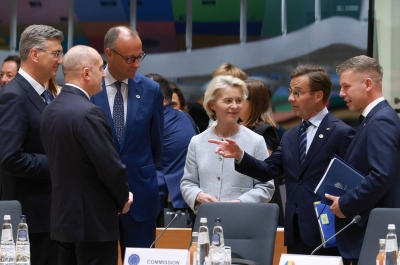
Ukraine : les Européens saluent un « moment spécial » en présence de Volodymyr Zelensky
The Twenty-Seven applauded, Thursday evening, a favorable situation in kyiv and agreed to extend the sanctions against Russia. Without success, the Ukrainian president pleaded for an acceleration of…
European Union leaders agreed to extend sanctions against Russia for 12 months. Meeting in Brussels, the leaders are also set to address the bloc's next long-term budget and global economic challenges.
The United Arab Emirates (UAE) has announced a social media ban for all children under 15. Platforms have one year to review and remove under-age accounts or face stiff penalties.
The European Union has taken tentative steps to establish direct communication with Moscow as officials seek to ensure the bloc has a seat at the table in any future negotiations a...
The French president's efforts have often failed to yield lasting strategic gains, though his vision of European Union "strategic autonomy" is gaining traction.
Politico: большинство стран ЕС поддержали создание центров приема мигрантов вне блока
More than half of the 27 EU member states have signed a corresponding letter calling for
AI read
What the coverage agrees on, and where it splits
This view is generated from the clustered articles, so it is best read as a map of coverage rather than a replacement for the source reporting.
Broadly agreed
All covering sources confirm the EU unanimously extended sanctions against Russia for 12 more months at the Brussels summit.
Sources confirm the EU leaders face sharp disagreements over the next seven-year budget framework's revenue sources.
Contested framing
Le Monde frames the summit primarily as a moment of solidarity with Ukraine; TASS frames it primarily through EU migration policy divisions, omitting Ukraine-focused outcomes.
La Repubblica frames Italian-Spanish tensions as a bilateral axis issue; Straits Times frames budget disagreements as a structural contributor-recipient divide.
Still unclear
What specific new revenue sources the EU will ultimately adopt for its next budget and whether Kyiv's EU accession negotiations will advance meaningfully remain unresolved.
Notable omissions
No outlet covers the specific content of the EU's plans to 'eventually complement' its toolbox regarding China trade imbalances, mentioned only obliquely in Japan Times coverage of EU-China relations.
Quality check
Sanctions extension confirmed; budget resolution remains open with significant internal divisions—this represents genuine policy uncertainty, not just reporting divergence.
Sanctions extension is straightforward consensus; budget disputes are real but lack specific revenue proposals in summaries
Le Monde Ukraine focus vs TASS migration focus represents outlet bias rather than factual disagreement
EU-China trade toolbox mentioned only obliquely in Japan Times; no outlet details specific measures
Kyiv accession timeline and prospects entirely unaddressed in available summaries
Review confidence: 70%
Signal strength
2/5Narrative divergence
7Sources compared
1Days in coverage
How each outlet frames this story
Divergence2/5
Narrative Divergence
How differently the sources covering this story frame it — measured by tone, emphasis, and what each outlet chooses to highlight or omit.
1 — Sources frame the story almost identically
2 — Minor differences in tone or emphasis
3 — Noticeable differences; some outlets highlight what others omit
4 — Stark contrasts; conflicting narratives
5 — Sources tell fundamentally different stories
French
Le Monde covers Zelensky's presence at the European Council, applause from the Twenty-Seven, and unanimous condemnation of Moscow attacks on UNESCO sites, framing it as a 'special moment' for European solidarity.
German
Deutsche Welle reports EU leaders discussed Ukraine and global issues with Russia sanctions extended, treating it through institutional sustainability and de-escalatory framing.
Singaporean
Straits Times covers the EU budget summit clash and search for new revenue sources, focusing on net contributors' and beneficiaries' sharp criticism of initial proposals through pragmatic supply-chain consequence framing.
Italian
La Repubblica covers Meloni's tension with Sánchez over EU envoy positioning and budget cuts, framing Italian positioning as defending sovereignty against Nordic-Russian negotiation tracks.
Russian
TASS reports most EU countries supported creating migrant reception centres outside the bloc, selectively covering EU division over migration rather than the Ukraine-focused solidarity outcomes of the summit.
Copied!
Related coverage
More topic clusters connected by category, source overlap, or narrative signal.