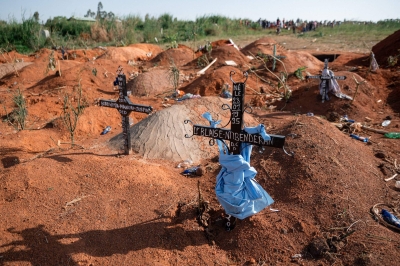
There are glimpses of happiness in the Democratic Republic of Congo's fight against the virus that has killed more than 170.
How the world covered this
Read the editorial comparison
Prose synthesis of how each outlet framed the story, with side-by-side outlet quotes and divergence notes.
3 articles from 3 sources
01

02
The outbreak, already the third largest Ebola epidemic on record and the biggest caused by the Bundibugyo strain, has spread across eastern Congo and into neighboring Uganda.
03
DRC’s National Institute of Public Health reported 808 confirmed cases and 192 deaths on June 15.
AI read
What the coverage agrees on, and where it splits
This view is generated from the clustered articles, so it is best read as a map of coverage rather than a replacement for the source reporting.
Broadly agreed
- All three covering sources confirm 808 confirmed cases and 192 deaths as of June 15, 2026.
- Multiple sources confirm this is the third-largest Ebola epidemic on record and the biggest caused by the Bundibugyo strain.
Contested framing
- BBC foregrounds the human dimension and emotional experience of those affected; Japan Times and Straits Times report primarily in epidemiological terms without humanising narrative — a consistent divergence between public broadcaster and business-focused outlet framing.
Still unclear
Aid groups warn the outbreak may be larger than reported, suggesting significant undercounting, but the actual scale remains unverified.
Notable omissions
No African outlet in the monitored set covers the DRC Ebola outbreak despite it occurring on the African continent, and no article addresses international funding for the response or WHO emergency status declarations.
Quality check
Confirmed cases are 808; actual scale may be substantially larger based on aid group warnings.
- Aid groups warn outbreak may be significantly larger than reported; actual scale remains unverified.
- Critical omission: No African outlet coverage; no article addresses WHO emergency status or international funding.
- Framing divergence (human narrative vs. epidemiological) reflects outlet mission differences, not analytical failure.
- Third-largest epidemic status is confirmed; Bundibugyo strain particularity is noted.
Review confidence: 80%
Signal strength
2/5
Narrative divergence
3
Sources compared
1
Days in coverage
How each outlet frames this story
Divergence
2/5
Narrative Divergence
How differently the sources covering this story frame it — measured by tone, emphasis, and what each outlet chooses to highlight or omit.
1 — Sources frame the story almost identically
2 — Minor differences in tone or emphasis
3 — Noticeable differences; some outlets highlight what others omit
4 — Stark contrasts; conflicting narratives
5 — Sources tell fundamentally different stories
British
BBC sends a correspondent to the 'epicentre' of the outbreak, reporting on glimpses of happiness amid death and the human cost of fighting the virus in remote DRC.
Japanese
Japan Times provides a factual epidemiological update confirming 808 confirmed cases and 192 deaths as of June 15, and notes aid groups warn the outbreak may be larger than reported.
Singaporean
Straits Times confirms the outbreak figures and spread, reporting 808 confirmed cases and 192 deaths, with the Bundibugyo strain distinction noted.