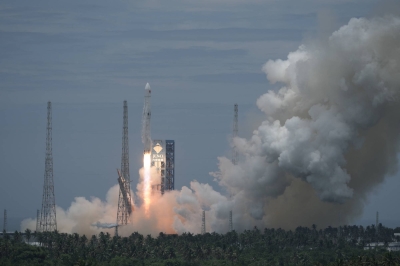
Long March 10B rocket launch marked China’s first successful controlled recovery of a carrier rocket’s booster
How the world covered this
Read the editorial comparison
Prose synthesis of how each outlet framed the story, with side-by-side outlet quotes and divergence notes.
5 articles from 5 sources
01

02
China has joined the small group of space powers that can now recover an orbital-class booster rocket. Developers of the landing method turned to a striking alternative to that used by existing players such as SpaceX.
03
The test marks China's first successful retrieval of an orbital-class rocket, as Beijing hopes to break U.S. dominance in the reusable technology.
04
China on Friday successfully tested an experimental rocket retrieval system using a net attached to a sea platform, state media reported, in the hope of breaking US dominance in reusable rockets. The Long March 10B…
05
中国 ヘリウム輸出を一時禁止
AI read
What the coverage agrees on, and where it splits
This view is generated from the clustered articles, so it is best read as a map of coverage rather than a replacement for the source reporting.
Broadly agreed
- All covering sources confirm China successfully conducted a sea-based rocket booster recovery test for the first time.
- Multiple outlets confirm this marks a significant step toward Chinese reusable launch capability at orbital scale.
Contested framing
- Deutsche Welle and Japan Times frame the achievement explicitly as a challenge to US/SpaceX dominance; The Hindu and Dawn report it as a technological milestone without competitive strategic framing.
- Yahoo Japan covers the helium export ban as a supply chain disruption event; no other outlet connects the two Chinese tech stories into a unified strategic technology assertion.
Still unclear
The duration of China's helium export ban and the specific domestic policy rationale behind it are not confirmed in available summaries.
Notable omissions
No outlet addresses the implications of China's rocket recovery for commercial launch pricing competition or the potential military applications of the sea-based recovery platform.
Quality check
Rocket test success is confirmed; strategic implications and helium ban rationale are incompletely explored.
- Sea-based rocket booster recovery test is factually confirmed across all sources.
- Characterization as 'first successful' and 'challenge to US dominance' is consistently reported but competitive framing is analytical, not factual.
- Helium export ban is separately documented by Yahoo Japan but no outlet connects the two into unified strategic technology narrative.
- Duration of helium ban and domestic policy rationale are appropriately flagged as unconfirmed.
Review confidence: 78%
Signal strength
2/5
Narrative divergence
5
Sources compared
1
Days in coverage
How each outlet frames this story
Divergence
2/5
Narrative Divergence
How differently the sources covering this story frame it — measured by tone, emphasis, and what each outlet chooses to highlight or omit.
1 — Sources frame the story almost identically
2 — Minor differences in tone or emphasis
3 — Noticeable differences; some outlets highlight what others omit
4 — Stark contrasts; conflicting narratives
5 — Sources tell fundamentally different stories
Indian
The Hindu reports China successfully tested a sea-based rocket booster recovery system in what state media describes as China's first successful controlled recovery of a carrier rocket booster, framing it as a technological milestone.
German
Deutsche Welle covers China retrieving its booster in what it describes as a reusable rocket breakthrough, noting China has joined the small group of space powers capable of recovering orbital-class boosters and framing it as breaking US dominance.
Japanese
Japan Times covers the sea-based rocket booster recovery as China's first successful retrieval of an orbital-class rocket, explicitly stating Beijing hopes to break US dominance in the sector.
Pakistani
Dawn covers China's successful sea-based rocket booster recovery system test, treating it as a significant technological achievement without strategic framing.
Japanese
Yahoo Japan covers China's temporary ban on helium exports, which has direct implications for semiconductor manufacturing supply chains.