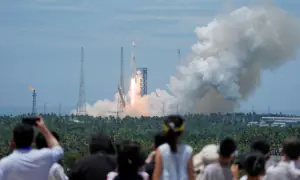
China successfully tests sea-based rocket booster recovery system, says state media
Long March 10B rocket launch marked China’s first successful controlled recovery of a carrier rocket’s booster

China's first successful sea-based rocket booster recovery test directly challenges US dominance in reusable launch technology, while China's temporary helium export ban has implications for semiconductor...
Deutsche Welle and Japan Times explicitly position the booster recovery as a challenge to US and SpaceX dominance. Deutsche Welle reports China has "joined the small group of space powers" that can recover orbital-class booster rockets. Japan Times emphasises Beijing "hopes to break U.S. dominance in the reusable" launch market.
The Hindu and Dawn report the same technological achievement—China's first successful controlled recovery of a carrier rocket booster using a net on a sea platform—without strategic competitive framing. Yahoo Japan separately reports China's temporary helium export ban as a supply chain disruption, but no outlet connects this to broader strategic technology assertion.
China tests sea-based rocket booster recovery system successfully
China retrieves booster in reusable rocket breakthrough
China tests sea-based rocket booster recovery system
China tests sea-based rocket booster recovery system
China temporarily bans helium exports
The duration of China's helium export ban and the specific domestic policy rationale behind it are not confirmed in available summaries.
No outlet addresses the implications of China's rocket recovery for commercial launch pricing competition or the potential military applications of the sea-based recovery platform.
The Hindu reports China successfully tested a sea-based rocket booster recovery system in what state media describes as China's first successful controlled recovery of a carrier rocket booster, framing it as a technological milestone.
Deutsche Welle covers China retrieving its booster in what it describes as a reusable rocket breakthrough, noting China has joined the small group of space powers capable of recovering orbital-class boosters and framing it as breaking US dominance.
Japan Times covers the sea-based rocket booster recovery as China's first successful retrieval of an orbital-class rocket, explicitly stating Beijing hopes to break US dominance in the sector.
Dawn covers China's successful sea-based rocket booster recovery system test, treating it as a significant technological achievement without strategic framing.
Yahoo Japan covers China's temporary ban on helium exports, which has direct implications for semiconductor manufacturing supply chains.
This page maps the coverage. The 5 articles below are the original reports the comparison is drawn from — open them for each publisher's full reporting.
Long March 10B rocket launch marked China’s first successful controlled recovery of a carrier rocket’s booster
China has joined the small group of space powers that can now recover an orbital-class booster rocket. Developers of the landing method turned to a striking alternative to that used by existing players such as SpaceX.
The test marks China's first successful retrieval of an orbital-class rocket, as Beijing hopes to break U.S. dominance in the reusable technology.
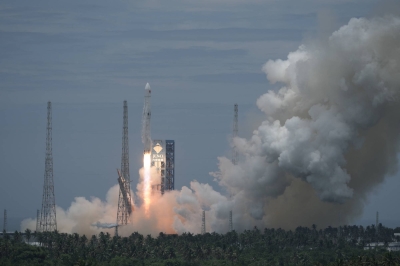
China on Friday successfully tested an experimental rocket retrieval system using a net attached to a sea platform, state media reported, in the hope of breaking US dominance in reusable rockets. The Long March 10B…