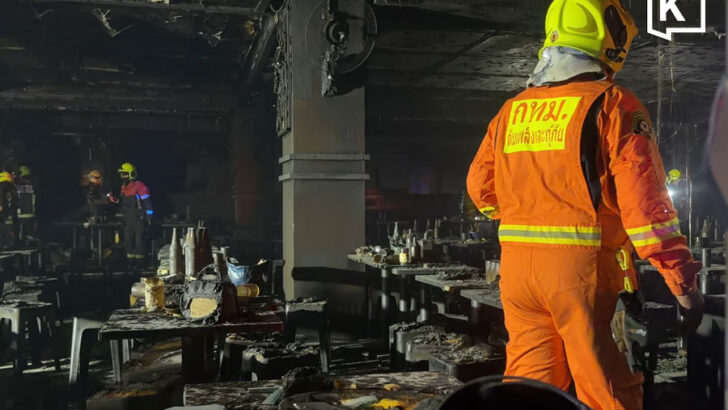
Survivors and first reporters reported doors being locked and the lack of signage marking emergency exits.
How the world covered this
Read the editorial comparison
Prose synthesis of how each outlet framed the story, with side-by-side outlet quotes and divergence notes.
9 articles from 7 sources
01

02
A huge fire that engulfed a music bar in Bangkok overnight left at least 27 people killed and 25 hospitalized in critical condition as investigations began on Monday into the Thai...

03
BANGKOK — 13 July 2026, The boyfriend of a woman critically injured in the deadly Na Ladprao beer hall fire has described the moment she escaped through the flames and tearfully asked whether she was still beautiful. “I…

04
Singer survives Lat Phrao beer bar fire, says emotional trauma overwhelming as two band members remain missing A singer performing at the beer bar where a devastating fire claimed 27 lives has survived after leaving the…

05
BANGKOK — 13 July 2026, Authorities have confirmed the identities of 10 people killed in a fire at a brewery near Lat Phrao Soi 1 in Chatuchak district, while efforts continue to identify 17 other victims. The 10…
06
Porta trancada pode ter impedido fuga em incêndio que matou 28 na Tailândia, aponta investigação
Thai police are investigating possible negligence in the fire that killed 28 people in a Bangkok bar on Sunday night (12). The investigation includes reports of blocked emergency exits, locked doors and…
07
An investigation into the cause of the fire and whether the bar was following safety regulations is ongoing.

08
ТАСС: число погибших при пожаре в Бангкоке возросло до 30
There are no Russians among the identified victims of the incident, police said.
09
Massive fire at a bar in Bangkok kills at least 27 people The Times of Israel
AI read
What the coverage agrees on, and where it splits
This view is generated from the clustered articles, so it is best read as a map of coverage rather than a replacement for the source reporting.
Broadly agreed
- All covering sources confirm at least 30 people died in the Bangkok bar fire, with dozens more hospitalised.
- Multiple sources confirm investigators are examining whether locked doors and absent emergency exit signage contributed to the death toll.
Contested framing
- BBC and Folha de S.Paulo frame locked doors as an institutional protocol violation that is the central accountability question; Khaosod English foregrounds survivor emotional trauma rather than regulatory failure.
- TASS reports the death toll without any accountability framing; Thai and British sources both foreground systemic safety failures.
Still unclear
Whether the bar was operating in compliance with Thai fire safety regulations, who is criminally liable, and the identities of all remaining victims have not yet been confirmed.
Notable omissions
People's Daily and Al Jazeera Arabic are absent from this story; Khaosod English, despite its Thailand base, avoids structural fire safety policy critique in favour of emotional personal narratives.
Quality check
Physical facts (locked doors, missing exits) are documented, but institutional accountability and regulatory compliance remain under investigation.
- Death toll ranges from 27–30 across articles without reconciliation; unclear if this reflects ongoing recovery or reporting lag
- Locked doors and emergency exit failures are documented by investigators, but criminal liability and compliance status remain unknown—appropriately flagged
- Khaosod English's focus on survivor trauma rather than safety failures is editorial choice, not reliability failure, but it does create information gap
- No international outlet participation limits external verification of Thai institutional response
Review confidence: 79%
Signal strength
2/5
Narrative divergence
7
Sources compared
1
Days in coverage
How each outlet frames this story
Divergence
2/5
Narrative Divergence
How differently the sources covering this story frame it — measured by tone, emphasis, and what each outlet chooses to highlight or omit.
1 — Sources frame the story almost identically
2 — Minor differences in tone or emphasis
3 — Noticeable differences; some outlets highlight what others omit
4 — Stark contrasts; conflicting narratives
5 — Sources tell fundamentally different stories
British
BBC leads with the death toll rising to 30 and focuses on institutional protocol violations — locked doors and absent emergency exit signage — as the primary accountability frame.
Turkish
Daily Sabah provides a factual incident report with 27 initial deaths and 25 hospitalised, noting a probe is underway.
Thai
Khaosod English focuses on survivor testimony and the emotional trauma of a band singer who survived while two bandmates remain missing, prioritising hyperlocal human drama.
Brazilian
Folha de S.Paulo investigates whether locked doors prevented escape — framing institutional negligence as the primary cause within an institutional failure analysis.
Singaporean
CNA reports the death toll and ongoing safety regulations investigation in terse factual terms, consistent with its operational accountability framing.
Israeli
Times of Israel reports factually on the initial 27 deaths as a notable international incident.
Russian
TASS confirms the death toll rising to 30, notes no Russians among identified victims.