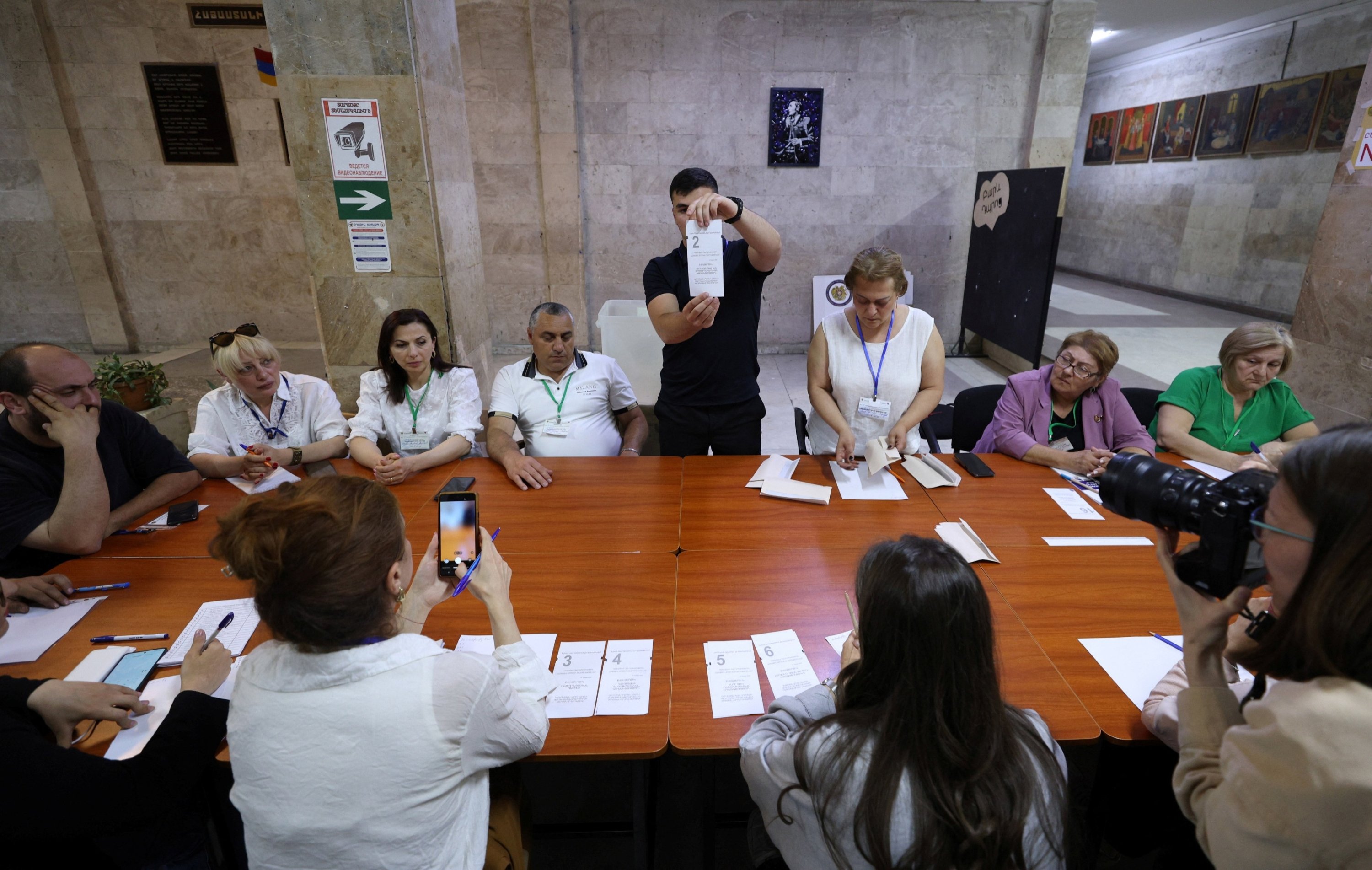
Prime Minister Nikol Pashinyan's Civil Contract Party secures nearly 50% of the vote, comfortably beating the other contenders.
How the world covered this
Read the editorial comparison
Prose synthesis of how each outlet framed the story, with side-by-side outlet quotes and divergence notes.
3 articles from 3 sources
01

02
Partido governista vence eleições na Armênia em teste sobre acordo de paz com Azerbaijão
Prime Minister Nikol Pashinyan's Civil Contract party won elections in Armenia. The party obtained 49.8% of the votes in all polling stations counted in Sunday's vote (7), enough to…
03
Türkiye on Monday welcomed the successful completion of Armenia's parliamentary election and expressed hope that the post-election period would create conditions conducive to...
AI read
What the coverage agrees on, and where it splits
This view is generated from the clustered articles, so it is best read as a map of coverage rather than a replacement for the source reporting.
Broadly agreed
- All covering sources confirm Pashinyan's Civil Contract party won the Armenian parliamentary election with approximately 50% of the vote.
- Sources confirm the election was conducted successfully despite Russian pressure on Armenia's political direction.
Contested framing
- BBC foregrounds Russian pressure as the key context for interpreting the result; Daily Sabah foregrounds Turkish-Armenian normalisation prospects; Brazilian outlets focus on democratic process quality.
Still unclear
How Russia will respond to the consolidated Pashinyan government and whether the Armenia-Azerbaijan peace treaty will now advance remain unconfirmed.
Notable omissions
No outlet addresses the status of ethnic Armenian communities formerly in Nagorno-Karabakh or their views on the election outcome.
Quality check
Read as confirmed electoral victory with geopolitical implications that remain pending. Nagorno-Karabakh displacement is completely absent from coverage.
- Russian response to consolidated Pashinyan government is speculative; avoid implying confrontation is imminent
- Armenia-Azerbaijan peace treaty advancement timeline is unconfirmed
- Ethnic Armenian communities in Nagorno-Karabakh and their views entirely absent—significant displacement perspective omitted
- Framing divergence (Russian pressure vs. Turkish normalization vs. democratic process) reflects different outlet priorities, not factual disputes
Review confidence: 82%
Signal strength
2/5
Narrative divergence
3
Sources compared
1
Days in coverage
How each outlet frames this story
Divergence
2/5
Narrative Divergence
How differently the sources covering this story frame it — measured by tone, emphasis, and what each outlet chooses to highlight or omit.
1 — Sources frame the story almost identically
2 — Minor differences in tone or emphasis
3 — Noticeable differences; some outlets highlight what others omit
4 — Stark contrasts; conflicting narratives
5 — Sources tell fundamentally different stories
British
BBC frames the result as a win for Pashinyan's pro-West government 'despite Russian pressure,' explicitly foregrounding the geopolitical context of Armenian democratic choice.
Brazilian
Folha de S.Paulo frames it as a test of the peace deal with Azerbaijan, noting Civil Contract obtained 49.8% of votes, treating it as a democratic consolidation story.
Turkish
Daily Sabah welcomes the successful completion of Armenia's election and expresses hope for progress toward a peace deal, framing it through Ankara's interest in regional normalisation.