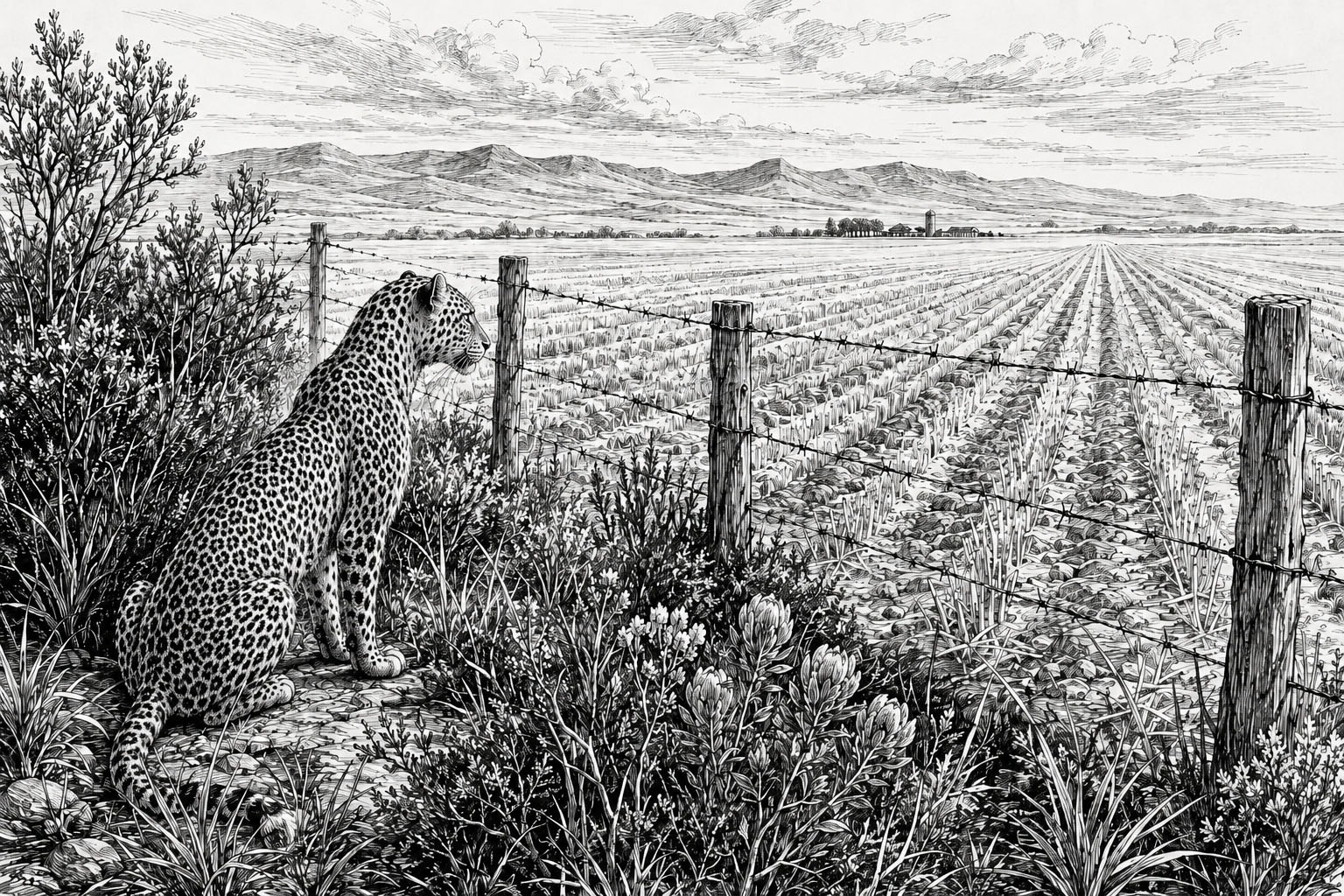
Not all islands are surrounded by water. Some are ringed by wheat fields, highways, fences, suburbs and municipal boundaries.
How the world covered this
Read the editorial comparison
Prose synthesis of how each outlet framed the story, with side-by-side outlet quotes and divergence notes.
1 article from 1 source
01
AI read
What the coverage agrees on, and where it splits
This view is generated from the clustered articles, so it is best read as a map of coverage rather than a replacement for the source reporting.
Broadly agreed
- The Guardian and Daily Maverick both frame habitat fragmentation as a human-created problem with documented consequences for species survival.
- Multiple sources confirm the Major Oak — described as one of Europe's oldest trees — failed to produce leaves and died after heat stress.
Contested framing
- Daily Maverick frames corridor restoration as a governance accountability imperative; The Guardian frames species loss through elegiac cultural mourning rather than governance failure analysis.
Still unclear
Whether South African or UK governments are funding corridor restoration at the scale scientists say is needed remains unaddressed in available summaries.
Notable omissions
The role of private landowners and agricultural corporations in blocking or enabling corridor restoration — a key implementation barrier — is absent from all available summaries.
Quality check
Habitat fragmentation is confirmed; governance funding, private-sector roles, and specific restoration scaling are all unaddressed.
- Contested framing: Daily Maverick treats as governance accountability imperative; Guardian treats through cultural mourning lens. Different policy implications not reconciled.
- Major Oak claim: 'one of Europe's oldest trees' and death from 'heat stress' attributed to both sources but specific verification of causation is not detailed.
- Unknown: whether South African or UK governments are funding corridor restoration at scale scientists say is needed remains entirely unaddressed.
- Critical omission: private landowner and agricultural corporation roles in blocking/enabling restoration (described as 'key implementation barrier') entirely absent—fundamental barrier not examined.
Review confidence: 76%
Signal strength
1/5
Narrative divergence
1
Sources compared
1
Days in coverage
How each outlet frames this story
Divergence
1/5
Narrative Divergence
How differently the sources covering this story frame it — measured by tone, emphasis, and what each outlet chooses to highlight or omit.
1 — Sources frame the story almost identically
2 — Minor differences in tone or emphasis
3 — Noticeable differences; some outlets highlight what others omit
4 — Stark contrasts; conflicting narratives
5 — Sources tell fundamentally different stories
South African
Daily Maverick uses the 'island' metaphor for fragmented South African wild landscapes to argue for wildlife corridors as a practical conservation mechanism, framing it as an infrastructure governance accountability question.