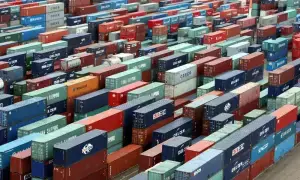
US announces new tariffs over forced labour concerns
It comes after the US Supreme Court struck down many of US President Donald Trump's previous duties in February.

The Trump administration's proposed 12.5% tariff on India, Japan, Colombia, and approximately sixty other countries—framed as a forced-labour enforcement mechanism after the Supreme Court struck down previous...
Le Monde headlines "the 'fight against forced labor,' Donald Trump's latest maneuver to circumvent the Supreme Court decision," explicitly positioning the tariff as institutional evasion of judicial constraints. BBC reports the mechanism neutrally: "It comes after the US Supreme Court struck down many of US President Donald Trump's previous duties in February."
The Hindu reports India "remains engaged" with Washington, signalling negotiating room and downplaying threat. Dawn quotes Pakistani exporters as confident the tariffs will have no impact, reflecting institutional confidence in Pakistan's exclusion or resilience. By contrast, El Tiempo frames the 12.5% tariff on Colombia as a direct economic threat, with Colombian lawmakers requesting OFAC sanctions guarantees as a condition of accepting the tariff.
US announces new tariffs over forced labour concerns
Trump's forced-labor tariffs circumvent Supreme Court decision
Trump tariff proposal raises Colombia duties to 12.5%
US considering additional tariffs of 12.5% on Japan
US proposes 12.5% tariff; India remains engaged with US
Exporters see no impact of 10pc US duty
Whether the new tariff framework will survive further legal challenge and which specific countries will face immediate implementation remains unconfirmed.
The impact of new US tariffs on African economies is absent from available coverage despite the proposed scope affecting 60 countries globally.
BBC reports US new tariffs over forced labour concerns following the Supreme Court striking down previous duties in February, framing it as a legal maneuver around institutional constraints.
Le Monde analyses Trump's forced labour tariff mechanism as a 'maneuver to circumvent the Supreme Court decision,' treating it as an institutional accountability issue.
El Tiempo reports Trump's new tariff offensive could hit Colombia with 12.5% duties, noting Washington classified Colombia as lacking mechanisms to prevent goods from circumventing tariffs.
The Hindu reports the US proposing 12.5% tariffs on India and other countries, with the Indian government saying it 'remains engaged' with Washington, framing it through strategic trade autonomy.
Dawn reports exporters are confident a proposed 10% US duty would have no significant impact on Pakistani exports, maintaining an optimistic institutional framing.
Yahoo Japan covers US consideration of additional 12.5% tariffs on Japan as a significant economic threat to Japanese export competitiveness.
El Tiempo also covers AI-driven immigration scam operations in the US, linking American institutional dysfunction to vulnerability exploitation affecting Colombian migrants.
This page maps the coverage. The 7 articles below are the original reports the comparison is drawn from — open them for each publisher's full reporting.
It comes after the US Supreme Court struck down many of US President Donald Trump's previous duties in February.
The Trump administration intends to impose new taxes on products from around sixty countries accused of being too lax towards forced labor. An attempt to escape his obligation to repay…
Washington included the country on a list of States that, according to its assessment, do not have mechanisms to prevent goods produced with forced labor.

The action follows investigations launched against 60 countries over what the USTR described as their failure to impose and effectively enforce bans on imports made with forced labour

The USTR on June 2 issued its findings in the forced labour investigation and proposed additional tariffs on imports from 60 economies

KARACHI: Representatives of exporters are confident that a proposal under consideration in Washington to impose 10 per cent additional duties on imports would not hurt Pakistan’s exports. The US Trade Representative…