US launches fresh strikes on Iran as Trump warns Tehran it 'better behave'
US President Donald Trump says he is yet to decide whether or not he will "finish off" Iran.

US airstrikes on Iranian territory for at least five consecutive days, combined with a naval blockade of Iranian ports, risk triggering a wider regional war that could disrupt global energy supplies and draw...
BBC News leads with Trump's uncertainty over whether to 'finish off' Iran, centering the decision-making ambiguity at the US executive level. Le Monde reports strikes on Bushehr with the Iranian governor's characterization of US forces as 'terrorist,' adopting the Iranian framing directly. Deutsche Welle documents strikes on missile and coastal defence sites alongside the naval blockade reinstatement, presenting both actions as coordinated escalation.
The Hindu reports dual action—US strikes on northern Iran and Iranian drone responses targeting Kuwait and Bahrain—emphasizing reciprocal military engagement rather than one-directional US aggression. The Hindu also provides technical detail on Greater Tunb Island's strategic importance to Strait of Hormuz control, grounding the conflict in infrastructure rather than political rhetoric.
Folha de S.Paulo reports Iran admitting negotiations after the blockade and fresh Trump threats, suggesting behind-the-scenes diplomatic movement despite public military posturing. Across all outlets, the strikes themselves are reported as factual, but their characterization—as defensive responses, legitimate military targeting, or unjustified escalation—varies sharply by source geopolitical alignment.
Trump says he is yet to decide whether to finish off Iran
Three points in Bushehr targeted by American forces
US launches fresh strikes on Iranian missile sites
US airstrikes hit northern Iran as it disables ship
Iran admits negotiating after blockade and Trump threats
The precise terms of the disputed clause in the US-Iran memorandum of understanding — particularly which party controls Strait of Hormuz transit rights — have not been publicly confirmed by either government.
People's Daily and TASS are silent on the conflict's civilian and humanitarian dimensions inside Iran; Western outlets largely omit the economic impact on Gulf states dependent on Hormuz transit for their own exports.
BBC leads with Trump's ambiguous threat to 'finish off' Iran and frames the conflict through institutional accountability — what decision-makers are deciding and civilian consequences — while noting Iran released a detained American woman.
CNN emphasises Trump's tactical options and the US military resumption of naval blockade after seven hours of strikes, framing events as a sequential military campaign with evolving presidential directives.
Le Monde covers new US strikes on Bushehr in a live blog and frames the conflict through expert institutional analysis, stressing ambiguity in the memorandum of understanding underpinning any ceasefire.
The Hindu provides detailed military geography — explaining the strategic significance of Greater Tunb Island in the Strait of Hormuz — while maintaining a non-aligned framing that avoids endorsing either side.
Deutsche Welle emphasises endurance and institutional sustainability, framing US strikes on missile and coastal defence sites as an escalation whose long-term energy infrastructure consequences for Germany are the primary concern.
La Repubblica frames the conflict as driven by mutual distrust and ambiguous agreement language, quoting a US physicist who argues Iran will not capitulate because it seeks a nuclear capability.
Folha de S.Paulo reports Iran acknowledged negotiations after the blockade, pairing humanistic consequence framing with structural analysis of Iran's conditional posture.
Al Jazeera Arabic covers the dispute over Strait of Hormuz control and examines the ambiguous clause in the memorandum of understanding, framing it as a gateway to further war rather than a path to de-escalation.
CNA analyses the first combat use of US sea drones, framing the conflict primarily as a logistics and operational signalling problem rather than a military confrontation.
The National emphasises that freedom of navigation must return to the Strait of Hormuz, framing the crisis through Gulf collective security and regional economic autonomy rather than US-Iran bilateral dynamics.
Times of Israel covers Iranian strikes hitting a Kuwaiti navy vessel and Iran's FM mocking Trump over Hormuz tolls, with coverage emphasising Iranian belligerence and regional destabilisation.
Yahoo Japan highlights the repeated shifts in Trump's statements on Iran, framing the conflict as an unpredictable US policy problem, and notes the attack on a merchant ship attempting to break the US port blockade.
El Tiempo frames the conflict as a new Middle East escalation with seven-hour US bombing runs and Iran conditioning reopening of the Strait of Hormuz, emphasising the bilateral economic and diplomatic tension.
This page maps the coverage. The 33 articles below are the original reports the comparison is drawn from — open them for each publisher's full reporting.
US President Donald Trump says he is yet to decide whether or not he will "finish off" Iran.
“Three points in the city of Bushehr were targeted by the American terrorist army,” the governor of the province of the same name declared on Wednesday, quoted by the Fars agency. The Iranian army also announced the…
The United States has launched fresh strikes on Iranian missile and coastal defense sites after reinstating a naval blockade. Iran responded by warning it could disrupt more regional energy exports.
“Three points in the city of Bushehr were targeted by the American terrorist army,” the governor of the province of the same name declared on Wednesday, quoted by the Fars agency. The Iranian army also announced the…
Iran's Amy says struck U.S. targets in Kuwait and Bahrain with drones
Greater Tunb is a small island in the Persian Gulf near the entrance to the Strait of Hormuz and is regarded as a strategically important location in the strait

U.S. Central Command said the strikes further degraded Iran's ability to attack commercial shipping in the Strait of Hormuz

On the first day of the American naval blockade of Iran and after new threats from Donald Trump, the theocracy maintained its aggressive rhetoric towards its rivals, but, for the first time since the resumption of hostilities in…
A mysterious clause in the memorandum of understanding between Washington and Tehran revived the dispute over the Strait of Hormuz, with each party interpreting it in a way that serves its interests, which undermined the truce and renewed escalation between the two parties, amid warnings of the crisis turning into a long-term conflict.
The Pasdaran are still keeping Hormuz closed and the Americans are bombing for the fifth consecutive day, provoking enemy retaliation
Abstruse formulations and mutual distrust push both countries to arms, thinking they have time on their side
David Albright, former inspector in Iraq for the Atomic Agency: “It was said that under this mountain there was a facility intended to house a large-scale centrifuge assembly line”
The US launched two waves of attacks on Iran’s coastal defences and missile sites on Wednesday after reimposing a naval blockade of its ports, while Iran struck back by targeting US military sites in neighbouring…


WASHINGTON, July 15 - The U.S. military said late on Wednesday it completed its latest wave of strikes on Iran that it carried out at President Donald Trump's direction, with targets including Bandar Abbas, Iran's…
Trump weighing options for expanding military operations in Iran CNN
US resumes naval blockade after seven hours of strikes on Iran CNN
The U.S. military was helping vessels through the strait as part of an operation involving scores of secretive ship-to-ship oil transfers to keep Gulf energy exports flowing.
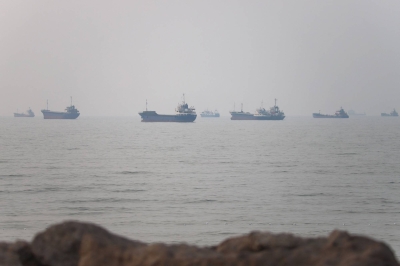
The two nations continue to clash on Iranian soil while the naval blockade continues in the country's ports.

Iran’s Islamic Revolutionary Guard Corps has threatened to close “all other export corridors that benefit the US and its allies”, Iranian media reported, after Iran shut the Strait of Hormuz and the US reimposed a…

Iran: US can't interfere in Hormuz, 'flames will engulf entire region' if nearby countries work with US army The Times of Israel
Kuwait says Iranian attacks hit navy vessel, injuring four troops The Times of Israel
‘POTUS is absolutely right’: Iran’s FM mocks Trump over tolls for Hormuz passage The Times of Israel
“An oil tanker reported being hit by a missile while leaving the Strait [of Hormuz] via the southern route,” the UKMTO said. The American command for the Middle East also announced that…