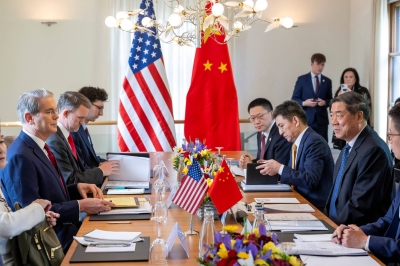
China expressed “serious concern” over recent US measures taken against Beijing.
How the world covered this
Read the editorial comparison
Prose synthesis of how each outlet framed the story, with side-by-side outlet quotes and divergence notes.
3 articles from 2 sources
01
02
Rare earths have gained outsized importance since 2025 when China placed export controls that rattled US manufacturers.
03
U.S. Treasury Secretary Scott Bessent said he held a call Thursday with Chinese Vice Premier He Lifeng to lay the groundwork for President Xi Jinping's U.S.
AI read
What the coverage agrees on, and where it splits
This view is generated from the clustered articles, so it is best read as a map of coverage rather than a replacement for the source reporting.
Broadly agreed
- Covering sources confirm US Treasury Secretary Bessent held a call with Chinese Vice Premier He Lifeng focused on trade and rare earths ahead of an Xi visit.
- Trump is confirmed to have signed an order on export curbs related to retaining critical minerals.
- China is confirmed to have expressed 'serious concern' over recent US measures against Beijing.
Contested framing
- SCMP frames China's Global South trade as indispensable and challenges decoupling as unrealistic; US and European outlets implicitly frame decoupling as a strategic necessity.
- Straits Times frames the call through supply-chain institutional resilience; Japan Times frames it through Asian energy security vulnerability.
Still unclear
The specific commitments or concessions discussed in the Bessent-He call, the date and agenda of the Xi visit, and the operational details of Trump's rare earth export curb order remain unpublished.
Notable omissions
The perspectives of Global South countries most affected by US-China trade competition — particularly those dependent on Chinese manufactured goods or US technology — are absent from this coverage.
Quality check
Engagement signals (call, visit planning) and policy actions (export curbs) are confirmed, but substantive agreements and operational details remain confidential.
- Specific Bessent-He call commitments or concessions unpublished
- Xi visit date and agenda unannounced
- Trump rare-earth export curb order operational details unpublished
- Global South perspectives on trade competition absent from coverage
Review confidence: 65%
Signal strength
3/5
Narrative divergence
2
Sources compared
2
Days in coverage
↘ converging
How each outlet frames this story
Divergence
3/5
Narrative Divergence
How differently the sources covering this story frame it — measured by tone, emphasis, and what each outlet chooses to highlight or omit.
1 — Sources frame the story almost identically
2 — Minor differences in tone or emphasis
3 — Noticeable differences; some outlets highlight what others omit
4 — Stark contrasts; conflicting narratives
5 — Sources tell fundamentally different stories
Singaporean
Straits Times reports the US-China call and Trump's rare earths order factually, framing through supply-chain institutional effects with China expressing 'serious concern' over recent US measures.
Japanese
Japan Times reports the US-China trade and rare earths call ahead of the Xi visit, framing through Asian energy security institutional vulnerability and corporate supply-chain implications.
Singaporean
Straits Times's SCMP (same ownership) also examines whether the West can actually decouple from China, presenting structural analysis of dependency that contradicts decoupling rhetoric.