Putin says there is 'no point' meeting Zelensky over ending Ukraine war
The Russian president's refusal comes after his Ukrainian counterpart wrote an open letter calling for face-to-face talks.

Putin's flat refusal to meet Zelensky following a public open letter, combined with Russia's continued strikes on civilian targets, signals the war's fifth year will see no near-term diplomatic resolution...
BBC News frames Zelensky's open letter as a sincere institutional accountability test of Putin's personal refusal to engage, centering the strategic communication as a direct challenge. Le Monde's framing (noted in context) positions the letter as strategically aimed at Russian elites rather than Putin personally, suggesting a more calculated diplomatic maneuver than BBC's framing implies.
TASS emphasizes Ukrainian drone attacks on Russian territory as the military context for understanding the diplomatic impasse, while BBC News and The Hindu foreground Russian strikes on Ukrainian civilian infrastructure as the relevant backdrop. This reversal in sourcing reflects fundamentally different narratives about who bears responsibility for the conflict's continuation. La Repubblica quotes an expert warning Moscow may escalate toward nuclear signalling after being 'humiliated,' a notably dramatic framing absent from Western outlet summaries, suggesting divergence in threat assessment severity.
Putin says there is 'no point' meeting Zelensky
Putin rules out meeting Zelenskyy and vows war goals
Putin sees no reason for meeting with Zelensky after letter
Putin rejects Zelensky's invitation to direct meeting
Putin rejects Zelenskyy's call for face-to-face talks
Putin denies meeting to Zelensky, then sees Schroeder
Whether the London summit of Starmer, Macron, and Merz with Zelensky produced any concrete peace framework proposal or security guarantee commitment is not confirmed in available summaries.
People's Daily is absent from Ukraine war coverage; TASS avoids any analysis of why Putin rejected talks or what Russian domestic opinion on the war's continuation might be.
BBC News frames Putin's refusal as a breakdown of institutional protocol, interrogating the credibility of his stated reasons and foregrounding civilian consequences of continued Russian strikes.
Le Monde analyses Zelensky's open letter as a sophisticated political communication targeting war-weary Russian elites rather than a sincere peace overture to Putin, emphasising elite political psychology.
TASS reports NATO's $70 billion Ukraine aid discussion and Ukrainian drone damage to a Tula region apartment building, framing Ukraine as the aggressor while avoiding analysis of Putin's peace refusal.
Folha de S.Paulo reports Putin's refusal matter-of-factly alongside noting Trump applauded the direct letter contact, capturing the US-Russia-Ukraine triangulation without taking sides.
The Hindu reports Putin ruling out a Zelensky meeting and vowing to pursue war goals, while also covering Putin's praise of India-Russia ties, maintaining a non-aligned dual-track framing.
Al Jazeera Arabic reports Putin's rejection and contextualises it with a Wall Street Journal opinion that US presidents chronically misread Putin's motivations, adding a systemic critique of Western diplomacy.
Daily Sabah covers Putin's rejection and Zelensky's call for face-to-face talks without editorial framing, consistent with Turkey's positioning as a potential future mediator.
La Repubblica highlights Putin meeting ex-German Chancellor Schröder and calling European elites chaos-causers, emphasising Russian narrative management and European internal divisions.
Yahoo Japan covers Putin's refusal to meet Zelensky as a headline fact without analytical depth.
SCMP reports Putin calling Zelensky's letter 'rude' and seeing no reason to meet, presenting Russian grievance framing without editorial commentary.
Irish Times publishes an opinion piece arguing a Ukraine peace solution must unite global and regional agendas, calling for broader multilateral framing beyond US-Russia bilateralism.
El Tiempo publishes Zelensky's full letter text and reports Putin calling the meeting 'meaningless' while Trump applauded the contact attempt, framing the story through US decision-making accountability.
This page maps the coverage. The 20 articles below are the original reports the comparison is drawn from — open them for each publisher's full reporting.
The Russian president's refusal comes after his Ukrainian counterpart wrote an open letter calling for face-to-face talks.
Ukraine says it struck five ships carrying illegal cargo in the Sea of Azov and in coastal waters of Russian-occupied territories.

The Russia President said he saw “no point” in meeting Mr. Zelenskyy until a possible peace deal had been agreed; the Ukrainian President hit back, saying the Russian leader was “weak” and “choosing war again”

The leader of Russia, Vladimir Putin, said this Friday (5) that he saw no reason to meet with Volodymir Zelensky after receiving an open letter from the President of Ukraine asking for a meeting and a ceasefire to...
Yesterday, Friday, Russian President Vladimir Putin ruled out meeting his Ukrainian counterpart, Volodymyr Zelensky, soon, stipulating a long-term agreement first, while Kiev accused him of choosing war and showing weakness.
Russian President Vladimir Putin on Friday dismissed Ukrainian President Volodymyr Zelenskyy's proposal for direct talks between the two leaders, saying he saw 'no point' in a...
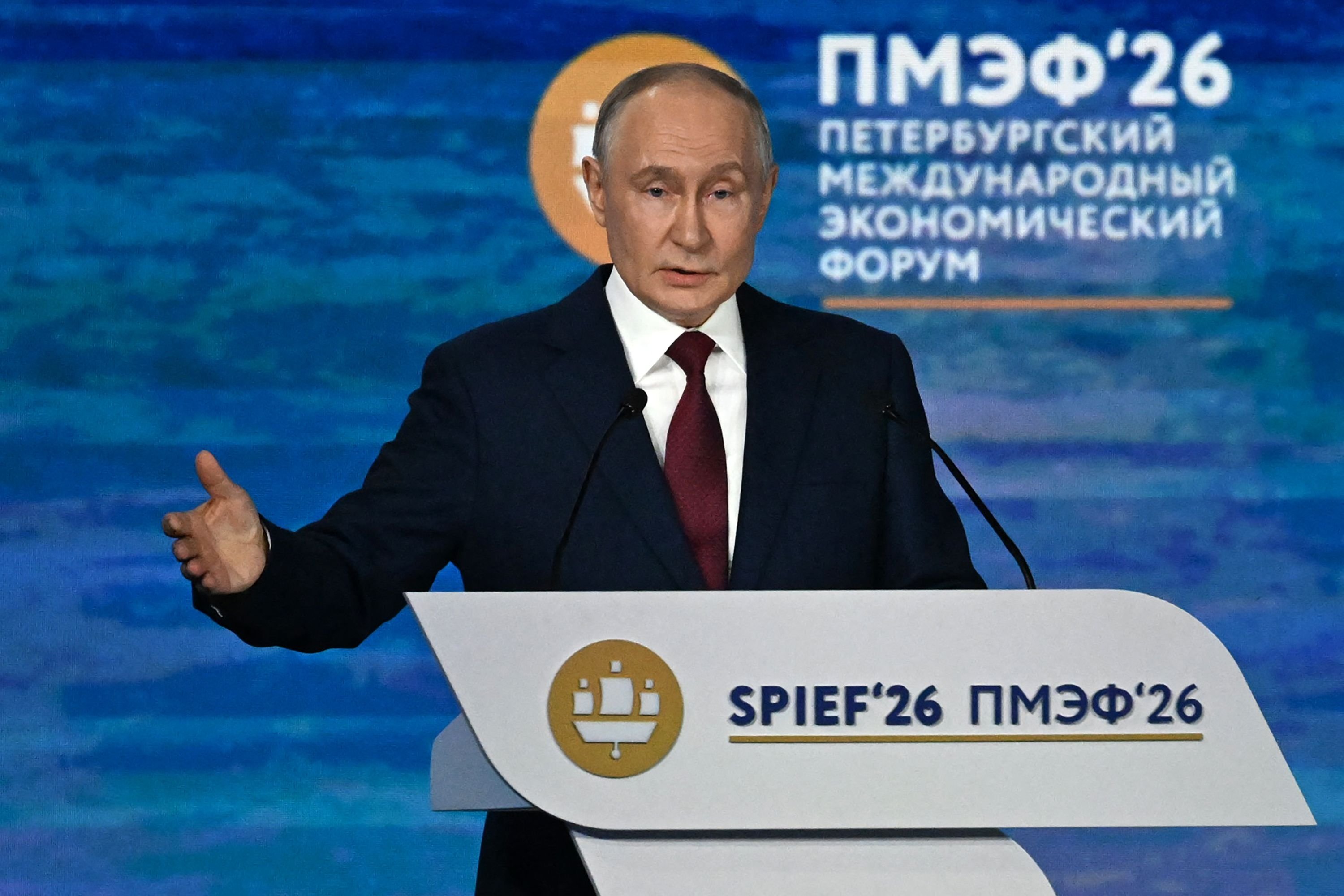
The Russian from St. Petersburg responds to the Ukrainian's letter: "There is no reason for a summit." Then he sees the former chancellor already rejected as a mediator by the EU.
The expert: “The Kremlin has been humiliated: now the hawks could push to give signals of a nuclear attack”
Tomorrow Starmer receives Macron and Merz together with Volodymyr: "Building a dialogue for peace"
Russian President Vladimir Putin said on Friday he currently saw no reason to meet Volodymyr Zelensky after the Ukrainian president published an open letter proposing they hold face-to-face talks to agree an end to a…

Russia could attack a Nato country within four years according to western intelligence assessments, UK Prime Minister Keir Starmer warned on Friday. He made the comments as he pledged his government would publish a…

Behind the proposal of an outstretched hand, the letter from the Ukrainian president to the head of the Kremlin seeks to exploit Moscow's flaws and the weariness of the Russians after four years of high-intensity war. Her…
Zelensky offered face-to-face peace talks with Putin to end Russia's war in Ukraine.
ST. PETERSBURG, Russia, June 5 - Russian President Vladimir Putin held a one-on-one meeting with former German Chancellor Gerhard Schroeder, which was \"good and friendly,\" Kremlin aide Yuri Ushakov was quoted as…
Ukraine's president tells the Russian leader that only "direct engagement" between the two countries could end the war, with the US focused on Iran.

The conflict is now entering its fifth year with no signs of a solution. Zelensky proposes a face-to-face summit with Putin.

Ukrainian President Volodimir Zelenski proposed this Thursday (4) a meeting with his Russian counterpart, Vladimir Putin, in an open letter in which he also offered a "total ceasefire" during the…
Such financial assistance for military needs could be announced during the summit of alliance leaders in Ankara in July, the publication writes.
Global perspective even more urgent today than during the Cold War
