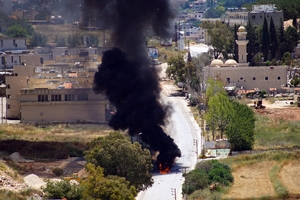
Hezbollah rejects renewed ceasefire agreed by Israel and Lebanon
The United States announced the ceasefire agreement on Wednesday night following a fresh round of talks.

Hezbollah's rejection of a US-brokered ceasefire between Israel and Lebanon, continued Israeli airstrikes on southern Lebanese villages with evacuation warnings, a UNIFIL peacekeeper killed, and the UN...
La Repubblica attributes the ceasefire freeze to a Netanyahu strategic decision, quoting the Israeli PM saying the agreement is 'useless' if Hezbollah does not accept discussion. This framing holds Israeli political leadership accountable for the collapse. BBC News frames it differently, arguing the ceasefire was structurally incoherent because Hezbollah was never party to US-brokered discussions, positioning the agreement itself as fundamentally flawed rather than Netanyahu's rejection as the causal breach.
Deutsche Welle foregrounds humanitarian consequences—the UN doubling Lebanon aid appeal to $640 million—rather than assigning strategic blame to Netanyahu, Israel, or Hezbollah. The Hindu emphasizes both the structural incompleteness of the truce and Israeli military actions (airstrikes, evacuation warnings). CNN's report that the Lebanese president accuses Iran of using Lebanon as a bargaining chip in US-Iran peace talks represents a framing—geopolitical leverage—absent from Israeli and US outlet coverage focusing on Hezbollah's military rejection.
Hezbollah rejects renewed ceasefire agreed by Israel Lebanon
Netanyahu freezes truce: 'If Hezbollah does not accept'
Incomplete truce: On the Israel-Lebanon ceasefire
UN doubles Lebanon aid appeal amid Israel war
Whether France's proposed post-UNIFIL security force concept has any support from Lebanon, Israel, or the US, and whether it could be operational before further ceasefire collapse, is not confirmed in available summaries.
No outlet's available summary addresses the perspective of ordinary southern Lebanese civilians living inside the Israeli buffer zone—Le Monde's ground-level reporting is the closest but focuses on one village.
BBC News frames Hezbollah's ceasefire rejection as an institutional protocol violation—a state (Lebanon) agreeing to a deal that a non-state actor within it rejects—interrogating the structural incoherence of the ceasefire architecture.
Deutsche Welle reports the UN doubling its Lebanon aid appeal to $331.5 million (in addition to existing appeals, totalling $640 million) while Israel continues targeting southern Lebanon, framing it as a humanitarian governance escalation.
The Hindu covers the UN doubling its Lebanon aid appeal to nearly $640 million and warns of a 'humanitarian catastrophe' with a quarter of Lebanon's population displaced, consistent with non-aligned humanitarian framing.
Times of Israel covers an IDF soldier killed by an anti-tank missile, a UNIFIL post struck by Hezbollah mortars, and the ceasefire rejection from an Israeli security perspective, foregrounding Israeli military vulnerability.
La Repubblica reports Netanyahu freezing the truce after Hezbollah rejected discussion, framing it as a strategic decision by Netanyahu rather than a structural ceasefire failure.
The National reports France considering a post-UNIFIL security force for southern Lebanon, positioning France as a potential alternative security architecture actor.
Korea Herald condemns all acts threatening UNIFIL peacekeepers following the Serbian peacekeeper death, reflecting South Korea's troop contribution to UNIFIL and alliance-positive framing.
This page maps the coverage. The 12 articles below are the original reports the comparison is drawn from — open them for each publisher's full reporting.
The United States announced the ceasefire agreement on Wednesday night following a fresh round of talks.
There is an agreement between the Jewish State and Lebanon, but the Shiite militia poses new conditions. Beirut leaders warn: "Tehran stop using us as a bargaining chip"
Israel has to pull back troops from Lebanon for peace to take hold
Israel’s air force has struck parts of southern Lebanon, and the military issued evacuation warnings for nine villages

The UN says it is seeking an additional $331.5 million to tackle a worsening humanitarian crisis in Lebanon. Meanwhile, Israel is carrying out fresh strikes on the south of the country.
Three months into the war, the United Nations warned that a "humanitarian catastrophe" was looming in Lebanon, with a quarter of its population needing aid

The Christian neighborhood in the city south of Lebanon, the only one spared by the air force, has become a refuge for thousands of displaced people. But the IDF threatens: "Expel the Shiite fighters, or we will strike there too"

Soldier killed in anti-tank missile attack as Hezbollah rejects Lebanon ceasefire proposal The Times of Israel
Launch trajectory shows Hezbollah fired mortars that struck UNIFIL post, IDF says The Times of Israel
UNIFIL says one peacekeeper killed, two hurt in south Lebanon; doesn’t assign blame The Times of Israel
South Korea on Friday condemned "all acts" threatening the safety of the U.N. peacekeeping mission in Lebanon, following the death of a Serbian peacekeeper serving with the mission.