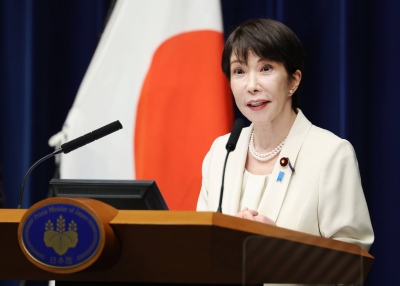
Japanese population falls below 120 million for first time in decades
The population of Japanese residents has been declining for 17 consecutive years since peaking in 2009.

Japan's resident population has fallen below 120 million for the first time since 1984 — the 17th consecutive year of decline — creating compounding fiscal and economic challenges as PM Takaichi's approval...
Japan Times frames the milestone through governance sustainability: 'The population of Japanese residents has been declining for 17 consecutive years since peaking in 2009,' and connects this to Prime Minister Takaichi's falling approval ratings, asking whether her administration can address 'deeper governing challenges' posed by demographic contraction. Folha de S.Paulo similarly reports the population decline milestone but without equivalent political context. Japan Times separately covers Takaichi's approval slide and its relationship to 'deeper governing challenges,' suggesting demographic crisis is an institutional political problem.
CNA reports the immediate policy response—Takaichi's vow to 'proceed with temporary cut in sales tax'—treating demographic decline as requiring consumption stimulus rather than interrogating structural causes. CNA also reports Japan's downward revision of growth outlook due to energy costs, connecting demographics to economic dynamics without addressing the underlying population loss.
Japanese population falls below 120 million for first time in decades
Japan has fewer than 120 million Japanese people for first time since 1984
Takaichi's popularity slide exposes deeper governing challenges
Japan PM vows to proceed with temporary cut in sales tax
Whether PM Takaichi's proposed sales tax cut will be sufficient to stimulate consumption meaningfully in the context of energy cost pressures and demographic contraction has not been assessed.
The immigration policy dimension—Japan's restrictive stance as a partial remedy for demographic decline—is not addressed in any of the covering articles; international comparison with other declining-population nations is absent.
Japan Times reports the population of Japanese residents has been declining for 17 consecutive years since peaking in 2009, framing through economic and demographic sustainability analysis.
Folha de S.Paulo reports Japan now has fewer than 120 million Japanese people for the first time since 1984, framing as a structural demographic milestone.
CNA reports Japan cutting its growth outlook as higher energy costs weigh on consumption, connecting the Iran war energy shock to Japan's domestic economic vulnerability.
This page maps the coverage. The 5 articles below are the original reports the comparison is drawn from — open them for each publisher's full reporting.
The population of Japanese residents has been declining for 17 consecutive years since peaking in 2009.
Japan has recorded its 17th consecutive year of falling total population and now has fewer than 120 million Japanese people. The number of the country's statistics office, equivalent to IBGE (Brazilian Institute of Geography…
Prime Minister Sanae Takaichi's drop raises the question of whether it is from the normal growing pains of a new administration or if it indicates deeper structural problems.