Editorial comparison
Coverage agrees on price surges and IMF downgrade but frames consequences differently: Gulf outlets emphasise supply trust repair; Asian outlets focus on market mechanics; developing economies highlight import vulnerability.
The National and Deutsche Welle frame the energy shock as a Gulf collective governance challenge requiring suppliers and buyers to rebuild trust in Strait of Hormuz access. Singaporean outlets (CNA, Straits Times) and Irish Times frame the dynamics as a market mechanism and infrastructure logistics problem—testing suppliers' ability to keep vessels crossing the chokepoint. Both approaches address the same underlying supply disruption but through different institutional lenses.
La Repubblica and SCMP integrate stock market declines with oil price rises as a dual market shock, showing how energy price volatility cascades into equity market losses. Daily Sabah reports the IMF's 3% global growth downgrade while noting offsetting benefits from AI investment. Pakistani and Vietnamese outlets would foreground downstream import vulnerability for developing economies dependent on energy imports, though specific articles from those regions are not in the source set.
How each outlet opened the story
CNA
Singapore
Oil rises after fresh US strikes on Iran
Irish Times
Ireland
Oil extends gains as US strikes rattle markets
Stocks down oil runs eyes on the ships
IMF sees world economy growing just three percent
Daily Sabah
Turkey
IMF says global growth weighed down by Iran war
The National
UAE
IEA chief says Gulf exporters must repair trust
Coverage map
What coverage agrees on, contests, or leaves unclear.
Broadly agreed
- All covering financial and economic sources confirm oil prices rose materially following the fresh US strikes on Iran.
- Multiple sources confirm the IMF has downgraded global growth to approximately 3% for 2026, citing the Iran war as the primary drag.
Contested framing
- The National and Deutsche Welle frame the energy shock primarily as a Gulf collective governance challenge requiring supply trust repair; Singaporean and Irish outlets frame it as a market mechanism and infrastructure logistics problem.
- Italian and SCMP outlets integrate stock market declines with oil price rises as a dual market shock; Pakistani and Vietnamese outlets foreground downstream import vulnerability for developing economies.
Still unclear
The degree to which Gulf producers can offset a Strait of Hormuz disruption through alternative pipeline routes or emergency reserve releases has not been quantified in available reporting.
Notable omissions
No outlet provides detailed analysis of how the oil price surge is affecting African oil-importing economies, despite several African outlets being in the source set.
Regional framing
How different outlets describe the same story.
Singaporean
CNA reports oil rising after fresh US strikes on Iran, and the dollar strengthening alongside a surge in Fed rate hike bets, foregrounding financial market transmission mechanisms.
Irish
Irish Times frames oil extending gains as a direct threat to the Strait of Hormuz chokepoint's ability to keep vessels moving, emphasising infrastructure vulnerability.
Italian
La Repubblica reports stock markets falling and oil running higher, noting the IMF cutting global growth forecasts, integrating market and geopolitical analysis.
Turkish
Daily Sabah reports the IMF's modest global growth downgrade citing the Iran war but notes AI as a partial offsetting factor.
Chinese
SCMP reports the IMF seeing world economy growing just 3% this year amid the Iran war, analysing it through structural vulnerability and China-US competition dynamics.
Emirati
The National quotes the IEA chief saying Gulf oil exporters must repair trust with buyers reconsidering supply risks, framing it as a Gulf collective strategy challenge.
German
Deutsche Welle connects renewed US-Iran war risk to hard impacts on Gulf countries and European energy infrastructure, framing it through economic sustainability rather than military capability.
Pakistani
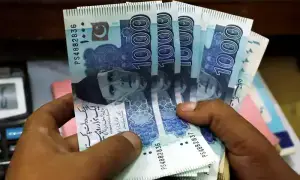
Dawn flags economic risks from the renewed US-Iran conflict through its Economic Affairs Division, noting vulnerability of Pakistan's energy import budget.
Source trail
Original reporting behind this perspective.
This page maps the coverage. The 13 articles below are the original reports the comparison is drawn from — open them for each publisher's full reporting.
Show 13 source articles

Oil extends gains as US strikes in Iran rattle markets
Fresh hostilities will test suppliers’ ability to keep vessels crossing Strait of Hormuz chokepoint

IMF sees world economy growing just 3% this year amid Iran war
The International Monetary Fund (IMF) on Wednesday modestly downgraded its outlook for the world economy this year, citing the energy shock caused by the Iran war. But the fallout from the conflict is being partially…

IMF says global growth weighed down by Iran war but helped by AI
The International Monetary Fund (IMF) on Wednesday modestly downgraded its outlook for the world economy this year, citing the energy shock caused by the Iran war. But the fallout...

Fuel, endless increases for consumers: discounts are back
Fifth day of increases on petrol and diesel. Trade associations are asking to re-evaluate the cut in excise duties

How Iran uses the Strait of Hormuz to pressure the US
Iran's latest attacks show it can easily disrupt shipping, energy markets and draw in Gulf neighbors. DW asks how much leverage Tehran really has over Washington and if its high-risk strategy could backfire.
Renewed US-Iran war would hit Gulf countries hard
After US strikes on Iran, Iran targeted US military sites in Bahrain and Kuwait. Even if Iran isn't targeting the governments or populations of its neighbors, Gulf countries have much to lose as fighting escalates.
Trump orders halt to US trade with Spain over NATO spending, Iran
ANKARA/MADRID, July 8 (Reuters) - U.S. President Donald Trump on Wednesday ordered an immediate halt to all trade with NATO ally Spain, escalating tensions over defence spending and the Iran war, despite European Union…

Economic Affairs Division flags economic risks from renewed US-Iran conflict
• NA panel seeks cheaper financing for Lyari freight corridor • Voices concern over K-IV delays, funding shortfall ISLAMABAD: The Economic Affairs Division (EAD) on Wednesday warned a parliamentary panel that any…