Wildfires in south-west France flare up as region braces for new 40C heatwave
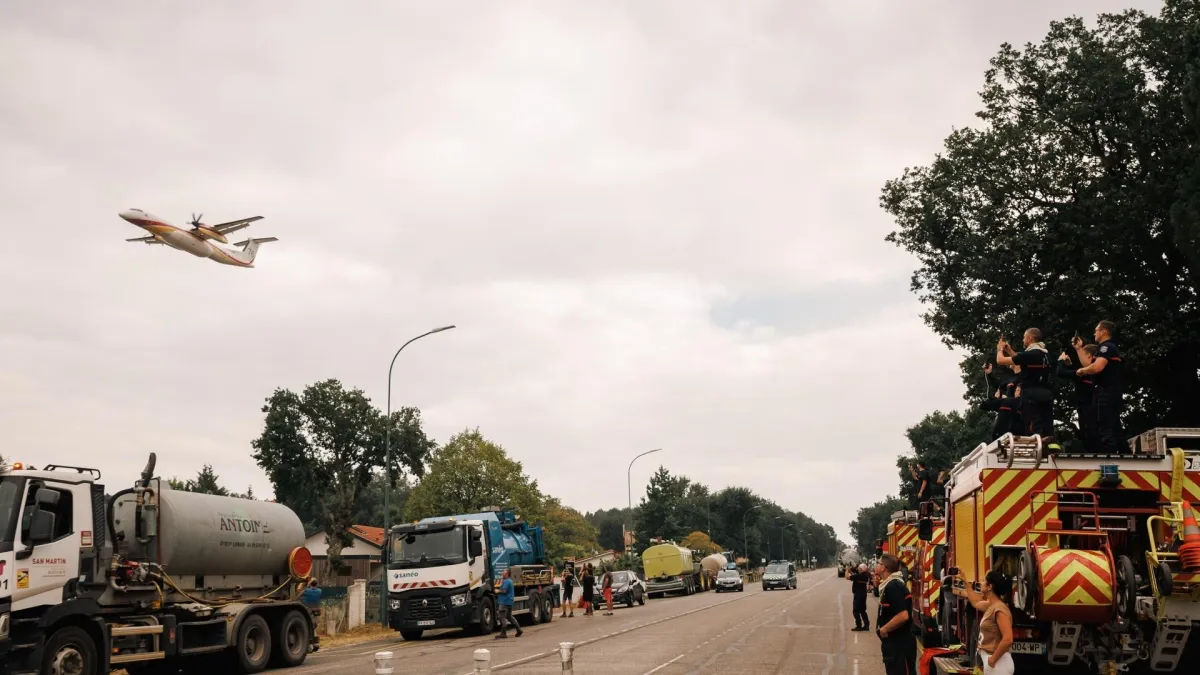
Firefighters are braced for a sharp rise in temperatures on Wednesday, which could complicate the containment of wildfires in Gironde.

Wildfires have displaced approximately 375,000 people across France and Spain, destroyed agricultural land, threatened military installations, and are intensifying due to a returning 40°C heatwave...
BBC News and Irish Times report factual convergence: BBC leads with firefighters bracing for 40°C heatwave complicating containment in Gironde and Madrid regions; Irish Times provides graphical summary showing 375,000 people displaced. Straits Times advances the EU accountability angle, reporting that wildfire response needs more funding and enhanced forest management.
The Guardian frames the crisis through climate institutional adaptation failure, emphasizing prosecution of climate crimes and the return of extreme heat as evidence of systemic policy inadequacy. Le Monde centers operational competence analysis, with extensive reporting on military installations and the Souge camp defense as an institutional capability story, avoiding explicit critique of climate policy architecture.
Le Monde uniquely foregrounds Spanish PM Sanchez's proposed climate "state pact" as being rejected by a climate-skeptic right opposition, a political dimension no other outlet emphasizes, revealing how Spanish governance polarization intersects with disaster response.
Firefighters braced for sharp temperature rise Wednesday
Spain grapples with devastating wildfires Madrid region concern
Military powder magazine defended against flames west Bordeaux
Nearly 4000 evacuated from tourist sites near Bordeaux
Godzilla El Niño could bring hottest year on record
EU wildfire response needs more funding and management
Current wildfires in Spain and France tourist impact
The total area burned and full economic damage across France and Spain remains unquantified in the available summaries.
People's Daily, TASS, and Al Jazeera Arabic provide no coverage of the European wildfire crisis, which has displaced hundreds of thousands of people.
BBC covers the French wildfire flare-up and bracing for a new 40°C heatwave as a factual emergency update, with The Guardian integrating climate institutional failure framing and structural adaptation critique.
Le Monde focuses on the Gironde fires threatening Lacanau resort and the stubborn defense of a military powder magazine, framing through elite analysis of the persistent threat from changing winds and exhausted firefighting resources.
Irish Times covers what Irish tourists need to know about the fires in Spain and France, provides graphics on the European wildfire scope, and connects to EU institutional competence framing.
The Hindu reports 330,000 people driven from homes across France and Spain with France ordering 4,000 additional evacuations, framing it as a factual humanitarian event.
La Repubblica covers Mediterranean sea temperatures reaching 25 degrees in depth, rhododendrons at 3,400 meters altitude, and algae invasion of Italian coasts as climate change effects.
SCMP covers the pyrocumulonimbus fire cloud phenomenon in France that spawned lightning and new blazes, emphasizing the technical severity of the disaster.
Straits Times reports EU calls for wildfire response to evolve with climate change through institutional adaptation framing.
This page maps the coverage. The 18 articles below are the original reports the comparison is drawn from — open them for each publisher's full reporting.
Firefighters are braced for a sharp rise in temperatures on Wednesday, which could complicate the containment of wildfires in Gironde.
Three fires in the Madrid region have caused particular concern, with a new heatwave expected to hit Spain from Wednesday.

Numerous land and air assets were deployed to protect defense sector installations and the Souge camp, located west of Bordeaux.
Return of winds and extreme heat threaten firefighters’ attempts to bring blazes under control Nearly 4,000 people have been evacuated from tourist sites on France’s Atlantic coast as the return of winds and extreme…
The Earth keeps getting hotter and experts fear this year's El Niño, nicknamed 'Godzilla' because of its predicted intensity, could raise global temperatures by up to 3.6C. Environment correspondent Damien Gayle spoke…
BRUSSELS, July 29 - The European Union's response to wildfires needs more funding, greater focus on forest management and enhanced education about fire risk as the climate changes, the head of the bloc's crisis response…
Unprecedented blazes in France and difficult conditions in Spain affect several tourist hotspots

Blazes have forced about 375,000 people to leave their homes in France and Spain

Coming days are ‘absolutely critical’ for firefighters before temperatures rise again this week, officials say Firefighters in France and Spain are racing to bring huge wildfires under control before another heatwave…
Temperatures up to 35C forecast, triggering heat health alerts and pleas to take care in parched parks and rural areas Paramedics and firefighters are braced for emergencies across the country this week after UK…
Hundreds of thousands of residents and holidaymakers in France and Spain have been forced to evacuate Wildfires have forced about 375,000 people to leave their homes in France and Spain . In France, nearly 260,000 have…
Across France and Spain, roughly 3,30,000 people have been driven from homes and vacation sites by huge wildfires

Firefighters raced on Tuesday to subdue huge wildfires that have forced unprecedented evacuations of tens of thousands of people across France and Spain, as western Europe braced for another heatwave. The fires have…

About 2.5 thousand fire and rescue service personnel arrived in Gironde to extinguish the largest fire in the history of the country
The emergency has forced the deployment of thousands of firefighters and civil protection teams to the Iberian Peninsula and southwestern France.
The Greenpeace report denounces temperatures above levels with peaks of plus 8 degrees: "Corals and ecosystems will pay the price"
Alarm for fauna and flora at high altitudes. The experts: “Significant anomalies in temperatures”.
Toxic, colouring, annoying, they are invading not only the coasts, but also rivers and lakes. “An emergency”