China’s Moonshot AI seeks $30 billion value in new funding talks
This is the third round of financing in six months for the Beijing-based company, which is emerging as one of the best-funded Chinese AI research labs.
China's Moonshot AI seeking a $30 billion valuation in a third funding round within six months signals a parallel AI investment race to the US, with direct implications for semiconductor supply chains and...
Japan Times leads with China's Moonshot AI seeking $30 billion valuation in third funding round within six months, characterizing this as part of a parallel AI investment race to the US—competitive framing that emphasizes the zero-sum nature of global tech dominance. Korea Herald reports Nvidia's deals with SK Group (Samsung, LG) and Hyundai partnerships, treating Chinese AI funding as creating opportunities for Korean semiconductor firms embedded in Nvidia's supply chain rather than as a threat.
CNN frames Moonshot-adjacent AI competition through Intel's potential revival as a US industrial policy story, treating the broader AI race as reshaping American semiconductor strategy. The divergence reflects geographic perspective: Japanese outlets emphasize China as a competitive threat to US-Japan interests; Korean outlets foreground Korean firm opportunities within Nvidia's ecosystem; American outlets treat the AI race as a domestic industrial policy question. All outlets acknowledge the funding surge's significance, but attribute different implications based on their regional strategic interests.
China's Moonshot AI seeks $30 billion value in new funding
Nvidia clinches deals with South Korean giants including SK
Nvidia CEO says company is working with LG on humanoid robots
Intel on brink of downfall twist in AI race could boost revival
Hyundai, Nvidia chiefs discuss deeper ties in physical AI
The specific investors and strategic partners in Moonshot AI's new funding round have not been publicly identified in available summaries.
No source addresses how US semiconductor export controls are specifically affecting Moonshot AI's compute access or what hardware infrastructure underpins the company's $30 billion valuation claim.
Japan Times reports Moonshot AI's funding talks as evidence of China's AI sector emerging as among the best-funded globally, framing it through supply-chain and corporate resilience implications for Japanese firms.
Korea Herald covers Nvidia clinching deals with SK Group to advance the AI boom, positioning South Korean firms as embedded in the global AI supply chain regardless of China competition.
CNA reports Nvidia CEO discussing humanoid robots and data centers with LG, framing AI hardware expansion as a regional tech partnership opportunity.
CNN covers Intel's potential AI revival, framing the AI race as a domestic US competitive challenge with geopolitical stakes.
Korea Herald separately reports Hyundai and Nvidia chiefs discussing deeper ties in physical AI, positioning South Korea as a strategic partner in the AI hardware ecosystem.
This page maps the coverage. The 5 articles below are the original reports the comparison is drawn from — open them for each publisher's full reporting.
This is the third round of financing in six months for the Beijing-based company, which is emerging as one of the best-funded Chinese AI research labs.
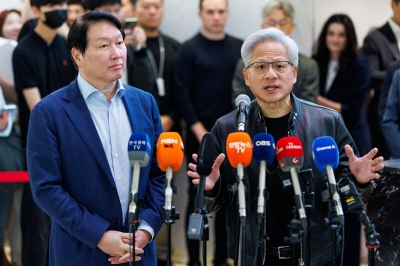
The agreement, which comes as memory chipmakers have been straining to keep up with demand, would enable supply to keep pace with Nvidia's plans.

Intel was on the brink of downfall. A twist in the AI race could boost its revival CNN
Hyundai Motor Group Executive Chair Chung Euisun and Nvidia CEO Jensen Huang met in Seoul on Monday, reportedly discussing their collaboration to incorporate physical AI in deep tech sectors spanning autonomous driving,…
