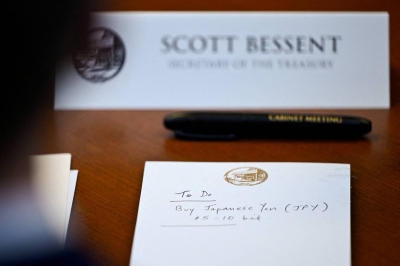
The notepad shows no other words, and Bessent's name card on the Camp David conference table is visible and positioned immediately above the notepad.
How the world covered this
Read the editorial comparison
Prose synthesis of how each outlet framed the story, with side-by-side outlet quotes and divergence notes.
6 articles from 3 sources
01
02
The U.S. Treasury stepped into the currency market on Friday to back the battered yen, the Financial Times reported.
03
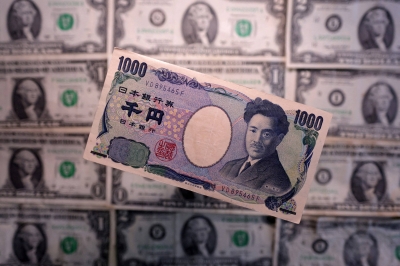
Analysts believe Japanese financial authorities moved to lift the yen on Thursday night after it suddenly spiked against the dollar.

06
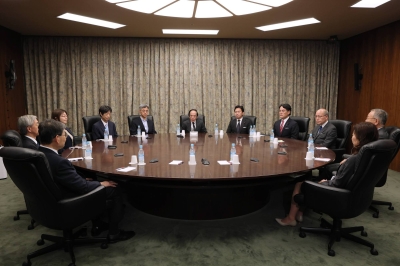
The US Treasury has not intervened to prop up the yen since 2011.
AI read
What the coverage agrees on, and where it splits
This view is generated from the clustered articles, so it is best read as a map of coverage rather than a replacement for the source reporting.
Broadly agreed
- All three covering sources confirm a Reuters photo of Bessent's notepad at Camp David showed a written plan to buy $5-10 billion worth of Japanese yen.
- Japan Times confirms the US Treasury stepped into currency markets to back the yen, corroborated by Straits Times citing the Financial Times.
Contested framing
- Japan Times frames the intervention as a bilateral institutional trust-building act; Straits Times frames it through supply-chain and currency market stability without bilateral relationship framing.
Still unclear
Whether the intervention was formally coordinated with Japan's government or was a unilateral US Treasury decision, and the exact mechanism of the currency purchase operation, are not confirmed in the available summaries.
Notable omissions
Market reactions, impacts on other Asian currencies, and the connection between Iran-war-driven oil price surges and yen weakness are not examined in the available summaries despite being structurally relevant.
Quality check
Notepad existence confirmed but intervention details and coordination status unverified; market impact absent.
- Coordination with Japan unconfirmed—presents as factual but represents assumption about bilateral coordination
- Mechanism of currency purchase operation entirely unspecified; $5-10B figure comes from leaked notepad interpretation, not official confirmation
- Iran war-driven oil prices and yen weakness connection asserted as structurally relevant but not examined in available summaries
- Market reactions and impacts on other Asian currencies explicitly absent—limits assessment of intervention's market significance
Review confidence: 68%
Signal strength
2/5
Narrative divergence
3
Sources compared
1
Days in coverage
How each outlet frames this story
Divergence
2/5
Narrative Divergence
How differently the sources covering this story frame it — measured by tone, emphasis, and what each outlet chooses to highlight or omit.
1 — Sources frame the story almost identically
2 — Minor differences in tone or emphasis
3 — Noticeable differences; some outlets highlight what others omit
4 — Stark contrasts; conflicting narratives
5 — Sources tell fundamentally different stories
Japanese
Japan Times reports the leaked notepad showing Bessent's plan and confirms the US Treasury stepped in to back the battered yen, framing it as a critical institutional infrastructure act protecting Japanese corporate resilience and the bilateral economic relationship.
Singaporean
Straits Times and CNA report the Bessent notepad leak and US Treasury intervention, framing it through supply-chain and currency market institutional implications with factual precision.
Japanese
Yahoo Japan notes the US has not intervened to prop up the yen since 2011, foregrounding the historical significance of the action.