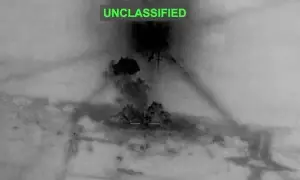
US Central Command says it has struck missile and drone storage facilities and coastal radar positions.
How the world covered this
Read the editorial comparison
Prose synthesis of how each outlet framed the story, with side-by-side outlet quotes and divergence notes.
14 articles from 12 sources
01

02
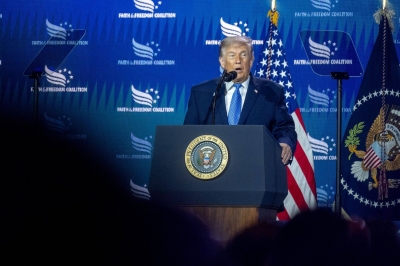
US President Donald Trump has accused Iran of carrying out a drone attack on a cargo vessel on Thursday and violating the US-Iran deal. In response, the US military has launched fresh strikes on Iran.
03
The United States carried out military strikes inside Iran on Friday in retaliation for an attack on a commercial vessel transiting the Strait of Hormuz, with U.S. Central Command...

04
The US struck Iran on Friday in response to a drone attack a day earlier on a cargo ship in the Strait of Hormuz, a provocation President Donald Trump said violated the ceasefire between the two countries. US Central…


06
Nobody was hurt when the Singapore-flagged ship was struck by an “unknown object” in Hormuz.
07
US strikes Iranian targets in response to attack on cargo ship CNN
08
U.S. Central Command said the military struck missile and drone locations and coastal radar sites in Iran

09
Estados Unidos voltam a atacar Irã 10 dias após anunciar acordo de trégua
The United States Army carried out bombings against Iran this Friday (26) in response to an attack attributed to Iranians in the Strait of Hormuz. Read more (06/26/2026 - 5:59 pm)
10
Crece el temor de guerra: Guardianes de la Revolución de Irán anuncian ataques contra objetivos de Estados Unidos en la región a pesar de la tregua
This offensive is in retaliation for the new bombings launched by Washington, state television Irib reported.

11
The United States and Iran traded military strikes after Washington on Friday accused Tehran of attacking a cargo ship, jeopardising a fragile ceasefire as diplomats struggle to contain the Middle East war. US Central…
12
Ballistic missiles and drones targeted U.S. military bases across the Persian Gulf, while Tehran also announced the closure of the Strait of Hormuz, one of the world’s most important energy chokepoints

13
The U.S. said its strikes were a response to "unwarranted aggression against commercial shipping by Iranian forces" that "clearly violated the ceasefire."
14
Iran’s Revolutionary Guards said that they had attacked U.S. sites in the Gulf region in retaliation to American strikes in Iran
AI read
What the coverage agrees on, and where it splits
This view is generated from the clustered articles, so it is best read as a map of coverage rather than a replacement for the source reporting.
Broadly agreed
- All covering sources confirm the US struck Iranian missile, drone, and radar facilities on June 26 in response to a drone attack on a commercial vessel in the Strait of Hormuz.
- Sources broadly agree the attack on the cargo ship preceded the US strikes and that Iran's Revolutionary Guards subsequently announced retaliatory attacks on US Gulf positions.
- Multiple sources confirm that 115 ships and approximately 2,500 seafarers had been evacuated from the Strait before the ceasefire collapse.
Contested framing
- BBC and Deutsche Welle frame the US strikes as a measured counterattack response; SCMP frames the broader 100-day war as having fundamentally undermined American geopolitical credibility.
- The Hindu and Times of Israel include the Lebanon-Israel framework deal in the same live coverage, implying West Asia is in simultaneous de-escalation and re-escalation; Dawn's editorial frames the entire US-Israeli campaign as 'illegal and ill-advised,' producing Arab capital rethinks.
- TASS is absent from direct Iran-US strike coverage, consistent with its pattern of avoiding analysis of Russian-allied-adjacent conflicts; Daily Sabah focuses on Turkish mediation framing rather than military exchange facts.
Still unclear
The extent of damage at Iranian and US Gulf facilities from the reciprocal strikes, and whether the original ceasefire agreement remains legally operative, have not been confirmed in any available summary.
Notable omissions
No covering source provides Iranian civilian or economic consequence data from the US strikes; SCMP notes Chinese exporters remain wary but no source details Chinese or Indian government responses to the renewed hostilities.
Quality check
Factual consensus on strike sequence is solid, but causation claims and regional consequences remain speculative.
- TASS notably absent from Iran-US strike coverage despite pattern; reliance on Western/regional outlets creates potential blind spot on Russian perspective
- Claimed 'ceasefire deal struck less than two weeks ago' is asserted but not substantiated by any listed source summary
- No damage assessment available from reciprocal strikes; extent of escalation cannot be independently verified
- Chinese and Indian government responses entirely absent despite regional importance
Review confidence: 72%
Signal strength
5/5
Narrative divergence
12
Sources compared
2
Days in coverage
→ stable
How each outlet frames this story
Divergence
5/5
Narrative Divergence
How differently the sources covering this story frame it — measured by tone, emphasis, and what each outlet chooses to highlight or omit.
1 — Sources frame the story almost identically
2 — Minor differences in tone or emphasis
3 — Noticeable differences; some outlets highlight what others omit
4 — Stark contrasts; conflicting narratives
5 — Sources tell fundamentally different stories
British
BBC frames the strikes as US Central Command targeting missile, drone storage, and coastal radar facilities in response to an Iranian drone attack on a cargo ship, maintaining careful distinction between US claims and verified facts.
German
Deutsche Welle emphasises the endurance framing — 'US military hits Iran over cargo vessel attack' — positioning the exchange as a test of institutional sustainability rather than escalating military capability.
Turkish
Daily Sabah foregrounds Trump's condemnation of the Hormuz drone attacks as a 'cease-fire violation' and FM Fidan's warning against Israeli provocations derailing US-Iran diplomacy, centring Turkish institutional mediation.
Indian
The Hindu's live coverage positions Iran's Revolutionary Guards' retaliatory strikes on US Gulf sites alongside the Lebanon-Israel-US trilateral pact, framing the region as simultaneously escalating and negotiating.
Brazilian
Folha de S.Paulo reports the US attacked Iran 'again 10 days after announcing a truce' and notes the UN's IMO reporting 115 ships and 2,500 sailors removed from the Strait, foregrounding humanitarian shipping consequence.
Pakistani
Dawn reports the strikes as 'US and Iran trade strikes putting fresh strain on Mideast ceasefire' and separately covers Iranian sailors arriving in Pakistan from a US-seized tanker, emphasising Pakistan's proximity to the crisis.
Japanese
Yahoo Japan reports 'Iran attacks US military base in retaliation' and 'US military claims bombing was a counterattack,' framing it as mutual escalation; Japan Times analyses the impact on Mideast ceasefire stability.
Chinese
SCMP analyses 'How America lost its swagger after 100 days of war against Iran' and why Chinese exporters remain wary despite the ceasefire deal, foregrounding structural economic vulnerability over military framing.
Emirati
The National covers 'Iran war latest: US strikes Iran' and links IAEA inspections at bombed Iranian nuclear sites to sanctions relief, emphasising Gulf regional security stakes.
Colombian
El Tiempo reports Iran's Revolutionary Guards announcing attacks on US targets 'despite truce,' framing it as a collapse of diplomatic progress.
Singaporean
Straits Times identifies the attacked vessel as Singapore-flagged 'Ever Lovely,' making this cluster personally consequential for a Singaporean audience and emphasising the logistics disruption angle.