En Ukraine, Volodymyr Zelensky assume d’ouvrir une crise politique avec son remaniement
By choosing to decide in favor of the commander-in-chief of the armed forces, Oleksandr Syrsky, against the Minister of Defense, Mykhaïlo Fedorov, the Ukrainian president provoked numerous demonstrations...
Zelenski muda chefia de segurança da Ucrânia durante segundo dia de protestos
President Volodimir Zelenski appointed this Friday (17) the former police chief and former Interior Minister of Ukraine, Ihor Klimenko, to head the National Security and Defense Council. The decision came after…
10 قتلى بهجمات روسية على أوكرانيا وكييف تقصف قاعدة النسر الجوية
The authorities in Ukraine announced that at least 10 people were killed yesterday, Friday, while about 20 others were injured in a series of Russian strikes.
Russia carried out deadly strikes across Ukraine overnight that hit residential areas, while Ukraine said drone strikes in the Black Sea hit 12 Russian vessels.
EN DIRECT, guerre en Ukraine : « Ne touchez pas à Fedorov », « Ramenez Fedorov »… des rassemblements dans plusieurs villes ukrainiennes pour protester contre le départ du ministre de la défense
These demonstrations, organized on the eve of Parliament's examination of a government reshuffle, were announced after reports of the imminent replacement of Mr. Fedorov and the publication by…
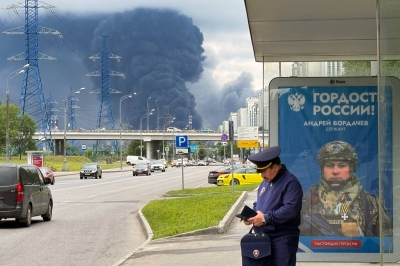
После атак ВСУ на Котовск и Электросталь завели дела о терактах
⚑ 1 language note
"terrorist attacks" — TASS frames Ukrainian military strikes on Russian civilian/commercial targets as 'terrorist attacks' rather than military operations—politically loaded terminology that delegitimizes opponent actions
AI read
What the coverage agrees on, and where it splits
This view is generated from the clustered articles, so it is best read as a map of coverage rather than a replacement for the source reporting.
Broadly agreed
All covering sources confirm Zelensky removed Fedorov as Defence Minister and that this triggered protests among soldiers and civilians.
Sources broadly confirm ongoing mutual strikes between Russia and Ukraine, with Russian attacks causing civilian casualties and Ukrainian drones striking Russian logistics infrastructure.
Contested framing
BBC frames Fedorov's removal as causing dangerous military morale damage documented through soldier testimony; Le Monde frames it as a calculated political risk Zelensky is consciously accepting.
TASS frames the conflict exclusively through Russian military achievement narratives; Japan Times frames it as a structural political crisis with no viable peace path under Putin's current governance model.
Still unclear
Whether the new Ukrainian security leadership will maintain or alter Fedorov's digital warfare and drone procurement strategy remains unconfirmed in available summaries.
Notable omissions
TASS entirely avoids coverage of Ukrainian soldier protests or the political crisis within Zelensky's government, while Western outlets provide minimal analysis of Russian domestic political reaction to ongoing Ukrainian strikes on Russian logistics centres.
Quality check
Read with caution: soldier outrage confirmed but military strategy implications unclear; Russian perspective deliberately missing.
Fedorov removal strategy and new leadership's drone/digital warfare approach unconfirmed
TASS deliberately omits soldier protests and political crisis coverage
Russian domestic political reaction to Ukrainian strikes not analyzed
BBC and Le Monde frames conflict differently on morale impact; both claim documentary evidence
Review confidence: 65%
Signal strength
5/5Narrative divergence
11Sources compared
1Days in coverage
How each outlet frames this story
Divergence5/5
Narrative Divergence
How differently the sources covering this story frame it — measured by tone, emphasis, and what each outlet chooses to highlight or omit.
1 — Sources frame the story almost identically
2 — Minor differences in tone or emphasis
3 — Noticeable differences; some outlets highlight what others omit
4 — Stark contrasts; conflicting narratives
5 — Sources tell fundamentally different stories
British
BBC reports many Ukrainian soldiers are outraged over Fedorov's removal, with troops criticising the move directly to BBC journalists, framing the crisis through institutional protocol violation and military morale consequences.
French
Le Monde and a live blog note Zelensky is assuming the political risk of his reshuffle by backing commander Syrsky against Fedorov, analysing the decision through elite institutional competence and political crisis management depth.
Brazilian
Folha de S.Paulo reports Zelensky's appointment of former police chief Ihor Klymenko as security chief, framing the reshuffle through individual political accountability and its implications for the broader war effort.
Russian
TASS focuses on Russian Armed Forces strikes on Ukrainian military targets including a Neptune-2 launcher, a container ship in Chernomorsk port, and a cargo ship carrying Ukrainian armed forces supplies, maintaining military achievement narrative without analysis of the Ukrainian political crisis.
Singaporean
Straits Times covers Russia saying a Ukrainian drone attack killed 7 and wounded 24 at a logistics centre, framing the mutual strike exchange through infrastructure disruption and operational consequence.
Japanese
Japan Times runs an opinion piece arguing that Ukraine's deep strikes mount as Putin lets Russia burn, and that the war has become the organising principle of Putin's regime with no path to peace without fundamental political change.
Irish
Irish Times editorialises that firing the defence minister exposes a Zelensky flaw, arguing Fedorov pushed a clear war prosecution strategy, framing the crisis through institutional competence interrogation.
Copied!
Related coverage
More topic clusters connected by category, source overlap, or narrative signal.