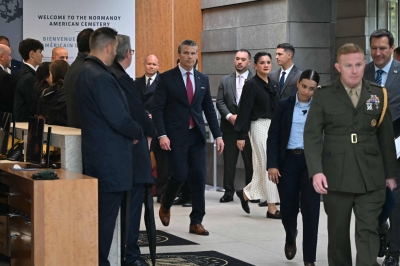
The US defence secretary was speaking in Normandy, 82 years after allied forces launched their operation to liberate Nazi-occupied north-western Europe.
How the world covered this
Read the editorial comparison
Prose synthesis of how each outlet framed the story, with side-by-side outlet quotes and divergence notes.
6 articles from 6 sources
01

02
Secretário de Trump compara Dia D a 'invasão' de imigrantes na Europa
The Secretary of Defense of the United States, Pete Hegseth, associated immigration in Europe with D-Day, the moment in World War II when troops from the American and British allies landed on beaches in…
03
US officials, including Trump and Vice President JD Vance as recently as Friday have often criticised European countries for failing to control immigration.

04
US Defence Secretary Pete Hegseth on Saturday urged Europe to counter what he termed an “invasion” of its coastline by migration, as he marked the 82nd anniversary of the World War II D-Day landings in northern France.…

05
The U.S. Defense Secretary also called on European countries to do more to contribute to their own defense.
06
Ucraina, Trump si tira fuori: “Putin e Zelensky se la sbrighino tra di loro”
And on the anniversary of D-Day, Pentagon chief Hegseth once again attacks the European allies: "Yesterday the Normandy landings, today the migrant landings. When should we do something against this invasion?"
AI read
What the coverage agrees on, and where it splits
This view is generated from the clustered articles, so it is best read as a map of coverage rather than a replacement for the source reporting.
Broadly agreed
- All covering sources confirm Hegseth used his D-Day Normandy speech to invoke migration as a present-day 'invasion' threatening Europe.
- Sources agree Hegseth simultaneously called for European countries to increase their own defense contributions.
Contested framing
- SCMP frames the speech as evidence of American strategic decline and confused messaging; BBC and Folha de S.Paulo frame it primarily as a rhetorical provocation against European sensibilities about historical memory.
- Japanese and Singaporean outlets frame the speech as a policy demand about burden-sharing; Italian outlet La Repubblica links it to a coherent US withdrawal from European security commitments.
Still unclear
Whether specific European governments formally protested the Hegseth speech beyond the UK pushback on Vance's earlier immigration remarks is not confirmed in the available summaries.
Notable omissions
No outlet in the sample reports reactions from French, German, or Polish governments to the Hegseth D-Day speech specifically; veteran organizations' responses are also absent.
Quality check
Speech facts confirmed; European and strategic reaction incomplete; intent ambiguous.
- Formal European government protest status unclear; only UK pushback on Vance documented; French, German, Polish responses absent
- Veteran and military history organizations' reactions entirely missing
- Framing divergence substantial: SCMP treats as strategic decline symptom; BBC/Folha treat as rhetorical provocation; La Repubblica links to withdrawal commitment—competing narratives
- Burden-sharing demand clarity varies by outlet; strategic intent behind timing not analyzed
Review confidence: 72%
Signal strength
4/5
Narrative divergence
6
Sources compared
1
Days in coverage
How each outlet frames this story
Divergence
4/5
Narrative Divergence
How differently the sources covering this story frame it — measured by tone, emphasis, and what each outlet chooses to highlight or omit.
1 — Sources frame the story almost identically
2 — Minor differences in tone or emphasis
3 — Noticeable differences; some outlets highlight what others omit
4 — Stark contrasts; conflicting narratives
5 — Sources tell fundamentally different stories
British
BBC reports Hegseth's 'beach invasion' comparison factually, emphasizing the provocative invocation of D-Day to attack European migration policy.
Brazilian
Folha de S.Paulo frames Hegseth as directly comparing immigration in Europe to D-Day, treating the speech as a deliberate rhetorical transgression against historical memory.
Singaporean
CNA reports Hegseth called on Europe to counter 'dangerous ideologies' and an 'invasion' of its coastline, contextualizing it within a pattern of US criticism of European allies.
Chinese
SCMP asks whether Hegseth's rhetorical volte-face on China reflects an America in decline, using the D-Day speech as a lens for broader US strategic credibility analysis.
Japanese
Japan Times reports Hegseth used D-Day to urge Europe to counter a present-day 'invasion' and called for greater European defense contributions.
Italian
La Repubblica notes Trump has pulled out of Ukraine diplomacy while Hegseth attacked European allies on D-Day, linking the two as a coherent US disengagement posture.