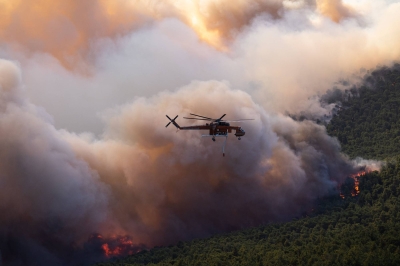
Firefighters were battling blazes in over 70 locations across Greece. Strong winds continue to fan the flames, adding to the firefighters' struggles.
How the world covered this
Read the editorial comparison
Prose synthesis of how each outlet framed the story, with side-by-side outlet quotes and divergence notes.
15 articles from 7 sources
01
02
Europe has been ravaged by wildfires this summer after a period of record-breaking heat and little rain, in conditions that scientists say have been exacerbated by climate change.
03
Wildfires fanned by gale-force winds burned across multiple areas of Greece Saturday, forcing residents to flee as conditions worsened again in parts of Spain and France. In one escalating Greek blaze, firefighters,…
04
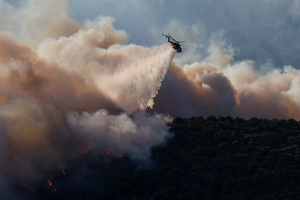
Exhausted firefighters wage ‘war of attrition’ against blaze that forced 200,000 people from their homes By noon it is time for a break. The temperature is about 35C, the smell of ash, cinders and burnt wood hang acrid…
05
In this week’s newsletter: As France and Spain battle huge fires in this summer of relentless heat, will it be enough to spur us to take action? • Don’t get Down to Earth delivered to your inbox?
06
Ferocious flames continue to rage in parts of France and Spain, with no sign of abating. We chart the destruction in graphics and pictures The hellish infernos that have torn through parts of France and Spain have…
07
Latest study says global heating has made hot, dry and windy conditions in Spain at least 20 times more likely The extreme heat and drought stoking huge wildfires in Spain and France were made far more likely by the…
08
Some 19 major Italian cities - including Rome, Milan and Naples - are already on red alert, and by Monday all but two will be.

09
Only 2 out of the nation’s 27 major cities were not placed on the highest alert.
10
Serge Joncour, romancier : « Depuis 2026, l’été n’a plus rien de léger, quelque chose a changé. L’été nous a été volé »
While France is suffocating under a succession of heatwaves and unprecedented waves and heat, summer no longer has the same meaning, notes the writer, in a column in “Le Monde”. Between devastating fires, transformed housing…
11
In country after country, more women are dying from the heat than men. But researchers say biology isn't the main reason.
12
Growers in dismay after scorching weather and lack of rain affect yields, sending wholesale prices rocketing Pubs, restaurants and supermarkets are having to buy lettuce and broccoli from Spain at what should be the…
13
As parks turn brown and paddling pools go unfilled, exemptions mean sports pitches can stay lush – even in school holidays After multiple punishing heatwaves, and no rain in parts for over a month, it seems the whole of…
14
Boom in solar farms and home installations in first half of 2026 began shortly after start of US-Israel war against Iran Great Britain has recorded more new solar power installations in the first half of this year than…
15
Heat and drought have affected shipping, power plants and tourism across eastern Europe – as well as unearthing some surprises Baking temperatures and drought across large swathes of central and eastern Europe have…
AI read
What the coverage agrees on, and where it splits
This view is generated from the clustered articles, so it is best read as a map of coverage rather than a replacement for the source reporting.
Broadly agreed
- All covering sources confirm simultaneous fires are burning across France, Spain, and Greece with significant hectare losses and mass evacuations.
- The Guardian and Deutsche Welle both confirm climate science directly links the extreme fire conditions to global heating.
- Multiple sources confirm Italy placed nearly all major cities on the highest heat alert from August 3.
Contested framing
- The Guardian frames wildfires as a direct consequence of policy failure requiring structural systemic change; Le Monde frames them through elite governmental competence and operational management — different accountability targets.
- Italian La Repubblica integrates aesthetic and cultural loss framing alongside institutional coordination analysis; The Guardian foregrounds climate science and policy failure without cultural-humanistic framing — different interpretive lenses.
Still unclear
The total final hectare loss across all three countries and the full economic cost to agriculture, tourism, and energy infrastructure remain unquantified in available summaries.
Notable omissions
People's Daily, TASS, and most Asian and African outlets are silent on the European wildfire crisis; the disproportionate impact on lower-income communities living near fire zones receives no coverage in available summaries.
Quality check
Climate causation is well-established, but total damage scale, economic cost, and equity impacts remain incompletely documented.
- Total final hectare loss across all three countries and full economic cost remain unquantified
- Guardian vs. Le Monde accountability framings differ (policy failure vs. operational management) without resolution
- Disproportionate impact on lower-income communities near fire zones receives no coverage
- People's Daily, TASS, and most Asian/African outlets silent on European crisis
Review confidence: 85%
Signal strength
2/5
Narrative divergence
7
Sources compared
1
Days in coverage
How each outlet frames this story
Divergence
2/5
Narrative Divergence
How differently the sources covering this story frame it — measured by tone, emphasis, and what each outlet chooses to highlight or omit.
1 — Sources frame the story almost identically
2 — Minor differences in tone or emphasis
3 — Noticeable differences; some outlets highlight what others omit
4 — Stark contrasts; conflicting narratives
5 — Sources tell fundamentally different stories
British
The Guardian frames European wildfires as direct evidence of climate institutional adaptation failure, citing research that extreme fire weather is at least 20 times more likely due to global heating, and covers UK crop drought losses and heatwave gender mortality disparities.
German
Deutsche Welle covers Greece battling fires in 70+ locations and French megafire conditions, maintaining climate institutional adaptation framing emphasising structural vulnerability.
Japanese
Japan Times reports wildfires spreading across Greece and worsening in France and Spain, noting the record-breaking heat and little rain as causes.
French
Le Monde covers the Gironde fire returning to a 'more stable situation' after burning 42,000 hectares over ten days, and a separate Var fire forcing 2,500 evacuations — government tempering optimism while situation 'remains evolving.'