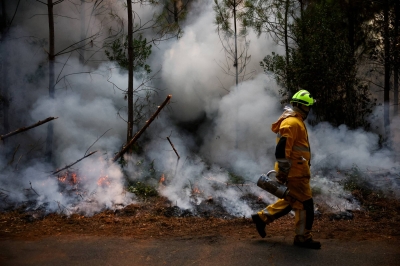
Around 500 people, mostly tourists, are evacuated by boat from Agios Vasileios after becoming trapped.
How the world covered this
Read the editorial comparison
Prose synthesis of how each outlet framed the story, with side-by-side outlet quotes and divergence notes.
14 articles from 7 sources
01

02
EN DIRECT, incendies : dans le Var, 2 500 personnes évacuées et 1 000 hectares parcourus par le feu ; des pompiers supplémentaires attendus sur place samedi
While the situation has improved in Gironde, the fire in the Gros Bessillon massif, in the Var, has grown again. Some 720 firefighters are mobilized to fight against its spread, to which…
03
Latest study says global heating has made hot, dry and windy conditions in Spain at least 20 times more likely The extreme heat and drought stoking huge wildfires in Spain and France were made far more likely by the…
04
Drought and extreme heat are killing plants, driving up prices while also making some farms economically unviable “It’s a constant battle,” says Tim Young. He and his family have been tracking the rainfall on their…
05
As parks turn brown and paddling pools go unfilled, exemptions mean sports pitches can stay lush – even in school holidays After multiple punishing heatwaves, and no rain in parts for over a month, it seems the whole of…
06
Exhausted firefighters wage ‘war of attrition’ against blaze that forced 200,000 people from their homes By noon it is time for a break. The temperature is about 35C, the smell of ash, cinders and burnt wood hang acrid…
07
In this week’s newsletter: As France and Spain battle huge fires in this summer of relentless heat, will it be enough to spur us to take action? • Don’t get Down to Earth delivered to your inbox?
08
Wildfires may start with a single spark, but experts say climate change, drought and decades of forest management decisions have created the conditions for Europe's biggest blazes.
09
Emergency crews say situation remains ‘dynamic’ as more than 100 firefighters battle Dunwich Heath blaze A wildfire near Britain’s biggest nuclear power station has caused “total devastation” to one of the UK’s most…
10
Ferocious flames continue to rage in parts of France and Spain, with no sign of abating. We chart the destruction in graphics and pictures The hellish infernos that have torn through parts of France and Spain have…
11
Major incident declared, with Sizewell B power station monitoring blaze and RSPB nature reserve badly hit Hundreds of people have been evacuated and a major incident declared after a wildfire spread over more than 80…
12
Insurers, reinsurers and brokers don't see the latest bouts of extreme heat as a temporary shock, but as a long-term trend.
13
Temperatures surpassed 40 C in the southeastern city of Yangsan for the fourth straight day to set a new record of 41.6 C as a scorching heat wave continued to grip the nation, the state weather agency said Saturday.…

14
No species left behind: how Spain saved its animals from wildfire CNN
AI read
What the coverage agrees on, and where it splits
This view is generated from the clustered articles, so it is best read as a map of coverage rather than a replacement for the source reporting.
Broadly agreed
- All covering sources confirm multiple simultaneous large wildfires are burning across France, Spain, and Greece, with hundreds of thousands evacuated.
- Climate scientists cited across multiple outlets confirm global heating is structurally increasing the likelihood and severity of these fire conditions.
- The wildfire near Sizewell nuclear plant in Suffolk is confirmed by BBC and The Guardian as causing 'total devastation' to the surrounding landscape while the plant itself monitors the situation.
Contested framing
- The Guardian frames the wildfires as direct proof of a systemic climate crisis requiring institutional adaptation policy overhaul; CNN focuses on positive animal rescue stories, avoiding systemic framing.
- Deutsche Welle examines decades of forest management failure as a co-cause alongside climate change; Le Monde focuses on the immediate crisis management response without examining structural policy causes.
- Japan Times frames the fires through insurance industry risk modeling as a long-term corporate concern; The Guardian frames it as a policy and institutional adaptation failure requiring urgent political response.
Still unclear
The total area burned across Europe in 2026 and final casualty and displacement figures from the current fire season remain unconfirmed in the available summaries.
Notable omissions
The experiences of rural and agricultural communities losing farms and livelihoods to wildfires, mentioned briefly in The Guardian's crop-damage coverage, receive no sustained investigation across the outlet set.
Quality check
Fire severity and climate link confirmed; final toll and economic impact still uncertain; rural farmer experiences underreported.
- Consensus on simultaneous fires and climate link is well-supported; but 'structural shift' claim in 'Why it Matters' goes beyond what summaries confirm
- Final total area burned and casualty/displacement figures explicitly unconfirmed; 'Why it Matters' presents outcome as settled when it remains uncertain
- Rural/agricultural livelihoods mentioned but not investigated—creates impression of comprehensive coverage when major stakeholder group is absent
- CNN's animal rescue framing vs. Guardian's systems framing presented as contested but reflects different story selection rather than disagreement on climate facts
Review confidence: 78%
Signal strength
2/5
Narrative divergence
7
Sources compared
2
Days in coverage
→ stable
How each outlet frames this story
Divergence
2/5
Narrative Divergence
How differently the sources covering this story frame it — measured by tone, emphasis, and what each outlet chooses to highlight or omit.
1 — Sources frame the story almost identically
2 — Minor differences in tone or emphasis
3 — Noticeable differences; some outlets highlight what others omit
4 — Stark contrasts; conflicting narratives
5 — Sources tell fundamentally different stories
British
The Guardian frames European wildfires as direct evidence of the climate crisis supercharging extreme weather, citing a study showing hot, dry, windy conditions in Spain are now at least 20 times more likely, and examines the nuclear risk near Sizewell as institutional failure.
French
Le Monde reports 2,500 people evacuated in the Var and 1,000 hectares burning, framing it as a crisis management challenge for elite institutions with humanistic depth about exhausted firefighters.
German
Deutsche Welle examines structural causes including climate change, drought, and decades of forest management failures, framing wildfires as a systemic institutional adaptation failure.
American
CNN reports Spain saved its animals from wildfire with a species rescue operation, using a human-interest positive angle rather than systemic climate framing.
South Korean
Korea Herald reports South Korea recording its highest-ever temperature of 41.4 degrees Celsius as a prolonged heatwave intensifies, linking European and Asian extreme heat events.
Japanese
Japan Times reports insurers are 'actively evaluating' new catastrophe risks as Europe burns, framing extreme heat as a long-term structural trend affecting corporate risk models.
Framing shifts since last cycle
Japanese
Moved from immediate supply-chain disruption consequences to long-term structural trend framing, deprioritizing acute economic impact for systemic risk models.