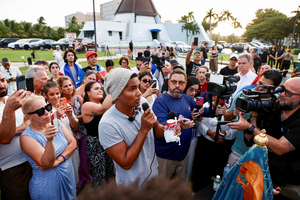
Luis Manuel Otero Alcantara, a prominent Cuban artist and dissident, was detained in July 2021 as he attempted to join unprecedented mass protests across the communist island.
How the world covered this
Read the editorial comparison
Prose synthesis of how each outlet framed the story, with side-by-side outlet quotes and divergence notes.
4 articles from 4 sources
01
02
A famous Cuban dissident artist and musician, Luis Manuel Otero Alcantara, arrived in Miami on Saturday after being released from a five-year prison sentence on the condition that he leave his country. Alcantara, 38,…
03
Prominent Cuban dissident artist Luis Manuel Otero Alcantara flew to exile on Saturday in the United States after serving a five-year sentence on the island, as Washington urged Havana to release more than 700 political…

04
WASHINGTON, July 18 - Cuban dissident artist Luis Manuel Otero Alcántara has arrived in the United States after completing a five-year prison sentence, U.S. Secretary of State Marco Rubio said on Saturday.
AI read
What the coverage agrees on, and where it splits
This view is generated from the clustered articles, so it is best read as a map of coverage rather than a replacement for the source reporting.
Broadly agreed
- All sources confirm Otero Alcantara arrived in the United States after five years in Cuban prison.
Contested framing
- Deutsche Welle frames the release within a human rights accountability narrative; Straits Times frames it through the lens of US diplomatic achievement under Secretary Rubio.
Still unclear
The specific diplomatic agreement or conditions under which Cuba agreed to release Otero Alcantara remain publicly unconfirmed.
Notable omissions
Cuban state media perspective is absent; the broader status of Cuba's political prisoners from the 2021 protests receives limited attention.
Quality check
Release and exile are confirmed; diplomatic negotiation details and broader prisoner context are not documented.
- Release and US arrival are confirmed, but diplomatic agreement terms remain unconfirmed—described as 'significant human rights development' but mechanism unknown
- Deutsche Welle human rights framing vs Straits Times US diplomatic achievement framing represents legitimate editorial choice difference
- Cuban state perspective and broader political prisoner status absent—limiting analysis
- Five-year imprisonment cause (2021 protest participation) confirmed but detention rationale may involve factors not discussed
Review confidence: 75%
Signal strength
2/5
Narrative divergence
4
Sources compared
0
Days in coverage
How each outlet frames this story
Divergence
2/5
Narrative Divergence
How differently the sources covering this story frame it — measured by tone, emphasis, and what each outlet chooses to highlight or omit.
1 — Sources frame the story almost identically
2 — Minor differences in tone or emphasis
3 — Noticeable differences; some outlets highlight what others omit
4 — Stark contrasts; conflicting narratives
5 — Sources tell fundamentally different stories
German
Deutsche Welle frames Otero Alcantara's arrival as a human rights milestone, noting he was detained in July 2021 as he attempted to join protests.
South Korean
Korea Herald reports his arrival in Miami after being released from a Cuban prison, framing it as a human rights and geopolitical story.
Chinese
SCMP reports the prominent Cuban dissident artist landed in US exile after serving a prison sentence in Cuba.
Singaporean
Straits Times reports his arrival citing Secretary Rubio's statement, connecting it to US diplomatic engagement.